
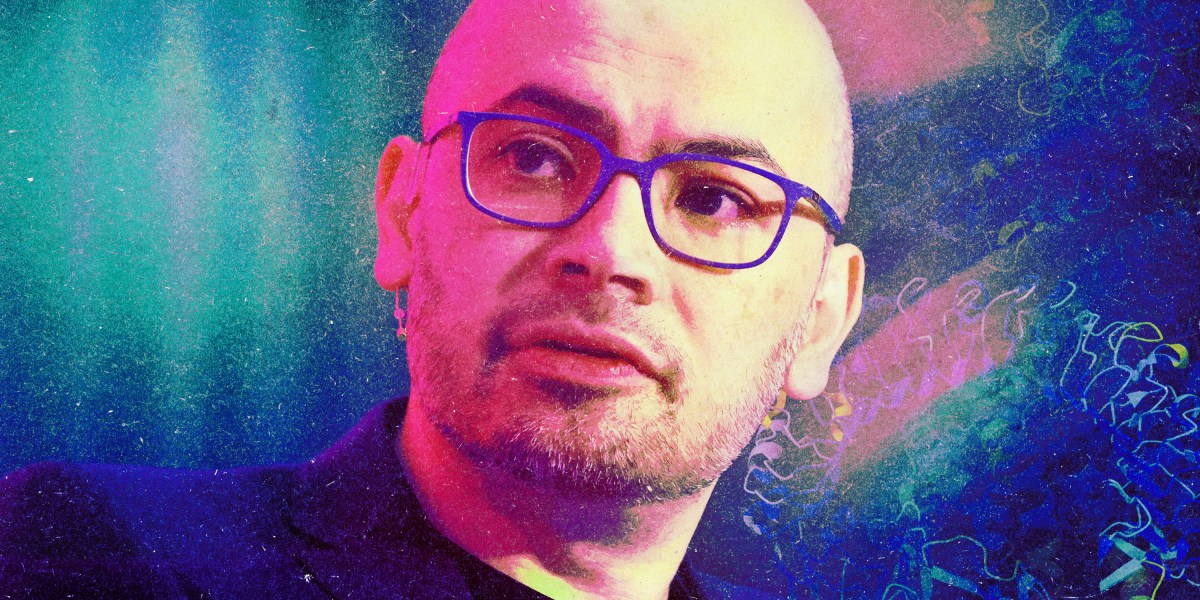

During Tuesday’s Google I/O keynote, Demis Hassabis, the CEO of Google DeepMind, proclaimed that we are currently “standing in the foothills of the singularity.” It was a striking statement—the singularity is the theoretical future moment when AI rapidly exceeds human intelligence and dramatically transforms the world. But what struck me as I listened in the audience was the context in which he said those words.
He was on stage to close out the session with a segment on scientific AI, the centerpiece of which was a video detailing how the company’s weather prediction software provided an advance alert about Hurricane Melissa’s catastrophic landfall in Jamaica last year—and potentially saved lives. If that software, called WeatherNext, helped anyone escape the storm or better fortify their home, that’s an enormous and meaningful achievement. But it’s hardly evidence of an impending singularity.
The juxtaposition of Hassabis’ lofty rhetoric with the real-world results of WeatherNext highlighted the tension between two very different approaches to AI for science. The first focuses on AI tools, like WeatherNext, that are designed and trained to solve specific scientific problems. The second is agentic, LLM-based systems that could one day execute cutting-edge research projects without human involvement.
This second vision powers a great deal of AI enthusiasm right now, including recent excitement around recursive self-improvement, or the idea that AI systems could eventually become the primary drivers of AI advancement—a process that would get faster and faster as the AI systems grow smarter. And agentic systems are now making real research contributions, sometimes with limited human guidance.
Just this week, Pushmeet Kohli, Google Cloud’s chief scientist, published a piece in a special AI and science issue of the journal Daedalus, writing: “We are moving toward AI that doesn’t just facilitate science but begins to do science.” With autonomous AI scientists on the horizon, it’s harder to justify massive efforts to develop super-specialized tools—even one like AlphaFold, for which DeepMind scientists won a Nobel Prize, or a potentially life-saving system like WeatherNext. It also heralds a far stranger future for science, in which humans and AI systems collaborate as peers—or AI even makes scientific progress on its own.
To be clear, Google does not appear to be abandoning its work on specialized AI for science tools. AlphaGenome and AlphaEarth Foundations, which are trained for genetics and Earth science applications respectively, were released last summer, and the newest version of WeatherNext came out in November.
What’s more, such tools remain extremely popular among scientists. Last year, for instance, Google reported that protein structure predictions from AlphaFold have been used by over three million researchers worldwide. And Isomorphic Labs, a Google subsidiary that aims to use AlphaFold and related technologies to develop new drugs, just raised a $2 billion Series B funding round.
But there are concrete signs of realignment, in both enthusiasm and resources. Last month, the Los Angeles Times reported that Google fellow John Jumper, who won the Nobel for AlphaFold, is now working on AI coding, not on science-specific AI tools. It’s not surprising that Google is assigning its best minds to the coding problem, as the company has recently taken a reputational hit because its coding tools don’t currently stand up to those offered by Anthropic and OpenAI. But it may also signal a prioritization of agentic science on Google’s part, as coding abilities are key to the success of some of those systems.
Across the industry, agentic researcher systems are showing real potential. This week, OpenAI announced that one of their models had disproved an important mathematics conjecture—perhaps the most meaningful contribution that generative AI has made to mathematics so far, according to some mathematicians.
Importantly, the model used by OpenAI is not specialized for solving mathematical problems, or even for research; according to the company, it’s a general-purpose reasoning model in the vein of GPT-5.5. If general agents can make independent contributions to mathematical research, they might soon be able to do the same in science (though the fact that ideas in science must be verified experimentally makes it a tougher domain for AI).
Google is certainly devoting a lot of attention toward an agent-driven scientific future. The big scientific announcement at I/O was the new Gemini for Science package, which unites several of the company’s LLM-based scientific systems under one brand.
This includes the hypothesis-generating AI Co-Scientist and algorithm-optimizing AlphaEvolve, which are still not publicly available—but as Google is now allowing any researcher to apply for access to Gemini for Science, they may soon see wider adoption in the scientific community. Scientists who were involved in early testing are enthusiastic about their potential: Gary Peltz, a Stanford geneticist, compared using the AI Co-Scientist to “consulting the oracle of Delphi” in a Nature Medicine article.
Gemini for Science isn’t incompatible with specialized tools; to the contrary, agentic systems can be designed to call on such tools when they might be useful. And no agentic system can predict the structure that a protein will fold into without AlphaFold’s help (at least not yet). But the company seems to be shifting its public image—and at least some resources and personnel, such as Jumper—away from specifically developing those kinds of tools. Though it has only been five years since AlphaFold solved the protein-folding problem, both the technology and the discourse have quickly moved beyond that once-revolutionary achievement.
Google has been careful to position this new set of scientific agents as an accelerant for human scientists, rather than a replacement for them—the choice of the name AI Co-Scientist as opposed to AI Scientist, for instance, appears quite deliberate. Hassabis uses that same human-centric framing when he talks about changes in the landscape of scientific AI. “For the next decade or so, we should think about AI as this amazing tool to help scientists,” Hassabis said in an interview published in the Daedalus issue. “Beyond that timeframe, it is hard to say with any certainty, but perhaps these systems will become more like collaborators.”
But no one can be an effective scientific collaborator without also being a skilled scientist in their own right. And if Hassabis is anywhere near the mark when he talks about the “foothills of the singularity,” then AI scientists could eventually exceed the capabilities of their human counterparts.
In a discussion with the journalist Mike Allen at I/O, Hassabis spoke of how he was initially inspired to pursue AI when he observed how progress in physics had stagnated since the 1970s; he wondered whether the human mind had reached its limits in that domain, and if AI could help to overcome that barrier. Superhuman agentic scientists would certainly fit that bill. We might not ever get anywhere near there, but Google seems to be aiming itself toward that summit.
