
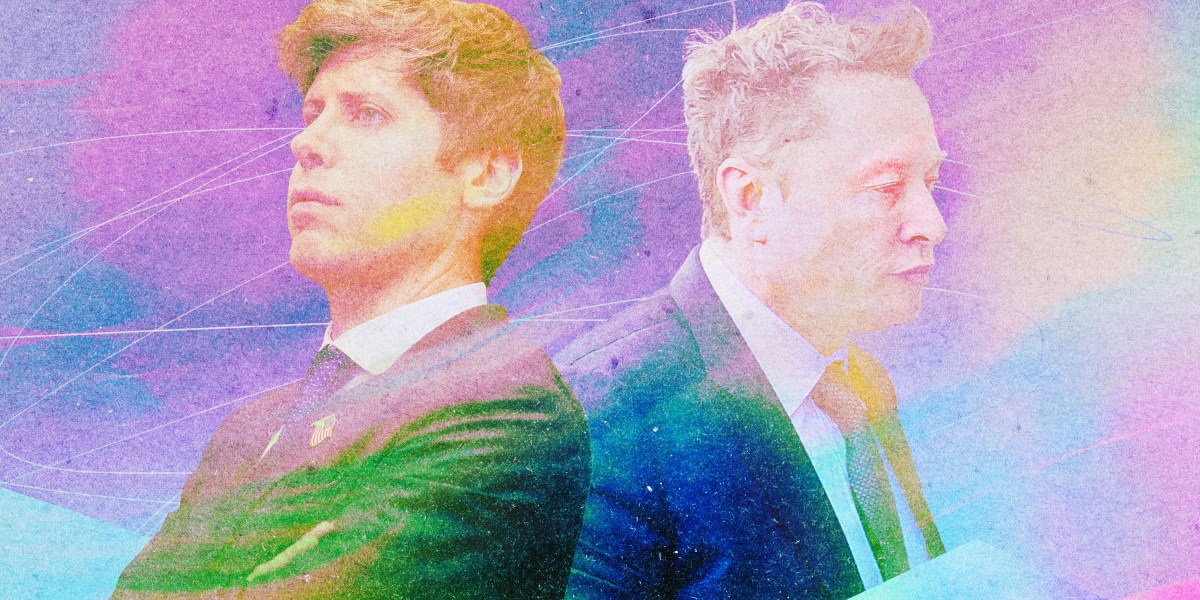

Following a prolonged legal battle, Elon Musk and OpenAI’s CEO Sam Altman are set to go to trial this week in Northern California over a case that may have significant ramifications. With OpenAI’s much-anticipated IPO on the horizon, the court could decide if the company can continue as a for-profit entity and may even remove its current executive team, including Altman.
Musk is suing OpenAI, claiming that Altman and OpenAI president Greg Brockman misled him into financing the company in its formative years by promising to keep it as a nonprofit focused on developing AI for humanity’s benefit, only to subsequently transition the organization to operate a for-profit subsidiary. Musk was a co-founder of OpenAI with Altman and others in 2015, but departed in 2018 following a contentious power conflict.
Musk is pursuing as much as $134 billion in damages from OpenAI and Microsoft, one of OpenAI’s major financial supporters. He is also requesting the court to dismiss Altman and Brockman from their positions and to revert OpenAI to its nonprofit status. Musk has requested that any awarded damages be allocated to OpenAI’s nonprofit rather than to him directly.
A jury of nine will provide an advisory verdict, a non-binding suggestion, to assist the judge in evaluating Musk’s allegations against Altman. Musk, Altman, and Brockman will testify. Former OpenAI chief scientist Ilya Sutskever, former OpenAI CTO Mira Murati, and Microsoft CEO Satya Nadella are also anticipated to testify. Personal texts, unfiltered diary entries, and ongoing manipulations regarding the founding and expansion of OpenAI are expected to surface.
In a sector rife with secrecy, the trial will offer a rare glimpse for the public into the inner workings of the companies creating the most groundbreaking technology ever made.
What is the conflict about?
When OpenAI was first established as a nonprofit, supported by a $38 million contribution from Musk, the organization promised to develop open-source technology for the benefit of the public, free from the pressure to achieve financial returns. However, over time, the organization felt that increasing competition could threaten its ability to disclose how it produces its AI models and that a nonprofit framework would struggle to secure sufficient funding for ongoing AI development. (MIT Technology Review initially reported on the internal disputes within OpenAI regarding its mission.)
The court has previously determined that in 2017, Altman and Brockman aimed to create a for-profit division, while Musk suggested merging OpenAI with his electric vehicle company, Tesla. When Musk threatened to withdraw funding, Altman and Brockman assured him they intended to keep the company a nonprofit. Musk contends that they pursued plans to shift to a for-profit model without keeping him informed. According to OpenAI, Musk acknowledged that the organization required a for-profit branch and even expressed a desire to be its CEO.
Even if Musk can demonstrate that he was deceived by Altman and Brockman, he may lack the legal standing to sue them for restructuring the organization to create a for-profit subsidiary. Some legal experts are perplexed by why the judge permitted him to file this claim. “The notion that Elon Musk can sue simply because he was a donor or previously served on the board is quite intriguing,” remarks Jill Horwitz, a law professor specializing in nonprofit law at Northwestern University. “Usually, it’s the responsibility of the attorneys general to bring such claims to uphold charitable objectives. And that process has already occurred.”
In October 2025, the attorneys general of California, where OpenAI is located, and Delaware, where OpenAI is registered, reached an agreement with OpenAI to sanction its new corporate arrangement under a set of conditions. For instance, a committee focused on safety and security at the nonprofit would oversee safety-related choices made by the for-profit subsidiary. Opponents of the restructuring, including Musk, AI safety advocates, and civil society organizations, have attempted to halt it.
California’s attorney general has refused to participate in Musk’s lawsuit, stating that the office did not find how his action serves the public interest.
However, whether the agreement binds OpenAI to its nonprofit mission remains uncertain. “Elon Musk needs to demonstrate… what the shortcomings are in the agreement made by OpenAI with the attorneys general,” explains Rose Chan Loui, director of UCLA School of Law’s philanthropy and nonprofit program. Even with the established terms, holding OpenAI accountable is contingent on “how effectively they can enforce them and how much visibility they have into OpenAI’s operations.”
More critically, legal specialists assert that the case is being reviewed under the incorrect legal framework. Musk contends that Altman and Brockman violated OpenAI’s charitable trust by establishing a proprietary, for-profit subsidiary. Consequently, the court has been examining the claim under the trust law. “But OpenAI is not a trust. OpenAI is a corporation. Therefore, they should ideally consider… the law related to charitable nonprofit organizations,” Chan Loui suggests.
What’s at stake?
Despite the legal complexities, the trial’s outcome could shake up the AI industry. Any of the remedies Musk is pursuing could cripple OpenAI as it strives to go public by year’s end. OpenAI, which has a valuation exceeding $850 billion, has labeled the legal battle with Musk as a possible threat to its operations. Musk’s competing company xAI, known for the chatbot Grok, is forecasted to also go public as part of his rocket venture SpaceX as soon as June. Should Musk win, xAI, combined with SpaceX, which is valued at $1.25 trillion, may gain a substantial edge in the AI competitive landscape.
Moreover, the trial has highlighted the profound divide between Musk and the organization he once co-founded. An OpenAI representative directed MIT Technology Review to a statement issued on X: “This lawsuit has consistently been an unfounded and envious attempt to undermine a competitor.” While Musk’s attorneys did not respond immediately for comment, he has tweeted on X that “Scam Altman lies as easily as he breathes.”
MIT Technology Review will provide continuous coverage of Musk v. Altman until it concludes. Follow @techreview or @michelletomkim on X or @michelletomkim on Bluesky for the latest updates.
