
European chip startups innovating alternative technology to Nvidia’s graphics processing units (GPUs) are attracting significant funding rounds as they aim to expand during the AI surge.
The Dutch firm Euclyd, supported by the former CEO of leading chipmaking equipment company ASML, is currently negotiating with investors for a round of at least 100 million euros ($118 million), as stated by its founder Bernardo Kastrup in an exclusive interview with CNBC.
Additionally, the U.K. startup Optalysys plans to raise over $100 million later this year, while British firm Fractile and France’s Arago are reportedly seeking nine-figure funding. Fractile declined to comment, and Arago did not reply to a request for comment. So far in 2026, backers have already invested more than $200 million into the Netherlands’ Axelera and the U.K.’s Olix.
Nvidia has quickly established itself as the most valuable company globally, as its GPUs, initially designed for gaming, have been adapted for training AI models, but attention is now shifting to the most effective ways to implement those models, referred to as AI inference.
While the U.S. chip leader is also working on semiconductor systems for this function, a new wave of European startups has emerged, claiming their technology can achieve this more efficiently.
“Inference is the key focus now, and the current GPU architecture was not designed for it in the most significant ways at scale,” remarked Patrick Schneider-Sikorsky, director at the Nato Innovation Fund (NIF), which has invested in Fractile, during his interview with CNBC.
“The geopolitical factors are clear with U.S. export controls, concentration risks surrounding [chipmaker] TSMC and an urgent demand for European sovereign computing, all steering investment toward local silicon.”
Alumni from ASML
Euclyd is creating AI chips that function within a system claiming to achieve 100x greater power efficiency for inference than Nvidia’s recent Vera Rubin chips. Nvidia did not respond to a request for comment from CNBC.
The Dutch startup, established in 2024 by prior ASML director Kastrup, with former ASML CEO Peter Wennink serving as an advisor and investor, has already secured a seed round under 10 million euros and is now seeking additional funds to scale its technology and start supplying its initial clients.
Euclyd is constructing chip systems to supplant GPUs, but with an alternate architecture, according to Kastrup. While GPUs require time and energy to transfer data through memory, Euclyd’s chips will process data in multiple locations, which Kastrup asserts will boost efficiency for AI inference.
The company’s silicon systems for foundational models will diminish the energy, cost, and footprint of AI data center infrastructure, he explained. However, unlike Nvidia’s chips, Euclyd’s systems have yet to be validated through large-scale commercial deployments.
Euclyd is actively pursuing this goal. It has developed a chip for AI inference and is currently working on a multi-chiplet system — expected to operate faster than the current version of its product — which it aims to have ready by 2028. Kastrup indicated it is in talks with four prospective clients, two of which the company aims to start supplying next year and the other two the following year.
Olix, which is creating photonics-based processors for AI, also plans to target initial customers next year, although it is still in a research and development stage, as stated by Taavet Hinrikus, a partner at Plural, an investor in the firm, during his chat with CNBC.
Photonic processors are chip systems that utilize light to transfer data and, in some instances, to execute computations.
The startup aims to cater to any clients requiring inference services, Hinrikus remarked, including hyperscalers and government bodies. Olix did not respond to a request for comment.
The electronic framework of chips, inclusive of GPUs, is truly “reaching the limits” in terms of size, Hinrikus said. Chip manufacturers are striving to miniaturize processors to allow more components on wafers and enhance the economics of running systems on them.
“The heat generated by [current chips] is becoming a significant issue. We firmly believe that photonics platforms will represent the next paradigm,” he added.
Nvidia is also exerting considerable effort to maintain its competitive edge. The chip titan invested over $18 billion in research and development in its last complete financial year, concluding in January 2026. In December, it acquired assets from AI inference startup Groq for $20 billion and announced in March it had invested $4 billion in two companies advancing photonics technology.
Obstacles for European startups persist
European startups encounter challenges.
“Chip development timelines are extended, the journey from tape-out to mass production is challenging, and Europe’s foundry ecosystem still requires maturation,” remarked NIF’s Schneider-Sikorsky.
Axelera CEO Fabrizio Del Maffeo communicated to CNBC that European governments are still “cautious” when it comes to investing in products from emerging companies, lacking an equivalent to DARPA, the U.S. Department of Defense agency that funds startups and other technological initiatives.
Europe also lacks frameworks to encourage the consumption of locally produced goods and fragmented labor regulations across borders complicate the recruitment of European talent, he noted.
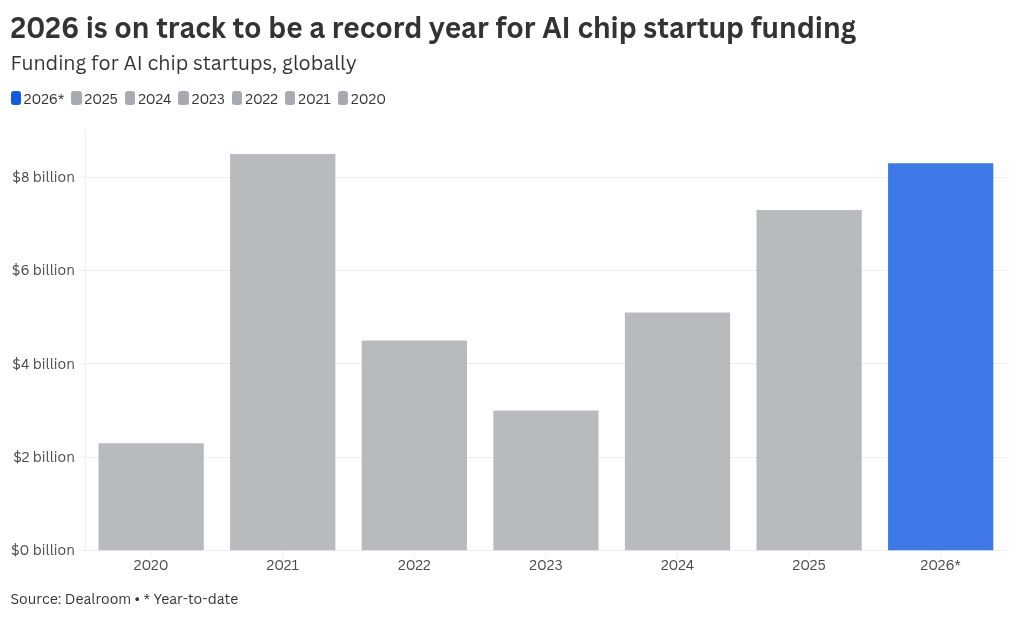
European AI chip startups are trailing in funding, having raised $800 million so far in 2026, contrasted with $4.7 billion for their U.S. counterparts, as reported by Dealroom.
In the U.S., Cerebras Systems secured $1 billion in February, with $500 million funding rounds for MatX, Ayar Labs, and Etched occurring this year.
Nonetheless, European startups developing chips for AI inference to compete with Nvidia are increasingly attracting investor interest.
“We’re observing this in deal flow and in the dialogues we’re having with founders in the domain,” Carlos Espinal, managing partner at Seedcamp, which backed chip startup Vaire Computing, shared with CNBC. “It’s no longer a fringe investment. It’s evolving into a central aspect of how people conceptualize AI infrastructure.”