
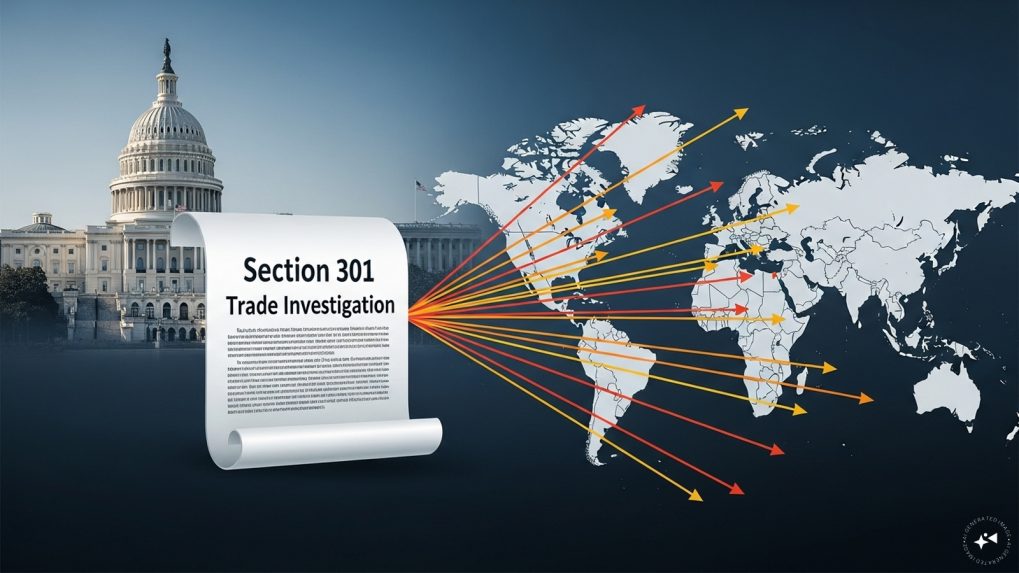
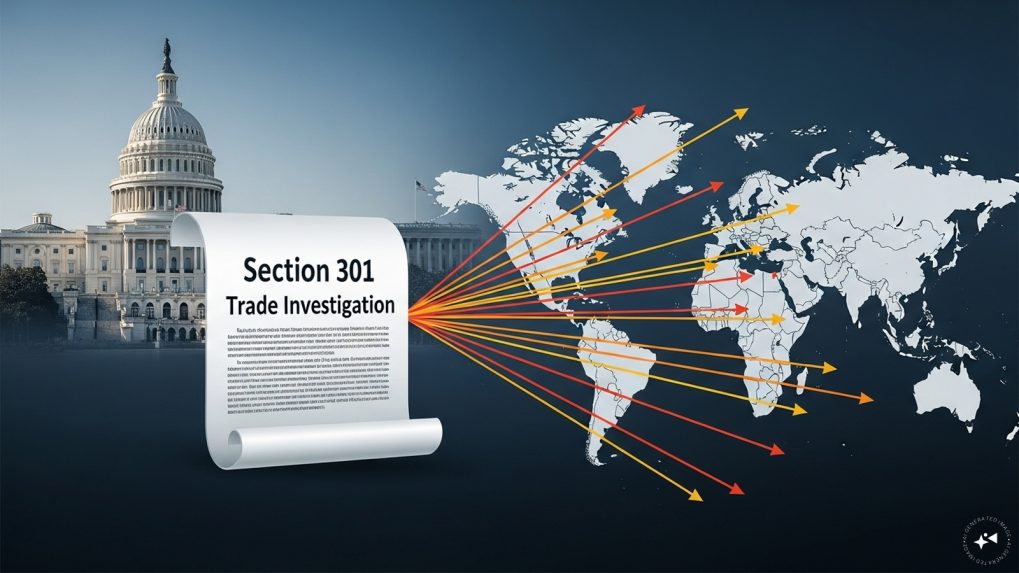

The United States initiated new trade investigations on Thursday targeting 60 economies to assess whether they have adequately restricted imports of products associated with forced labor, just a day after commencing probes into 16 partners for unfair trade practices.
The newly launched investigations, executed under Section 301(b) of the Trade Act of 1974, involve nations such as China, the European Union, India, and Mexico, as per a statement from the United States Trade Representative.
“In spite of the global agreement against forced labor, governments have not succeeded in enacting and effectively enforcing prohibitions against the import of goods produced through forced labor into their markets,” commented U.S. Trade Representative Jamieson Greer.
“These investigations will ascertain whether foreign governments have implemented adequate measures to prevent the import of goods produced by forced labor and how the failure to eliminate these deplorable practices affects U.S. workers and businesses,” he added.
Section 301 allows the U.S. to impose tariffs on nations identified as participating in unfair trade practices without needing additional congressional approval — the legal right that former U.S. President Donald Trump leveraged during his initial term to impose duties on Chinese products.
The probes into forced labor follow Section 301 investigations that were initiated on Wednesday, addressing surplus industrial capacity among 16 economies, including China, Australia, Indonesia, Japan, Malaysia, Singapore, South Korea, Switzerland, and Thailand.
The latest investigations have broadened the roster of countries currently under Section 301 examination to encompass additional nations such as the U.K., Brazil, and Russia.
The new probes appear to provide an alternative strategy to substitute at least some of the “reciprocal tariffs” that were invalidated by the U.S. Supreme Court last month.
“Following the annulment of the reciprocal tariffs, the administration signaled that a plan-B would be implemented promptly,” stated Wendy Cutler, vice president at the Asia Society Policy Institute and a former U.S. trade representative.
The Supreme Court overturned Trump’s reciprocal tariffs last month, determining that the president had exceeded his authority. In response, Trump swiftly imposed a 10% worldwide blanket tariff based on Section 122 of the Trade Act of 1974, threatening an increase to 15%.
The extensive nature of the investigations has raised concerns regarding their viability and justification among trade experts.
The U.S. Trade Representative is scheduled to conduct hearings on the investigations from April 28 to May 1 — an “unrealistically short” timeframe given the extent of countries being examined, suggested Deborah Elms, head of trade policy at the Hinrich Foundation.
Read more
Critics argue that targeting the European Union, which has implemented its own legal framework against forced labor, while overlooking nations with substantially poorer enforcement records, “is illogical,” according to Elms.
The expansive scope of the trade investigations could also risk alienating allies and undermining the goodwill necessary to foster a united approach to addressing China’s industrial excesses, experts warn.
“The administration misses a crucial opportunity to collaborate with partners to address the legitimate overcapacity issue globally, specifically focused on China,” Cutler noted.
“By encompassing more than a dozen countries in the excess capacity investigation, our partners may be disinclined to cooperate in confronting the significant global challenges posed by China’s excess capacity,” she added.
Is China in the crosshairs?
The investigations unfold as U.S. Treasury Secretary Scott Bessent is scheduled to meet with his Chinese counterpart He Lifeng in Paris this weekend to advance trade and economic discussions. The Chinese Ministry of Commerce confirmed the Paris meeting is set for March 14 to March 17.
This meeting aims to establish a foundation for a summit between Trump and Chinese President Xi Jinping.
“Initiating new trade investigations immediately ahead of the summit sends an unfavorable message,” remarked Wang Huiyao, founder of the Center for China and Globalization, a think-tank often perceived as aligned with Chinese perspectives.
“Section 301 has been an approach previously tried, and what is needed now is cooperative efforts — including engagement regarding the situation in the Middle East,” he added.
A spokesperson from the Chinese Ministry of Commerce responded to Washington’s characterization of its industrial capacity as excess, asserting that it is “narrow-minded” to view the gap between domestic production and demand as an unfair trade issue.
The official also called on Washington to “rectify its errors and return to negotiations as a means of resolving disputes.” On the matter of forced labor, China mentioned it is currently evaluating the investigations but provided no further details.
“China will likely articulate its dissatisfaction during the upcoming meeting in Paris,” noted Stephen Olson, senior visiting fellow at ISEAS-Yusof Ishak Institute and a former U.S. trade negotiator.
However, both parties seem dedicated to ensuring the Trump-Xi meeting proceeds as planned, “I wouldn’t anticipate this [trade investigation] disrupting the process,” he concluded.
The initial Trump administration initiated six Section 301 investigations, with actions against China and the European Union leading to increased tariffs. The Biden administration also conducted Section 301 investigations, and two probes into Brazil and China remain in progress.
