
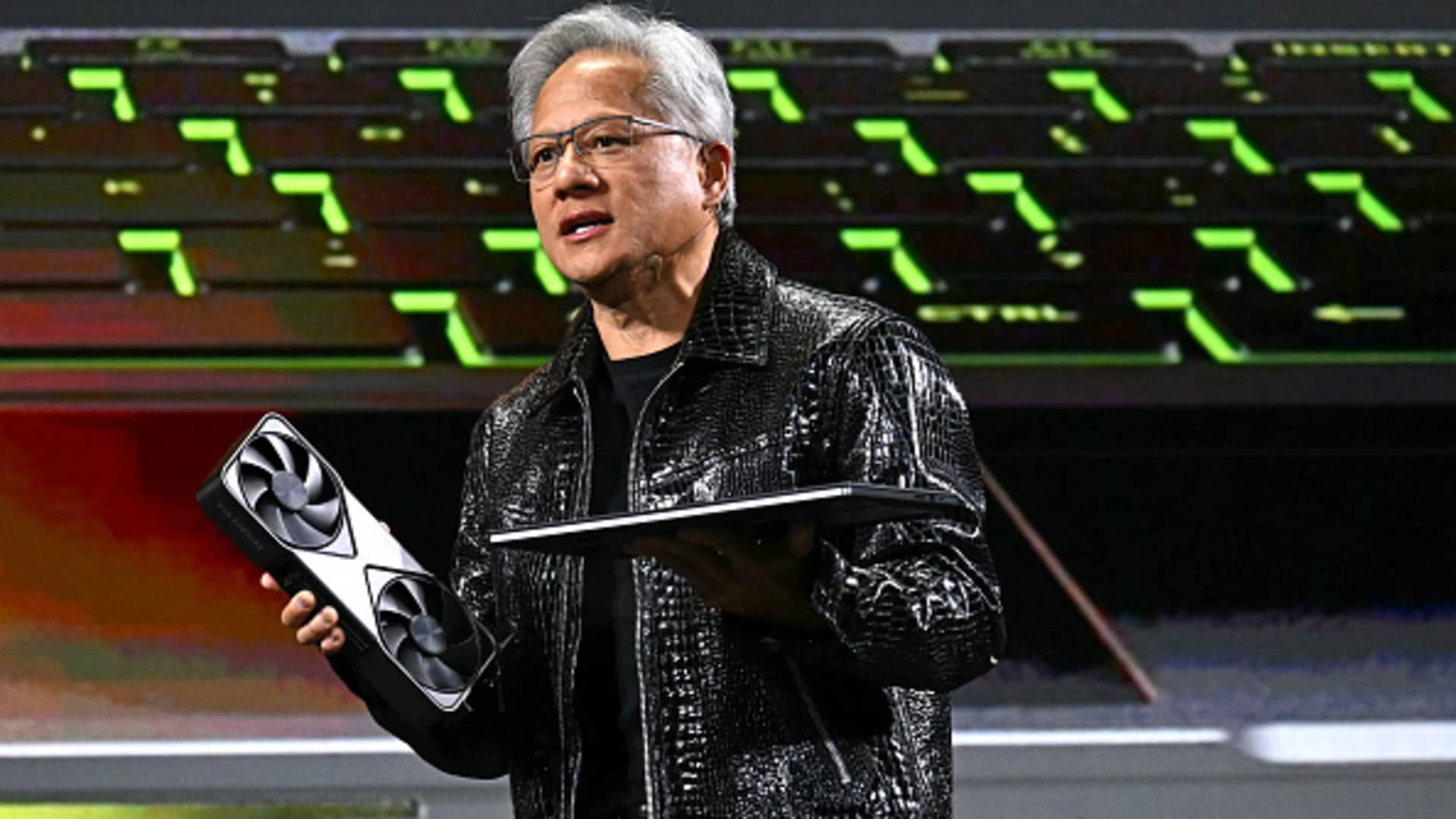

For its initial three decades, Nvidia was not recognized by most unless they were part of the gaming community. Presently, some of its early supporters feel neglected as artificial intelligence has elevated the chipmaker to being the most valuable company globally.
“The gaming sector is no longer the primary engine for the company. There was a time when it indisputably was,” stated Stacy Rasgon from Bernstein Research.
Nvidia pioneered the graphics processing units, or GPUs, that facilitate high frame rates and rendering necessary for optimal video game experiences.
When Nvidia launched its inaugural GPU in 1999, the GeForce 256, they dismissed most employees and faced bankruptcy to accomplish this. Gamers eagerly adopted this new form of processor, reviving Nvidia from near failure.
Currently, as AI demand skyrockets, nearly all of Nvidia’s earnings stem from products catering to that field, shifting away from gaming. With AI chip production limiting the available memory supply, Nvidia has had to navigate difficult choices regarding its focus areas.
In an environment constrained by memory, it is understandable that Nvidia would prioritize its significantly more lucrative data center GPUs like Hopper and Blackwell.
Nvidia’s operating profit margins in its compute and networking segment have averaged 69% over the past three years, in contrast to a 40% margin for the consumer-oriented graphics division.
“I get that they’re going to pursue that. And that saddens me,” remarked Greg Miller, co-founder and host of the widely popular gaming podcast Kinda Funny Games Daily during an interview with CNBC.
“Stick with those who supported you. Gamers have helped you reach this point,” Miller added.
If analyst forecasts are on point, 2026 will mark the first occasion in thirty years that Nvidia does not unveil a new generation of its consumer-oriented GeForce graphics processing units.
Gamers are “extremely significant” to Nvidia, as per an email the company sent to CNBC, clarifying that it is “constantly innovating, assessing, and releasing” new technologies focused on gaming.
The current RTX 50 series of GeForce GPU was presented at CES in January 2025.
However, with 2026 CES and GTC behind, some express concerns that this year may not bring a new generation, although Nvidia frequently presents new hardware as late as September.
While this indicates a significant strategic shift, some gamers argue it isn’t detrimental to their financial plans.
“It’s tough to keep pace. Upgrading every year isn’t feasible, so having some time off and waiting for a vital generation seems to serve gamers well,” stated Tim Gettys, Miller’s co-founder at Kinda Funny Games.
AI earnings overshadow
Nvidia’s present phase of AI supremacy commenced two decades ago with the 2006 introduction of its CUDA software toolkit. Suddenly, developers were able to utilize GPUs for general computing tasks as opposed to solely for graphics.
Later, in 2012, Nvidia’s deep learning prowess was established during what many refer to as the pivotal moment for contemporary AI. Nvidia’s GPUs and CUDA were instrumental in creating a neural network known as AlexNet that outperformed all rivals during a notable image recognition competition.
While Nvidia continued producing gaming GPUs, it underscored a new commitment to AI-focused GPUs in 2020 when it acquired high-performance computing chip manufacturer Mellanox Technologies for $7 billion.
Since then, the company has been unveiling new iterations of high-end GPUs consistently, alongside full rack-scale systems for AI tasks such as the new Vera Rubin platform, which CNBC obtained an exclusive preview of in February.
Nvidia does not disclose pricing for its AI chips, yet experts indicate a single Blackwell GPU can be priced up to $40,000, while the Futurum Group assesses a complete Vera Rubin system may reach up to $4 million.
Conversely, Nvidia retails its RTX 50-series gaming GPUs within a range of $299 to $1,999.
During the cryptocurrency highs of 2018 and 2021, Nvidia’s GPUs were sold online at prices up to three times their listed prices as they were pivotal for mining Bitcoin and Ethereum.
Despite price drops when mining shifted in 2022, Nvidia’s current RTX 5090 GPU continues to sell online at prices up to double the retail cost.
Robust demand for last year’s generation may lessen Nvidia’s motivation to launch a new version this year.
‘Challenging to secure memory’
However, the memory scarcity is a more probable reason for Nvidia’s gaming setback.
Industry speculations indicate Nvidia has intentions to cut output of its latest gaming GPUs by as much as 40% due to a significant shortage of the general-purpose memory required for GPU production.
Dynamic Random Access Memory, or DRAM, provides rapid, temporary data storage that allows the GPU to execute parallel tasks.
Personal computers, the destination for Nvidia’s gaming GPUs, have been particularly impacted by DRAM shortages. When memory costs increase, producing a GPU becomes more expensive, which eventually affects consumers.
Gartner anticipates that PC prices will rise by 17% this year, leading to a 10.4% decline in PC shipments.
“With how costly everything has become, it’s troubling to see gaming prices increase with no sign of coming down, while Nvidia is evidently pursuing a wholly different consumer segment,” Gettys stated.
If the entry-level consumer PC market collapses by 2028, as Gartner warns, the market for Nvidia’s entry-level gaming GPUs is likely to diminish as well.
Instead, Nvidia will probably conserve limited memory stocks for its AI chips, which carry higher costs and profit margins.
“If there are delays or alterations in the gaming pipeline, it’s likely because they might struggle to produce the cards due to memory shortages,” Rasgon explained. “Every bit of available memory is likely being allocated for AI computing needs.”
High-performance GPUs such as Blackwell and Rubin utilize dense assemblages of a unique DRAM type known as High Bandwidth Memory, or HBM. Rasgon mentioned it requires roughly four times the number of silicon wafers to produce a gigabyte of HBM compared to traditional DRAM types.
“This scenario is depriving the overall market of the kind of memory typically employed for more consumer-oriented applications. It’s simply not obtainable,” Rasgon remarked.
Nvidia informed CNBC that it continues to distribute all GeForce GPUs given robust demand, and is collaborating closely with suppliers to enhance memory accessibility.
“If they are earning threefold and shareholders are threefold more satisfied, then yes, I do believe they will shift away from gaming, despite it being their origin,” Gettys noted.
‘Feels like an insult’
CEO Jensen Huang did make a significant gaming declaration at the start of his keynote presentation at Nvidia’s annual GTC conference in March, yet the gaming audience was less than thrilled.
Huang unveiled the next iteration of its rendering software named Deep Learning Super Sampling or DLSS, anticipated in the fall. It is renowned for enhancing frame rates by rendering games at lower resolutions and utilizing AI to upscale the visuals, improving gameplay on less powerful systems.
The contention surrounding the new DLSS 5 arises from gamers’ concerns that it employs generative AI to alter the aesthetics of the game. Huang revealed DLSS 5 with a promotional video showcasing photorealistically enhanced versions of characters from popular titles such as Resident Evil Requiem, Starfield, and Hogwarts Legacy.
“I engage in video games because they’re a form of art. Thus, I appreciate seeing the creator’s imprint in the experience,” stated Miller of Kinda Funny Games. “This raised significant concerns among many in the gaming sector amidst widespread layoffs and numerous studio closures.”
As it faces a post-pandemic downturn, the gaming sector has encountered studio shutdowns, canceled projects, and extensive layoffs across major companies like Epic Games, Microsoft’s Xbox, and Sony’s PlayStation.
Gettys appreciated previous iterations of Nvidia’s DLSS for facilitating gaming accessibility on tighter budgets.
“This technology is astonishing in terms of enabling games to run on lower-end systems,” he remarked. “Yet, introducing this generative AI aspect feels extremely disrespectful.”
Gettys’ primary concern is that this leads toward entirely AI-generated games, which he perceives as “definitely the objective.”
Elon Musk has also addressed the potential for this. In a post on X from October, Musk indicated that his xAI gaming studio plans to launch “a remarkable AI-generated game” by the conclusion of 2026.
“You’re effectively modifying the art developed by the creators. And soon enough, you’ll be replacing the developers, resulting in studio closures,” Gettys commented.
Nvidia communicated to CNBC that “Games are an artistic medium that allow developers to share compelling narratives and immerse players in extraordinary worlds. Our RTX technologies serve as instruments enabling game creators to fulfill their imaginative goals – this encompasses rendering methods like ray tracing and path tracing, augmented by AI, such as DLSS Super Resolution, DLSS Frame Generation, and DLSS 5, all collaboratively working to deliver superior performance and visual fidelity.”
During his GTC keynote, Huang asserted that AI will “transform how computer graphics are created.”
In a follow-up Q&A session, Huang addressed claims from the gaming community that DLSS 5 makes games appear uniform.
“They are entirely mistaken,” Huang replied.
He underscored that game developers will maintain control, able to “adjust the generative AI” to correspond with their artistic style.
‘Evident preference’
Over the last ten years, Nvidia has provided cloud gaming through a service called GeForce NOW. The model has developed to offer various subscription levels — including a complimentary option — allowing users to stream games they own on platforms like Steam, utilizing Nvidia GPUs located in data centers rather than on individual devices.
“You observe Xbox and PlayStation, as well as other rivals attempting to bring cloud gaming to players in a logical manner. And Nvidia GeForce NOW has substantially figured that out,” Miller commented.
Gettys stated to CNBC that Nvidia’s streaming platform is far superior “by a vast margin.”
“It offers access to high-level gaming for millions more individuals, even those without the latest hardware. And it’s technology that is truly impressive,” he confirmed.
Advanced Micro Devices is Nvidia’s main competitor in the gaming sector, primarily with its Radeon GPU series.
However, the memory crisis poses a challenge for both entities.
“If Nvidia can’t secure the memory, AMD will struggle as well,” Rasgon stated. “From a sentiment perspective, both brands have their loyal followers and can inspire fanaticism.”
“There’s a clear preference,” Gettys remarked. “If you’re gaming on a PC, you’re inclined to choose an Nvidia card.”
Watch: How AMD evolved into a chip giant and ultimately caught Intel
