
“Although Lenovo has made some headway complying with French consumer law by adding more repair score PDFs to its website, we urge the company to address this long-running problem,” this year’s report states.
PIRG’s analysis found that “laptops remain largely stagnant in terms of repairability” across many of the eight most popular laptop brands in the US.
Proctor told Ars that while consumers’ access to parts, tools, and the vendor-level information has improved, gains in how easily devices can be disassembled “take longer to materialize.”
He also commended manufacturers for releasing more repair-friendly designs, such as Apple’s MacBook Neo.
Phone repairability ratings
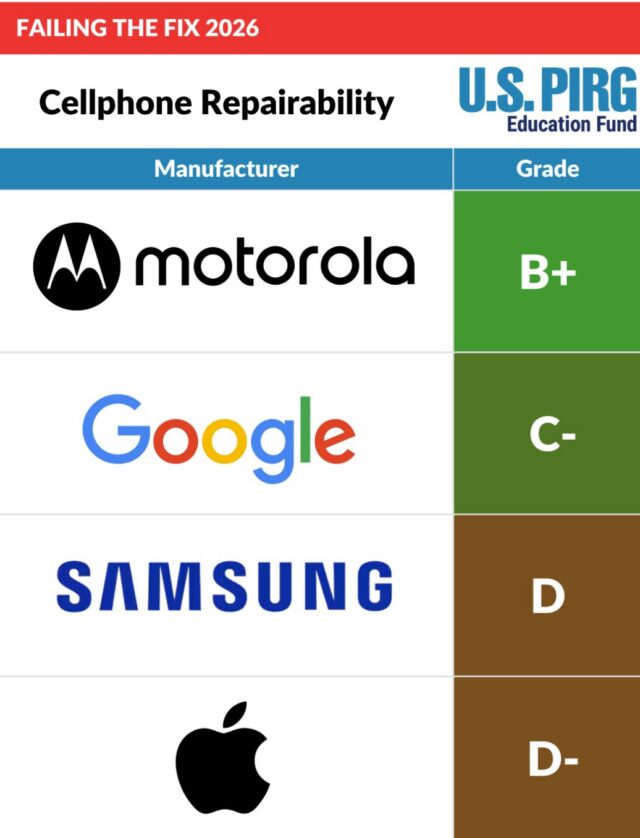
PIRG’s phone manufacturer scores this year draw on the European Product Registry for Energy Labelling (EPREL), a system the European Commission introduced in June 2025 to rate smartphone and tablet repairability. It considers six factors:
- Disassembly depth
- Fasteners
- Tools
- Spare part availability
- Software updates
- Repair information
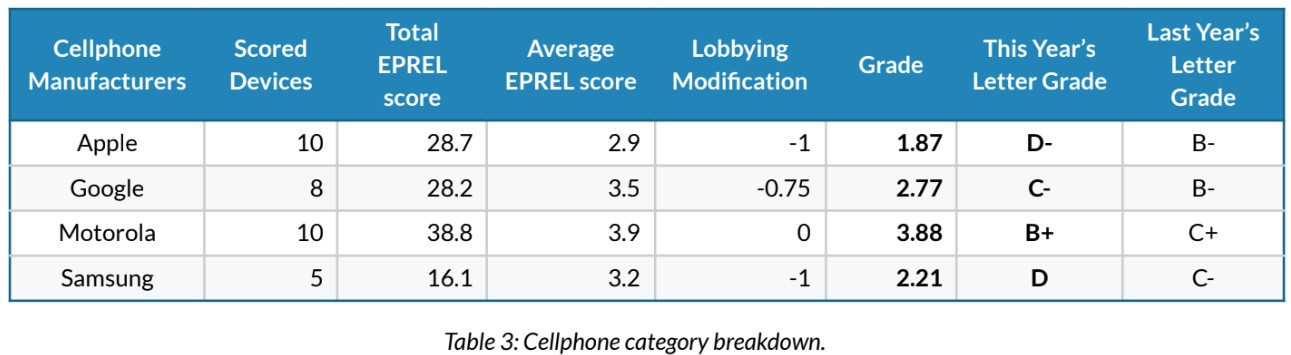
PIRG’s report said Apple and Samsung scored poorly under EPREL in part because the phones assessed are guaranteed updates for five years but not beyond.
PIRG observed that Apple has improved phone repairability by moving away from parts pairing—where parts must pass encrypted software checks to function—and by introducing the Repair Assistant. Still, the report’s author regretted that third-party Face ID replacements still don’t function. The report adds:
Apple also expanded its Activation Lock anti-theft feature to individual components, which repair advocates warn could leave large numbers of otherwise working parts stranded—effectively locking them out of the repair ecosystem.
Apple is not alone: parts pairing and software restrictions remain an industry-wide issue that consumers and independent technicians continue to confront across manufacturers.
