
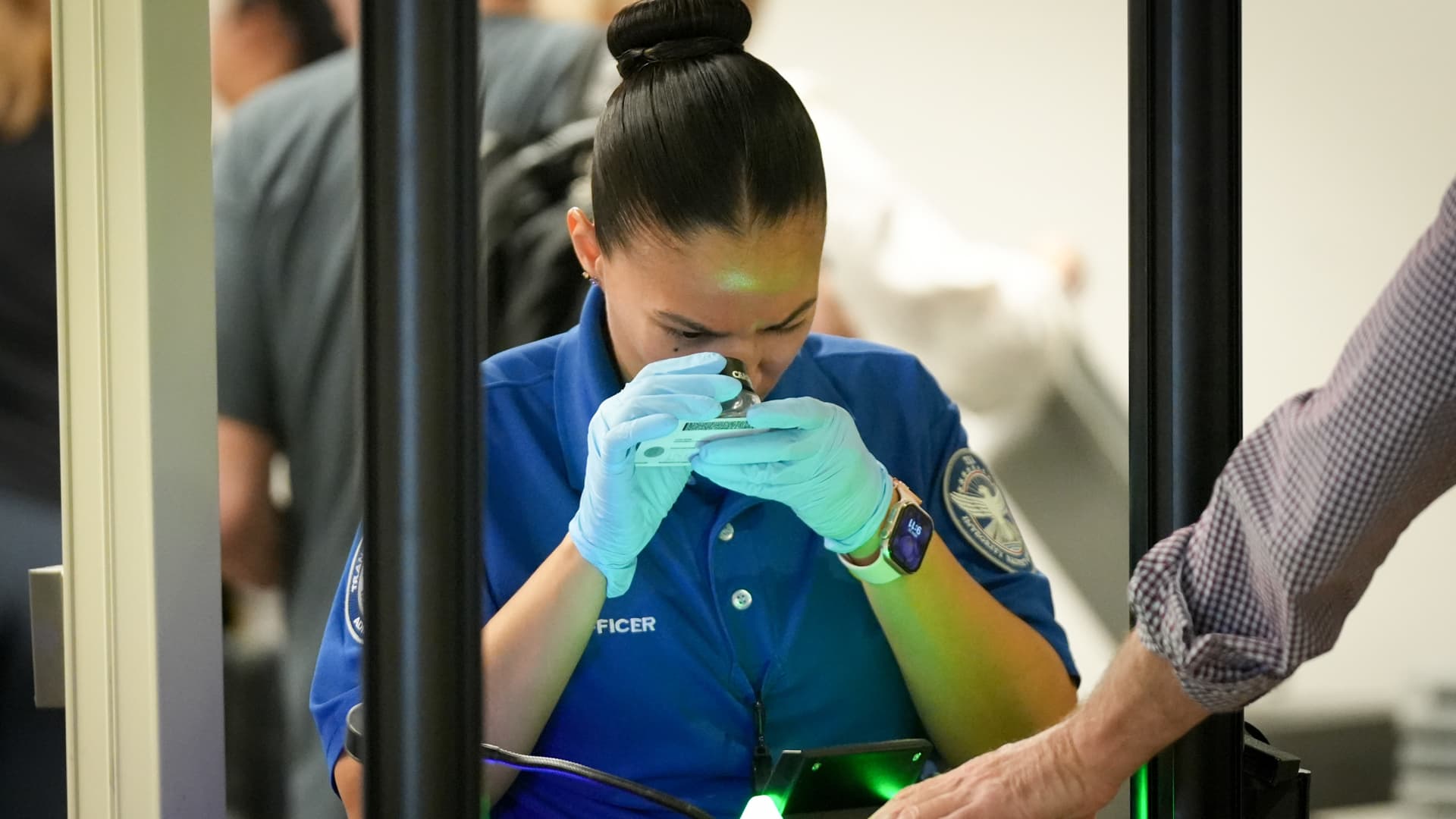

Following several weeks of extensive queues at airports and disputes within Congress, agents of the Transportation Security Administration started to receive payment earlier this week due to an executive order issued by President Donald Trump.
The decision to circumvent Congress — which under the U.S. Constitution holds authority over federal spending — and to pay the airport security personnel unilaterally is merely a temporary solution. Discussions regarding funding for the Department of Homeland Security, which has been suspended since February, are primarily stalled while Congress takes a two-week recess.
The issuance of paychecks raises numerous inquiries: Where is the funding Trump is utilizing sourced from? How much is currently accessible? And for what duration can Trump sustain salaries for TSA personnel if Congress does not reach an agreement promptly?
Trump’s executive order instructs the Secretary of Homeland Security and the Director of the White House Office of Management and Budget “to utilize funds with a logical and reasonable connection to TSA operations to provide TSA employees with the compensation and benefits that would have been available to them if not for the Democrat-led DHS shutdown.”
The Trump administration has confirmed that the funding is derived from last year’s Republican tax and spending legislation, known as the One Big Beautiful Bill Act.
“Similar to measures taken during the initial Democrat shutdown (for example, compensating military personnel), President Trump has concluded that congressional Democrats have created an emergency scenario that cannot persist,” a senior administration official stated via email.
The White House has not detailed the specific source of the funds within the tax and spending legislation, but Bobby Kogan, senior director of federal budget policy at the Center for American Progress, indicated that there is only one viable part that the administration might be referencing.
Hidden within the over 300-page document is a provision that allocates $10 billion “for the reimbursement of costs incurred in supporting the Department of Homeland Security’s mission to protect the borders of the United States.”
“They do have a source of funding. It is a considerable slush fund. However, it cannot be utilized for [just] anything,” Kogan stated.
Trump has previously employed creative methods to compensate certain federal employees. During the complete government shutdown last autumn, he accessed unspent research and development funds, as well as a $130 million contribution from a donor to pay the U.S. military. While Trump did not disclose the private benefactor, The New York Times reported it was billionaire Trump supporter Timothy Mellon.
While Democrats also express the desire for TSA agents to receive their pay, Trump’s latest unilateral decision to compensate federal workers without first obtaining Congressional approval raised concerns.
“I am pleased that this administration has finally opted to pay these employees, after not doing so for 41 days. The administration must clarify what funding it is allocating to compensate these workers after previously asserting it was unable to do so,” House Appropriations Committee ranking member Rosa DeLauro, D-Conn., stated in a press release on the day Trump announced his intentions.
Kogan believes the majority of the $10 billion in the DHS fund from last year’s tax and spending legislation remains accessible. He approximated that funding TSA could cost around $140 million each week, indicating that the White House could sustain funding for the agency for a year without depleting finances.
But should it?
Devin O’Connor, a senior fellow at the Center on Budget and Policy Priorities, mentioned that there are substantial questions regarding the legality of such an action.
“The administration has not provided any real transparency regarding their public actions that would allow anyone to determine whether what they are doing is lawful or illegal,” O’Connor stated. “They have not made a compelling argument for it publicly.”
“It is clear that when Congress allotted that $10 billion, the intention was not for those funds to be allocated for the payment of TSA employees,” O’Connor stated.
Kogan was more direct. He considers it a clear infringement of the Antideficiency Act, a law originating in the 1800s that prohibits federal agencies from utilizing funds that Congress has not authorized.
The White House, when invited to address the accusation of law violation, referred to its Office of Management and Budget. An OMB official defended the legality of the funding via email, referencing a Department of Justice memorandum that claims agencies have “considerable latitude in determining whether expenditures further the agency’s authorized functions and therefore signify appropriate usage of general or lump-sum appropriations.”
According to Kogan, no one has ever faced prosecution under the Antideficiency Act. And congressional Democrats — who typically are keen to hold Trump accountable — are unlikely to challenge the action and risk halting wages for TSA personnel given the political unpopularity of prolonged airport lines.
“No one possesses the authority to challenge this. No one was able to prevent Trump from illegally compensating the military last time,” Kogan explained. “It is simply going to be one of his countless unlawful budgetary decisions.”
TSA personnel have received payment
Trump’s executive order seems to have reduced wait times at airport security this week, at least temporarily.
Acting Assistant DHS Secretary for Public Affairs Lauren Bis stated in an email that “Most TSA employees” received a retroactive paycheck this week “that encompassed at least two full paychecks” for the recent missed payment periods.
Over 500 officers departed TSA due to missed payments triggered by the shutdown, and thousands were called out of work, according to Bis.
“A small subset might experience a slight delay due to various reasons, such as processing times at financial institutions or issues with direct deposits. We are diligently collaborating with USDA’s National Finance Center to expedite the processing for the partial paycheck they are owed from pay period 3 as quickly as possible,” Bis said.
The duration for which TSA will continue to receive compensation through the DHS fund remains uncertain as Congress struggles to unify around an agreement.
Last week, there were no objections from senators regarding a proposal to fund the entirety of DHS with the exception of Immigration and Customs Enforcement and certain sections of Customs and Border Protection, sending it to the House for final confirmation. This action enabled the Senate to effectively conclude the shutdown and depart for its scheduled recess while also easing the extensive waits at airports nationwide ahead of a busy travel period in early April for Easter and Passover.
This deal infuriated House Republicans, who declined to entertain the Senate’s compromise and instead opted to advance their own temporary spending measure aimed at sustaining funding for all of DHS — including ICE and CBP — through May 22 and refer it back to the Senate.
By that point, the Senate had already vacated Washington, ensuring a prolonged shutdown. Democrats are determined to obstruct any package that incorporates immigration enforcement funding without modifications to the agency’s operations, and senators are dispersed across the country and globe for the recess.
The White House has urged Congress to reconvene early from its break, but leaders in both chambers have not indicated any plans to do so.
Trump on Wednesday commented via TruthSocial, urging congressional Republicans to utilize the budget reconciliation process — a procedural method for spending-related measures necessitating only a simple majority in the Senate to pass — to bypass Democrats and fund ICE and CBP.
“I am requesting that the Bill be on my desk NO LATER than June 1st. Our Law Enforcement Officers and the American People should not be made to wait until the Democrats come to their senses or learn the hard way through the Polls,” Trump stated.
— CNBC’s Megan Cassella contributed to this report.
