
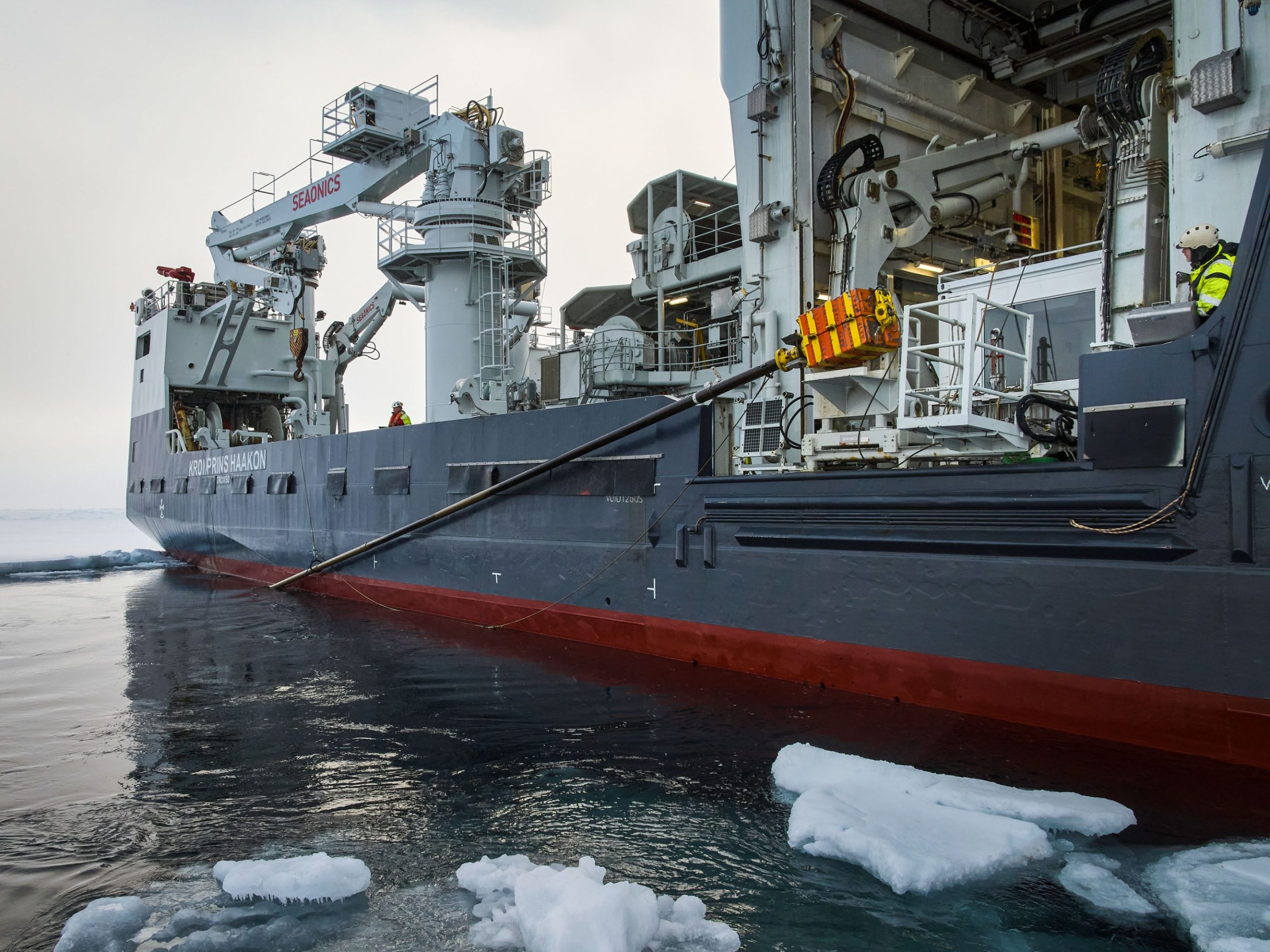
Historically, even with an icebreaker and amidst peak melting seasons, reaching the North Pole was not guaranteed. It required favorable winds to break the icy ocean surface, and vessels had to navigate through ice that had solidified to several meters thick over numerous winters. However, in the summer of 2025, Jochen Knies from the Arctic University of Norway, Tromsø, and his team encountered minimal obstacles en route to 90 degrees North aboard the research ship Kronprins Haakon. The geologist “didn’t hear the usual grinding of ice” that he recalled from 1996, when he first visited the pole by boat. Instead, they encountered thin ice floes and expansive areas of open water that allowed for a smooth, quiet passage. It served as “a reminder of how rapidly the Arctic is transforming.”
Since the late 1970s, following the initiation of satellite monitoring of polar oceans, the summer ice extent in the Arctic Ocean has reduced by over 40%. Within a few decades, a frozen region equivalent to the Mediterranean Sea has converted into blue open waters due to swift warming in the high northern latitudes. If this trend persists, we may soon witness summers at the North Pole devoid of any sea ice. This last occurred possibly around 120,000 years in the past. Yet, the exact timeline remains uncertain.
This is why Knies and his colleagues, a research team from Norway and Germany, launched an expedition from Svalbard to the central Arctic last August. Their five-week mission aimed to investigate if this area had experienced ice-free periods in recent geological history—and if it had, at what times. As a part of a €12.5 million project funded by the European Union, they also sought answers regarding the future of the Arctic and beyond: How does the reduction of sea ice impact the marine ecosystem? What are the implications for ocean circulation and global climate?
In their quest for insights, the expedition gathered sediment cores reaching lengths of up to 22 meters from various locations across the Arctic seabed. Marine sediments function as invaluable climate records that provide scientists a glimpse into past eras. They meticulously document former water temperatures, sea-ice coverage, and ocean current strengths. This information is embedded in the chemical and physical characteristics of the plankton remnants and weathered rock present on the sea floor.


Although sediment cores several meters in length were retrieved during previous Arctic expeditions, a scientific consensus regarding the age of the deposits or whether sea ice completely vanished during summer has yet to be established.
To decipher the Arctic’s climate record, Knies enlisted a group of specialists from various fields aboard the Kronprins Haakon to delve deeper and obtain new samples for the latest analytical techniques.


Some of this research was carried out while the scientists were still at sea. Currently, back in their laboratories, they are completing the analysis of the seabed samples. A significant task involves dating the sediments, which may date back as far as 2 million years. The team employs various techniques for this, such as examining magnetization, assessing the decay of radioactive substances, and determining the exposure of mineral grains to sunlight before they sank to the bottom. Once they establish a timeline, the materials within the cores will aid researchers in reconstructing what the Arctic Ocean resembled in warmer periods than the present. For instance, the detection of the molecule IP25, produced solely by ice algae, could indicate how extensively the sea ice retreated at specific times.

Ultimately, the team aspires to acquire data that could enhance climate predictions for a potentially ice-free “blue Arctic,” helping us to comprehend how it would impact marine life and carbon sequestration, Atlantic Ocean currents, or extreme weather patterns in Europe and North America.
Tim Kalvelage is a freelance science journalist based in Bremen, Germany, specializing in climate, oceanic, and polar research. He has journeyed to the North Pole twice.