
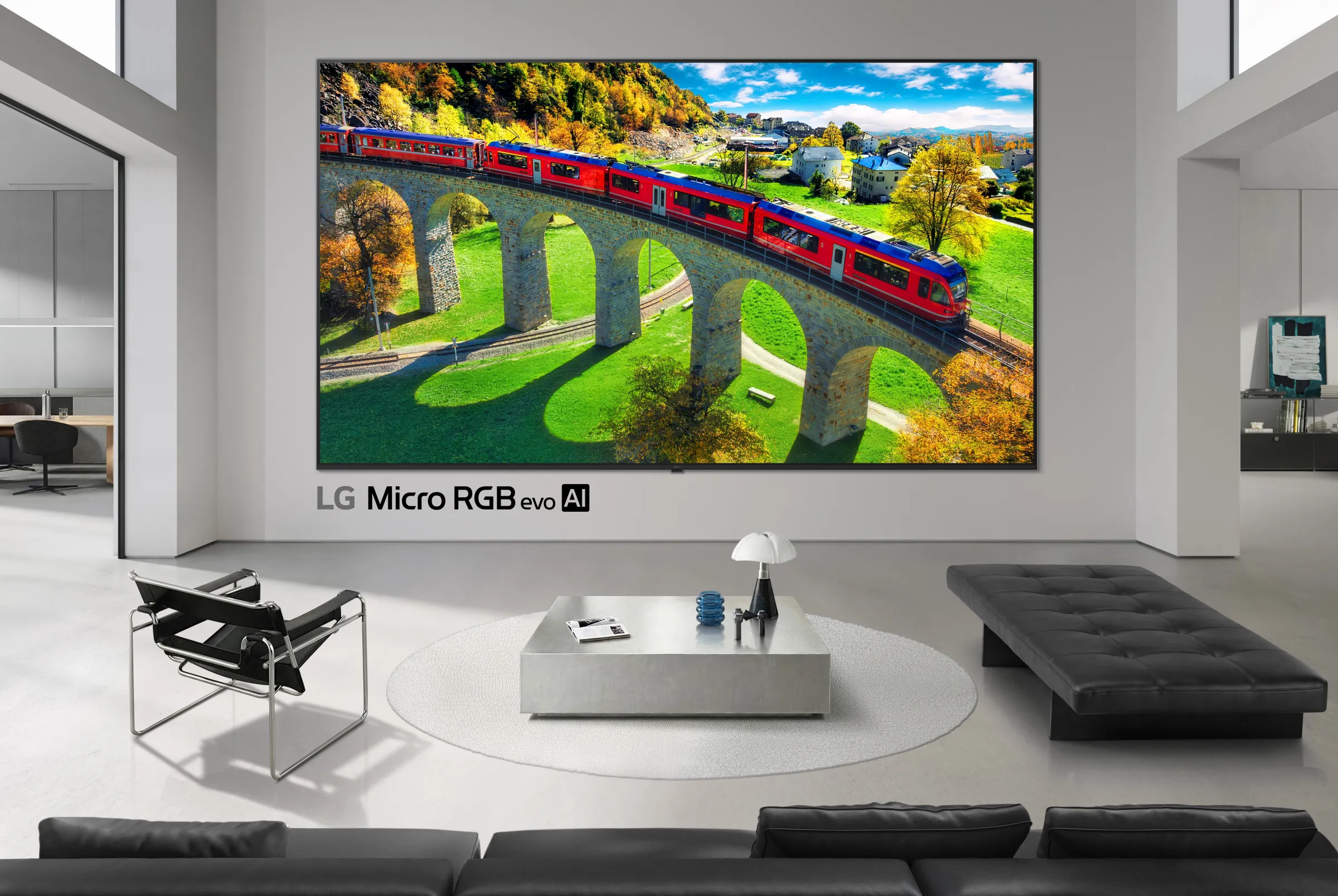

In what is likely the start of many announcements, LG has confirmed its launch of the first premium RGB TV in 2026. While it wasn’t entirely secret, as “a high-end LCD TV featuring Micro RGB technology” earned a CES 2026 Innovation Award last November. However, it is now confirmed that the LG Micro RGB evo TV will debut in 2026 in sizes of 100, 86, and 75 inches, with US pricing to be disclosed later.
The Micro RGB evo TV will incorporate an enhanced variant of LG’s Alpha 11 processor, typically used in the company’s top-tier OLED models like the LG G5. This TV has also been certified by Intertek—a certification and testing agency—to deliver 100 percent color gamut coverage for BT.2020, DCI-P3, and Adobe RGB. Details regarding its brightness capacity remain undisclosed (I anticipate the brightest highlights might exceed 5,000 nits).
CES—and 2026 overall—seems poised to be the year of the RGB TV, with more brands expected to unveil flagship models featuring this technology. This trend kicked off when Hisense showcased the 116-inch 116UX at CES 2025, while Samsung revealed its 115-inch Micro RGB TV, which was launched this previous August. I predict that this coming January, we will witness additional models, possibly in smaller sizes, to rival the new LG Micro RGB. (During my meeting with Samsung in August to review its Micro RGB TV, a representative remarked, “We have thrilling advancements on the horizon for Micro RGB.”) TCL has already demonstrated two RGB TV versions targeted at the Chinese market, and Sony will introduce its TrueRGB TV early in 2026.
It’s crucial to differentiate that micro RGB technology is not to be confused with microLED, which employs tiny red, green, and blue LEDs for each pixel. The RGB technology presented by LG (as well as by Samsung, Hisense, and eventually Sony and TCL) utilizes clusters of red, green, and blue LEDs to illuminate multiple pixels. These LEDs are minuscule—hence the term “micro”—and the three distinct colored LEDs enhance gamut coverage and color fidelity, although the TV still utilizes a color filter to accurately produce color for each individual pixel. The LED displays we are accustomed to create either a blue or white backlight.
The RGB LED technologies from Hisense and Samsung that I have encountered thus far have been extraordinarily impressive, showcasing vibrant, vivid images that surpass anything available today. However, these have primarily been large televisions with price tags in the tens of thousands of dollars—not something many of us would integrate into our homes. Now that each TV manufacturer appears to be launching their unique models, particularly in smaller sizes, it is hoped that costs will decrease to more accessible levels.