
The seas contain highly effective, intricate traps: nets, hooks, and fishing lines. Built to catch animals meant for our plates, they frequently ensnare other wildlife as well.
This accidental harvest is known as bycatch, and every year it results in the deaths of millions of marine animals, including whales, dolphins, sharks, turtles, and seabirds. Nets and gear can suffocate or inflict fatal wounds; even when animals are thrown back into the sea, they often do not survive. Bycatch is also a problem for fishers—entangled animals can damage equipment, wasting time and money and harming fisheries’ reputations.
Over the years, conservationists, scientists, and fishermen have devised methods to cut different types of bycatch across fisheries worldwide. Yet putting these fixes into practice is frequently difficult, and many mitigation measures never achieve widespread use.
Credit:
Georgia Dept. of Natural Resources NOAA permit #20556
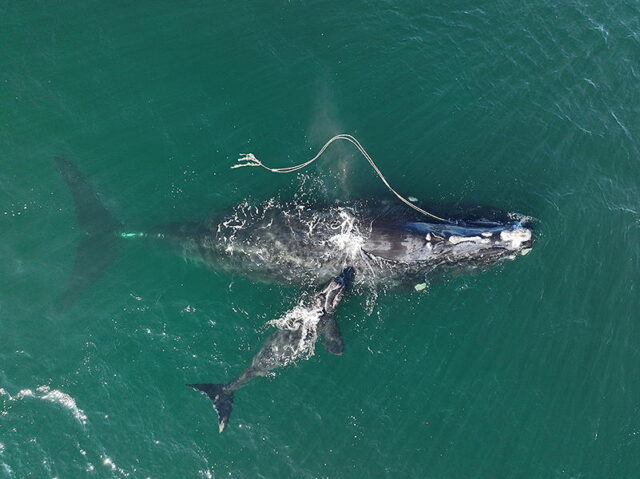
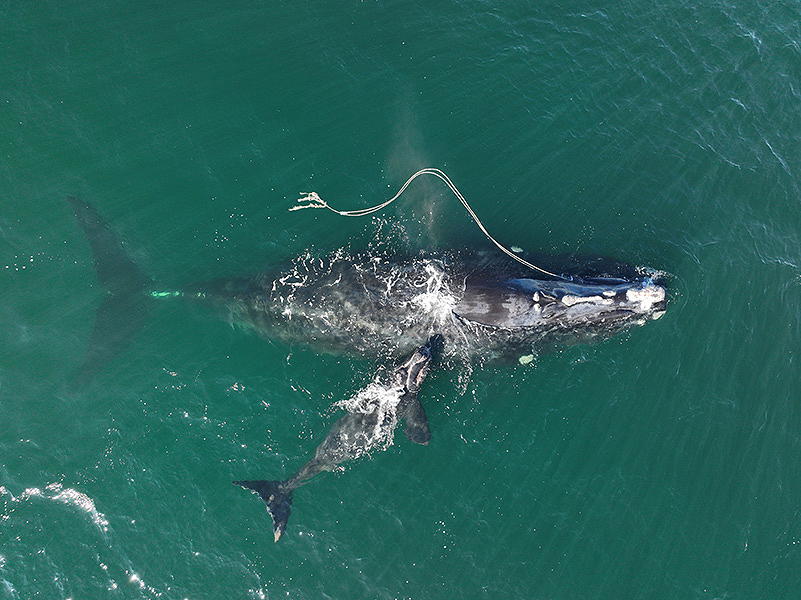
Fishing gear that entangles dolphins, porpoises, and whales poses a serious threat to these animals. Here, gear trails from the North Atlantic right whale called Snowcone (known individual #3560) who swims with her calf in waters off Georgia.
Credit:
Georgia Dept. of Natural Resources NOAA permit #20556
Some methods, however, already show measurable success—and more options may be coming. Recent studies have tested nets fitted with lights; even simple fixes like attaching plastic water bottles to gear appear to reduce certain kinds of bycatch while remaining feasible for fishermen to adopt.
Despite the hurdles, researchers are optimistic. “There are not very many conservation issues that I’m aware of where industry and conservationists and consumers and the fishermen and the resource users all want the same thing,” says marine biologist Matthew Savoca, a research scientist at Stanford University’s Hopkins Marine Station. “Every stakeholder wants less bycatch.”
Preventing turtle entanglement
Bycatch has long been a part of fishing. “It’s a conflict that’s intrinsic to the whole idea of fishing,” says marine scientist Nancy Knowlton, marine biologist emerita at the Smithsonian’s National Museum of Natural History. “If you have something that’s designed to catch animals, you’re going to wind up, almost always, catching some things that you didn’t mean to catch.”
