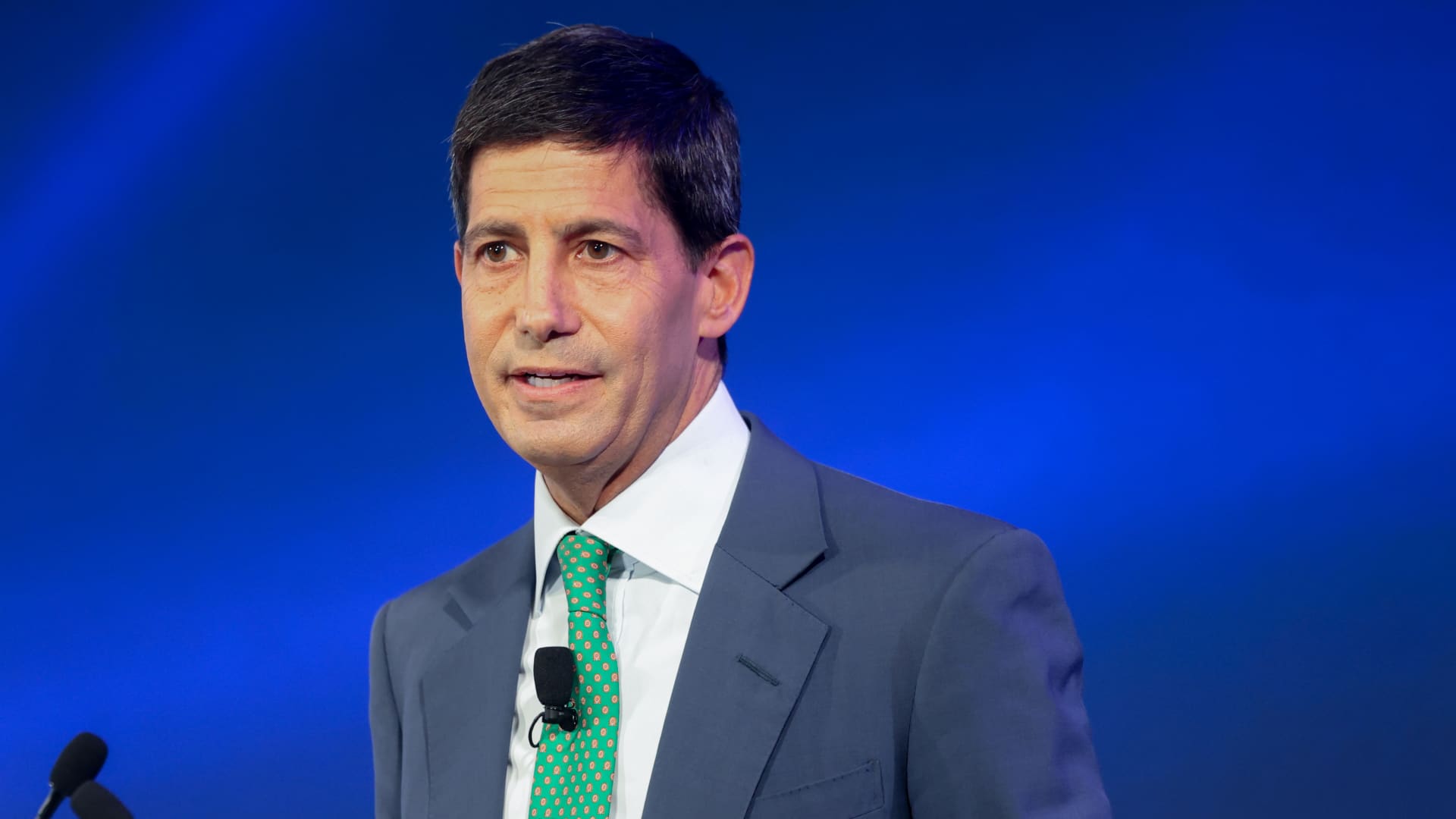

In his initial tenure at the Federal Reserve, Kevin Warsh encountered a central bank on the verge of being tasked with global rescue. He returns now in a vastly different context, summoned to cater to a notoriously unpredictable president who will impose substantial but divergent expectations on him.
Warsh is indeed a veteran of the Fed, having served during the pivotal years of 2006 to 2011 that preceded and unfolded through the global financial meltdown and the central bank’s measures to stabilize the economy. Appointed by President George W. Bush, he was among the youngest individuals to ever occupy a position on the board of governors.
During his time at the Fed, Warsh was instrumental in formulating and executing emergency lending initiatives designed to stabilize credit markets. He also played a significant part in developing numerous programs intended to salvage the economy. One such initiative, crafted separately at the Treasury Department, became known as the Troubled Asset Relief Program, conceived by Neel Kashkari, who currently serves as the Minneapolis Fed president.
Nevertheless, Warsh emerged from this period as a critic of the Fed.
He cautioned that extensive asset purchases and persistently low benchmark interest rates risked distorting markets and jeopardizing long-term price stability. While he supported earlier initiatives, Warsh cast a dissenting vote against the second phase of Fed bond purchases, a strategy known as quantitative easing.
‘Central casting’
Warsh has additionally reprimanded the post-financial crisis Fed for overreaching with monetary policy stimulus, asserting that it contributes to the conditions for future crises. In some ways, President Donald Trump is appointing a Fed chair who may be even less likely to yield to political pressures than Jerome Powell.
Trump noted Warsh’s extensive experience while announcing his nomination for the leading Fed position on Friday morning. Warsh is presently a distinguished visiting fellow at Stanford University.
“Beyond everything else, he is ‘central casting,’ and he will never disappoint you,” the president posted on Truth Social.
Warsh is a graduate of Stanford University, where he obtained his law degree from Harvard and ultimately became part of the Lauder cosmetics family through marriage. Prior to joining the Fed, he worked in investment banking at Morgan Stanley and served in the George W. Bush administration as a special assistant to the president for economic policy.
While positioning himself as a supporter of Fed autonomy, Warsh has also condemned it for overextending its mandate and stated in a CNBC interview last year that the central bank requires “regime change.”
Warsh has expressed his concerns regarding the current Fed.
“The credibility deficit resides with the current leaders at the Fed, in my opinion,” he stated during that July interview. This viewpoint could place him in a confrontational position in an institution where consensus is crucial for implementing policy.
Despite numerous missteps in policymaking, Chair Powell has generally managed to maintain consensus within the Fed. However, in recent months that has deteriorated, with each of the last several meetings featuring at least one and sometimes multiple dissenting opinions.
Warsh’s nomination would signify a significant philosophical transition from Powell’s pragmatic, consensus-oriented approach and indicate a potential tightening of the Fed’s tolerance for inflation and balance sheet enlargement. He would occupy the seat currently held by Stephen Miran, whose term concludes Saturday.
Miran stated to CNBC on Friday that he endorses the nomination.
“Chairman-designate Warsh has a long-standing reputation for being an innovative and original thinker on monetary policy,” Miran expressed. “He possesses numerous vital insights acquired over the years, and I am eager to witness all the valuable work he will accomplish at the Fed.”
Can Warsh sway the Fed committee?
However, if Trump believes Warsh will effortlessly implement aggressive rate cuts, he might be in for an unpleasant shock. Several voting members on the Federal Open Market Committee have voiced opposition to further cuts until there is more compelling evidence that inflation is definitively moving towards the central bank’s 2% target.
Furthermore, the entire group of Fed officials in December indicated they anticipate just one additional rate cut occurring in 2026, followed by another in 2027. Collectively, this aligns with market expectations, with futures traders pricing in two cuts this year and none for the following year.
Traditionally, however, the chair has been regarded as first among equals when it comes to voting within the FOMC, so Warsh may possess the ability to steer the group in a somewhat more dovish direction.
“We consider Warsh to be a pragmatist rather than an ideological hawk in the tradition of the independent conservative central banker,” noted Krishna Guha, head of global policy and central bank strategy at Evercore ISI, in a memo. “Given his hawkish reputation and perceived independence, he is better positioned to guide the FOMC towards delivering at least two and possibly three cuts this year compared to some alternatives.”
Thus, while Warsh may be seen as an ideological ally of the administration, how that manifests in practice will be a crucial inquiry.
“Analytically, we foresee him strongly aligning with the Administration’s assertions that surging productivity will enable neutral or accommodative rates even amid robust growth,” articulated Tobin Marcus, head of U.S. policy and politics at Wolfe Research. “Yet it all hinges on how the data unfolds, as we believe the rest of the FOMC will continue to be data-driven and centered on the standard Fed models that Warsh has critiqued.”
Warsh participated in a competitive selection process that included 11 candidates, featuring a mix of former and current Fed officials, prominent economists, and several Wall Street investment professionals including BlackRock fixed income chief Rick Rieder. The pool was narrowed to five, then to four before Warsh was chosen.
Trump has been explicit about the primary criterion — a readiness to reduce rates significantly and maintain them at low levels. The president has emphasized the necessity of lower rates as both a remedy for the struggling U.S. housing market and a means to lessen financing costs for the $37 trillion U.S. debt.
Before all of this, he must be confirmed by a Senate facing a delicate political environment.
The Trump Justice Department is investigating the extensive renovation project at the Fed’s Washington, D.C., headquarters and has issued a subpoena to Powell for information. Republican Sen. Thom Tillis of North Carolina has committed to opposing any Trump Fed nominees until that situation is resolved.
Once that obstacle is overcome, Warsh would contend with a full Senate where Republicans still hold a majority.
“The Warsh nomination is likely to garner considerable support – Democrat economist Jason Furman has expressed early backing – and he should find it relatively straightforward to confirm in the Senate,” Guha stated.