
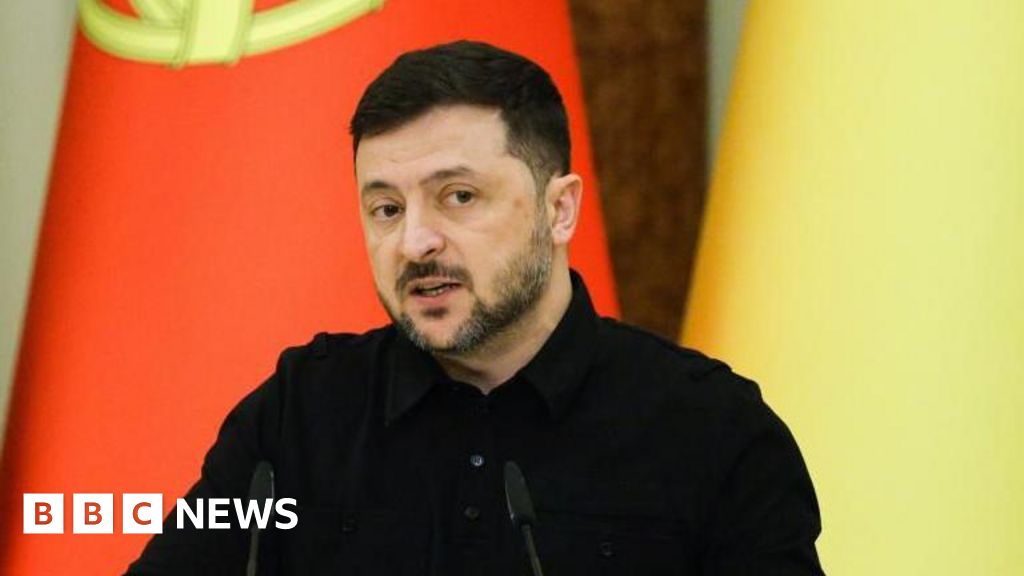

President Volodymyr Zelensky of Ukraine has expressed optimism regarding a discussion he had with US representatives about ending the conflict between Russia and Ukraine.
Zelensky mentioned that the call with Steve Witkoff and Jared Kushner on Thursday, which lasted close to an hour, resulted in “new concepts concerning formats, meetings, and… timing to bring genuine peace closer”.
He made these remarks a day after unveiling details of a revised 20-point peace proposal, finalized by US and Ukrainian representatives in Florida.
Zelensky also conveyed that he requested Witkoff and Kushner to relay Christmas greetings to US President Donald Trump “and the entire Trump family”.
The Kremlin stated that it was evaluating the proposals returned from the US by a Russian envoy.
Trump and his aides have been engaged in discussions with both Ukraine and Russia to seek an agreement to put an end to the conflict that began with Russia’s large-scale invasion of Ukraine in February 2022.
There seems to have been some advancement lately, as Ukraine’s president commended the “constructive ideas” suggested by Witkoff and Trump’s son-in-law, Kushner.
Zelensky mentioned it was an “active day” for his nation’s diplomatic efforts, as he shared specifics with the US envoys.
He acknowledged that there was still “work to be done on delicate matters” but asserted that “alongside the American team, we comprehend how to implement all of this”.
Zelensky added that Ukraine’s chief negotiator Rustem Umerov, the country’s leading security official, “will persist in discussions with the American team”.
The 20-point peace plan agreed upon by the US and Ukraine is perceived as a revision of the initial draft created by Witkoff several weeks prior.
That draft was largely regarded as heavily biased towards Russia’s maximalist demands prior to its invasion, which Kyiv and its European supporters believed equated to Ukraine’s de facto surrender.
While describing the revised plan on Wednesday, Zelensky stated it provided Russia with the possibility of withdrawing Ukrainian forces from the east and establishing a demilitarized zone in their place.
He mentioned the proposal now included security assurances from the US, NATO, and European countries for a coordinated military response if Russia were to invade Ukraine again.
Regarding Ukraine’s industrial eastern region of Donetsk, Zelensky indicated that a “free economic zone” was a potential solution. He emphasized that any area from which Ukrainian troops withdrew would need to be overseen by Ukraine.
Currently, Moscow holds approximately 75% of the Donetsk region, and roughly 99% of the neighboring Luhansk. Collectively, they are referred to as Donbas.
Zelensky is facing substantial pressure from Trump to concede all of Donbas to Russia during the ongoing peace negotiations led by Washington.
The Ukrainian leader has thus far rebuffed any territorial compromises, insisting instead on robust security guarantees for Ukraine in any potential agreement.
Russian President Vladimir Putin hascontinuously cautioned that Ukrainian forces must depart Donbas or Russia will take it.
On Thursday, Kremlin spokesman Dmitry Peskov stated that Moscow was reviewing the proposals that the Russian envoy, Kirill Dmitriev, had returned from the US.
“We are analyzing this information, and based on decisions made by the head of state, we will proceed with our communications with the Americans,” he remarked.
While diplomatic efforts to resolve the conflict make slow progress, hostilities persist on the ground.
The Ukrainian military reported on Thursday that it had targeted one of Russia’s major oil refineries in the southern Rostov region using cruise missiles.
The Novoshakhtinsk refinery, located near the Ukrainian border, is essential for supplying fuel to Russian military operations in occupied eastern Ukraine.
The Russian defense ministry announced that its forces had seized control of the settlement of Sviato-Pokrovske in the Donetsk region.
Earlier this week, Ukrainian troops withdrew from the contested eastern town of Siversk.
The town’s capture brings Russia closer to the last remaining cities of the “fortress belt” of Sloviansk and Kramatorsk that are still under Ukrainian control in the Donetsk region.
