
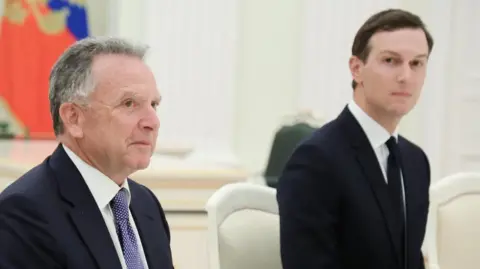
US envoy Steve Witkoff is scheduled to engage in discussions with Rustem Umerov, head of Ukraine’s national security council, in Miami on Thursday, as confirmed by the White House.
This discussion follows Witkoff’s nearly five-hour session with Russian President Vladimir Putin in Moscow on Tuesday, with the Kremlin stating that these negotiations yielded “no compromise” towards concluding the conflict in Ukraine.
US President Trump described the discussions — also involving his son-in-law, Jared Kushner — as “reasonably good,” but noted it was premature to predict outcomes, emphasizing, “it does take two to tango.”
Ukrainian Foreign Minister Andrii Sybhia demanded Russia to “cease the bloodshed” and accused Putin of “wasting global time.”
When a reporter inquired whether Witkoff and Kushner believed Putin was sincere about wanting to end the war, Trump replied: “[Putin] would like to conclude the war. That was their perception.”
Earlier on Wednesday, Zelensky indicated that a meeting of US and Ukrainian negotiators would occur “in the upcoming days”.
In a statement on X, Zelensky remarked: “Currently, the world evidently senses a genuine opportunity to resolve the war.”
However, he asserted that negotiations must be “supported by pressure on Russia”.
The US-Russia discussions in the Kremlin followed several days of US consultations with Ukrainian and European leaders, amidst concerns that the draft of a peace agreement was overly favorable to Russia’s interests.
“Some of the US recommendations seem somewhat acceptable, though they warrant further discussion,” Ushakov stated, while noting that others were openly criticized by Russia’s leader.
Although Ushakov did not provide further details, at least two significant issues remain contentious between Moscow and Kyiv – the future of areas in Ukraine seized by Russian troops and security assurances for Ukraine.
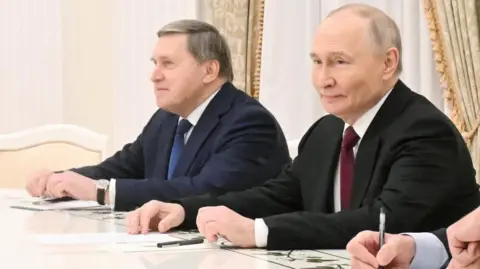
Kyiv and its European counterparts are convinced that, even if a peace agreement is reached, the most effective deterrent against future Russian aggression would be Ukraine’s accession to NATO.
Russia firmly opposes this suggestion, and Trump has repeatedly indicated that he has no plans to facilitate Kyiv’s entry into the alliance.
The possibility of Ukraine joining NATO was a “primary issue” discussed in Moscow, according to the Kremlin on Wednesday.
Ushakov, a senior advisor on foreign policy to Putin, suggested that the Russian negotiating position had gained strength due to recent battlefield achievements.
Russian forces had “influenced the assessments of our foreign partners regarding the pathways to a peace resolution in a more fitting way,” he stated.
Prior to the US visit to the Kremlin, Putin was seen in military attire at a Russian command center, receiving updates from commanders who were asserting the capture of the strategically vital city of Pokrovsk in eastern Ukraine, along with surrounding locales.
Fighting persists in Pokrovsk, and Russian troops do not have full control over the city, but officials from Russia appear to believe that their narrative of military successes is being recognized by the US.
Russian units have made modest advancements in the east and seem to have escalated operations recently. They claimed about 701 square kilometers (270 square miles) of Ukrainian land in November, as per AFP’s analysis of data from the US-based Institute for the Study of War (ISW), now holding 19.3% of Ukrainian territory.
The Kremlin stated on Wednesday that Putin is prepared to continue meetings with American representatives “as often as necessary”.
However, while Russian-American ties seem to be warming, the divide between Moscow and Europe grows.
Putin has accused Europe of undermining Russia’s relations with the US, presenting demands that Moscow cannot accept, and obstructing the peace process. Just before meeting Witkoff and Kushner, he expressed during a forum in Moscow that, while he does not seek conflict with Europe, he is “prepared for war”.
UK government representatives dismissed Putin’s assertions as “yet another round of Kremlin nonsense from a president who isn’t earnest about peace”.
NATO foreign ministers convened in Brussels on Wednesday, where Secretary-General Mark Rutte remarked that while it is encouraging that peace discussions are occurring, Ukraine needs to be positioned “as strongly as possible to maintain the struggle.”
EU member states have struck an agreement with European Parliament members to attain full independence from Russian gas by the end of 2027.
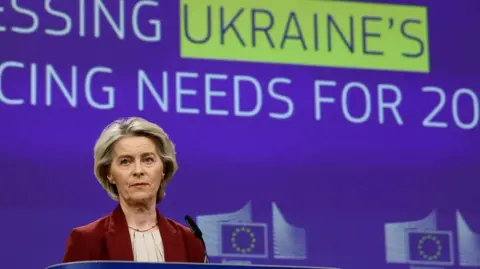
European Commission President Ursula von der Leyen celebrated “the beginning of a new era”, under a deal that prohibits long-term gas supply contracts with Russia starting September 2027 and bans long-term contracts for liquefied natural gas from January 2027.
“We have opted for energy security and autonomy for Europe. No more extortion. No more market manipulation by Putin. We stand resolutely with Ukraine,” stated EU Energy Commissioner Dan Jorgensen on Wednesday.
The Commission is also proposing to raise €90bn for Ukraine to support its military and essential services while the conflict with Russia persists.
The proposal would require Belgium to agree to a “reparations loan” using frozen Russian assets maintained in a financial institution in Brussels, or the funding would be sourced through international borrowing.
Ukrainian Prime Minister Yulia Svyrydenko has welcomed this suggestion, which would address two-thirds of Ukraine’s funding requirements for the next two years.
Belgium has been hesitant regarding the plan to utilize frozen assets within its borders, citing worries over potential legal repercussions from Moscow. The European Central Bank (ECB) has also resisted the proposal, indicating it would not support a reparations loan.
The suggested loan is lower than the initially planned €140bn, with German Foreign Minister Johann Wadephul affirming, “we endorse this and, naturally, regard Belgium’s apprehensions seriously.”
Simultaneously, in New York on Wednesday, the United States joined 90 other nations at the United Nations to call on Russia to “guarantee the immediate, safe, and unconditional return of all Ukrainian children who have been forcibly relocated or deported”, urging Moscow to cease this practice.
As per the Ukrainian government, over 19,000 Ukrainian children have been forcibly deported to Russia. The UK government estimates around 6,000 Ukrainian children have been sent to a network of “re-education camps” in Russia.
In 2023, the International Criminal Court issued an arrest warrant for Putin, partly for the unlawful deportation of minors. Putin and his administration deny these allegations.