
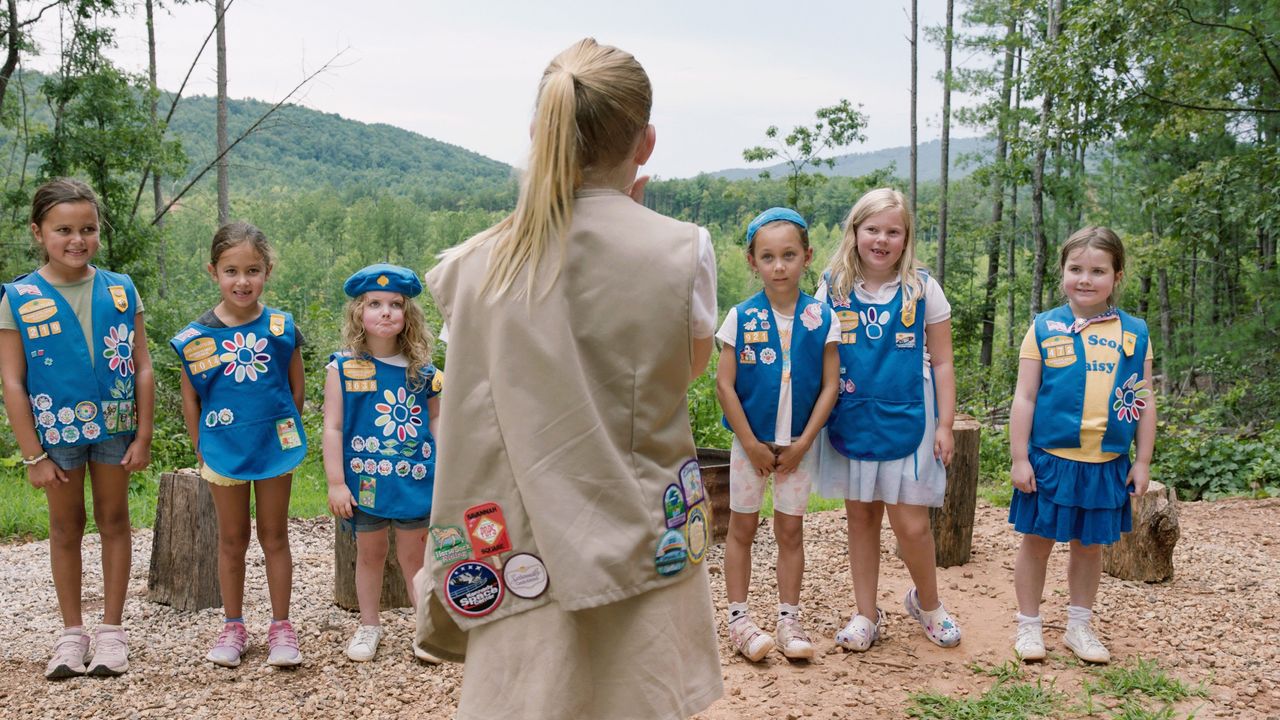

“It fluctuates by roughly 50 cents, where it’s like the more you sell, you get a little higher,” said Nahmias. Olive’s troop makes $1.10 per box but that number varies across troops. The remaining per-box cost goes towards paying for the larger organization’s bakery, staff, and facilities.
Technically, all the Scouts make as remuneration are their badges and prizes—from plushies to camps, to trips to Europe—and their troops make little more than a dollar per box, depending on each local Girl Scout Council’s guidelines. What they do with that money is decided upon by a collective decision-making process that involves the Scouts and their councils, but it usually includes community service projects, travel, and other programming.
“I have always been very aware of political issues,” Olive said. “When you think about Girl Scouts not getting enough money per box, it is a political issue.” Which is why, towards the end of the film, Olive makes a bid for fair compensation for Girl Scouts, along with having a larger say in the organization’s programming.
Troops receiving more money per box sold through the Scouts’ labor will let them “go on trips,” Olive explains by way of example. “We might be able to pay for badges and people’s membership because membership prices just got raised.” She wrote to the Girl Scout CEO, Tayuanee Dewberry, following which, the film tells us, Olive is invited to be a member of a non-voting advisory board.
Her involvement with “the board hasn’t been as successful as I had hoped,” she said, “but I will certainly keep trying to get my demands. I am still writing letters, talking to people.”
Among Olive’s more immediate ambitions is to be a delegate at the National Girl Scout Convention. Delegates have the power to vote on matters like pricing and programming. “It’s real Girl Scouts doing things, not just the adults in power, which I think is awesome,” she said.
For Nahmias, who made her filmmaking debut in 2011, Olive’s struggles are all too familiar.
“When I’m pitching my films, there is always that idea that cuteness sells. And I was interested in how early we start to get those ideas,” she says, admitting that before the film, her relationship to the Girls Scouts was minimal. “I really saw myself in the girls in a bigger way; it was never really about [scouting]. It was about girlhood and capitalism.”
Nahmias’s mother, she said, was a Girl Scout.
“She grew up in Chicago in the 1950s and ended up being the first person, not just the first woman in her big immigrant family, to go to college,” she says. “I remember her talking about Girl Scouts as one of the things she was able to do as a girl.”
Girl Scouting gave Nahmias’s mother a sense of agency. Similarly, the organization is an early training ground for developing leadership and business skills that millions of young girls, much like Olive and the film’s other protagonists, can hone through selling cookies.
It’s also a program that exposes scouts to hurdles women face in the workplace.
