
Intel’s Core Ultra laptop CPUs have led its lineup since it abandoned the older generational naming and the i3/i5/i7/i9 scheme a few years ago. The Core Ultra Series 1, Series 2, and Series 3 models have showcased the newer CPU and GPU architectures and more advanced fabrication technology.
Intel has also sold non‑Ultra Core processors, but they’ve seldom been compelling—largely because both the Series 1 and Series 2 parts were built on Intel’s older Raptor Lake architecture. Raptor Lake was the codename for the 13th‑generation Core family in 2023, and many Raptor Lake chips were essentially the same silicon used in 2022’s 12th‑generation Core lineup.
The Raptor Lake rebranding couldn’t continue indefinitely. Intel’s new, non-Ultra Core Series 3 processors are fabricated on fresh silicon, marking a return to an era when both high-end and midrange Intel parts shared many of the same improvements despite differing performance levels.
Credit:
Intel
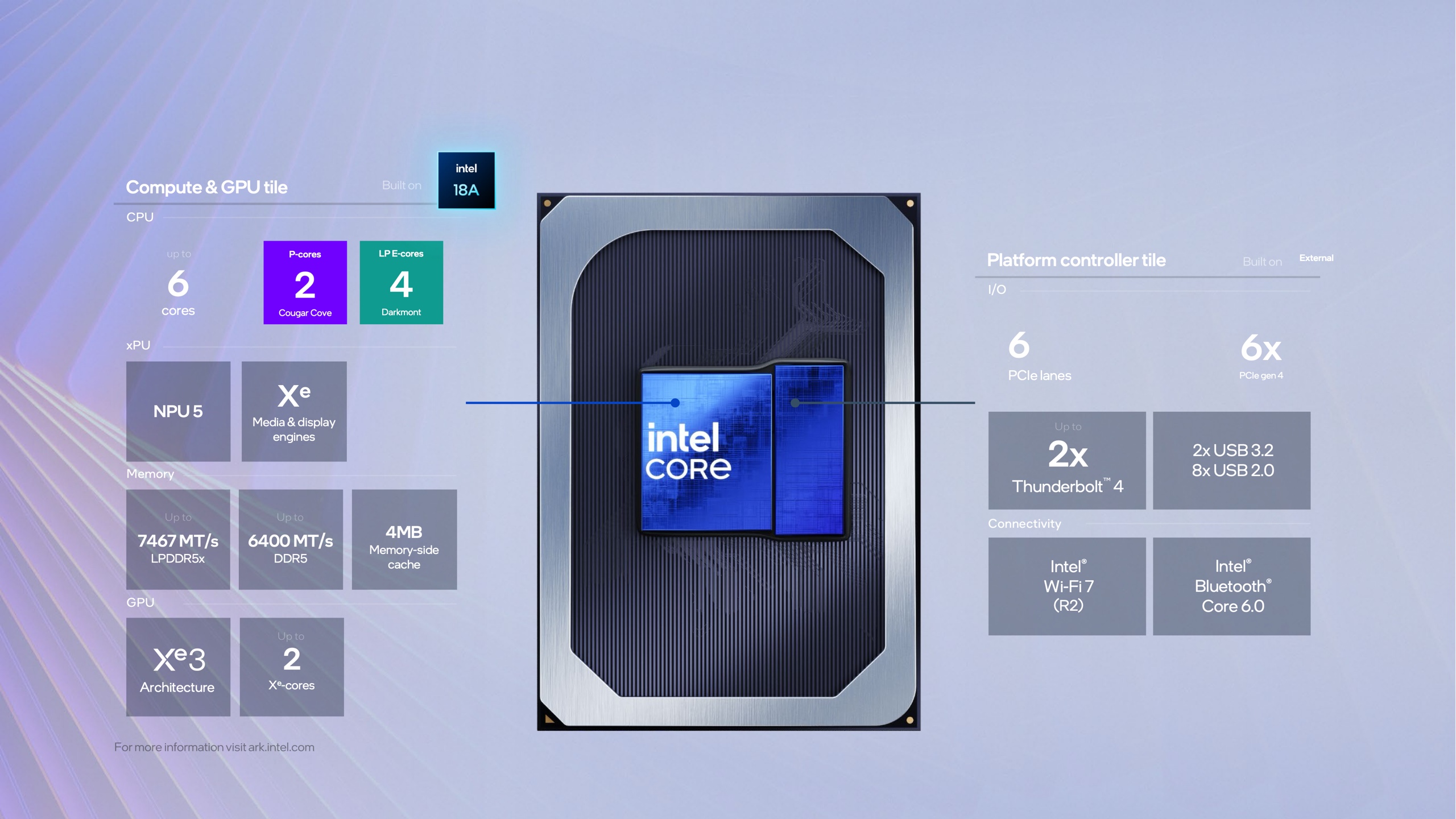
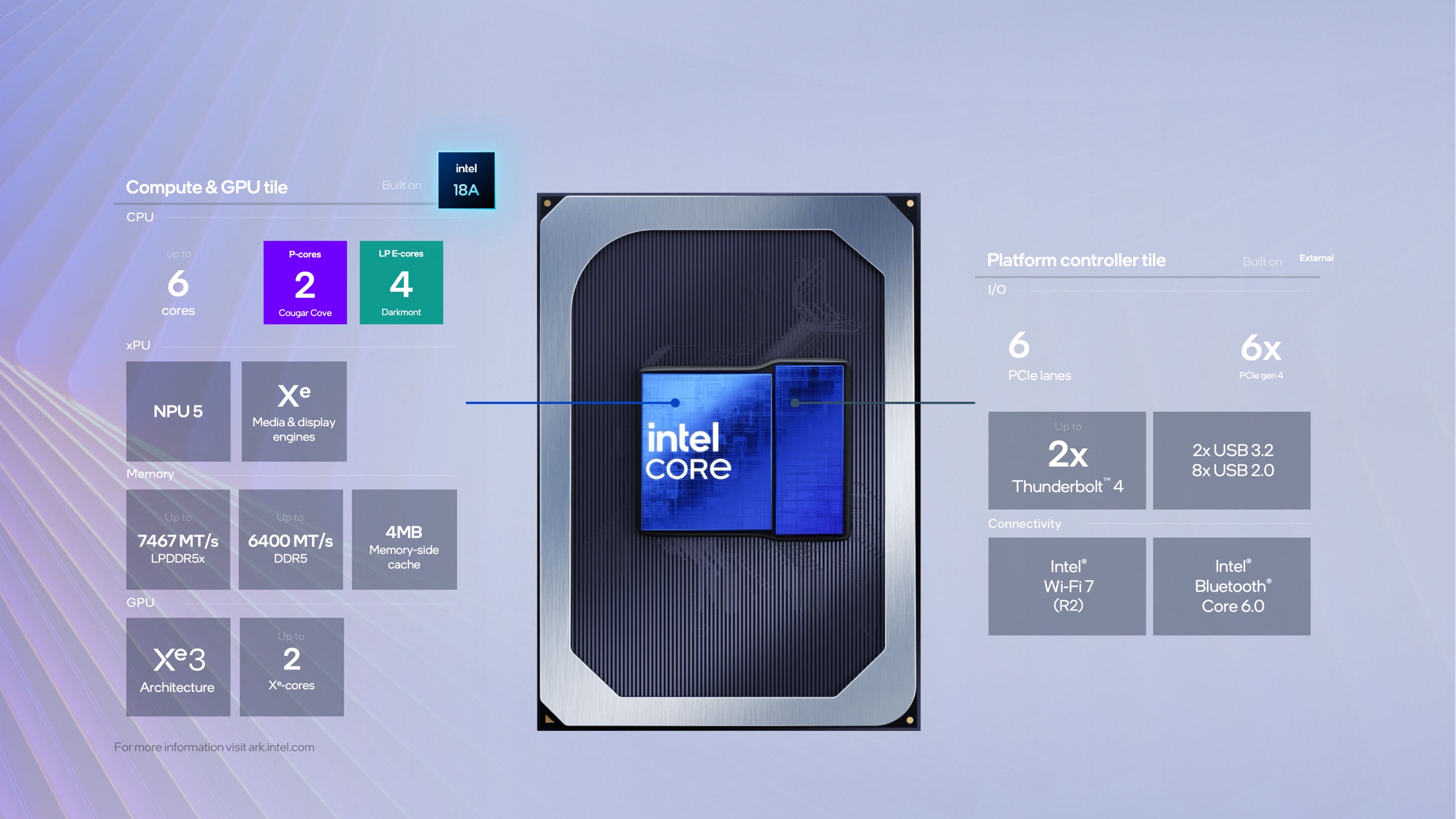
“Wildcat Lake” has some similarities to Panther Lake, but it is a more modest and simplified design.
Credit:
Intel
These chips carry the codename “Wildcat Lake,” and although they share some traits with the Core Ultra Series 3 CPUs (aka Panther Lake), the non‑Ultra parts rely on a simpler architecture with noticeably less compute capability.
Each part is built from two silicon tiles: a compute tile that contains a CPU with up to two Cougar Cove P‑cores and four Darkmont E‑cores; an integrated GPU with one or two of Intel’s latest Xe3 GPU cores; and typically an NPU rated as high as 17 trillion operations per second (TOPS). A separate platform controller tile, manufactured on an unspecified non‑Intel process, provides up to two Thunderbolt 4 ports, Wi‑Fi 7 and Bluetooth 6.0 support, and six PCIe 4.0 lanes for external connectivity. All chips support up to 48GB of LPDDR5X‑7467 or up to 64GB of DDR5‑6400, and are specified with a 15 W base power level and a 35 W maximum boost power level.
