
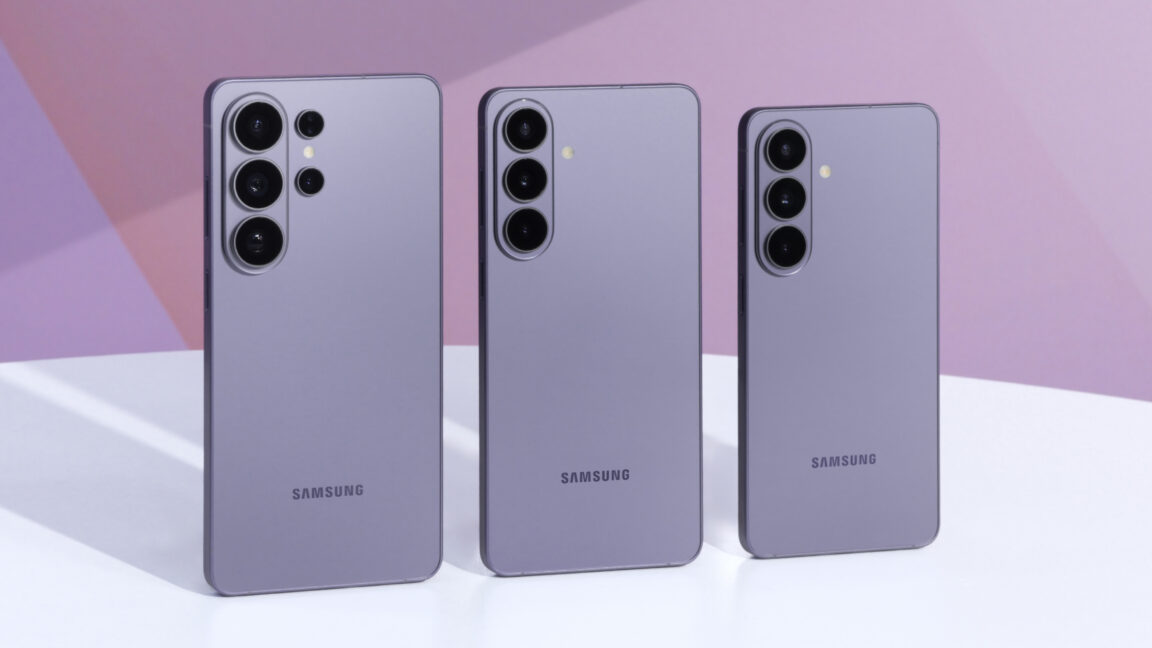
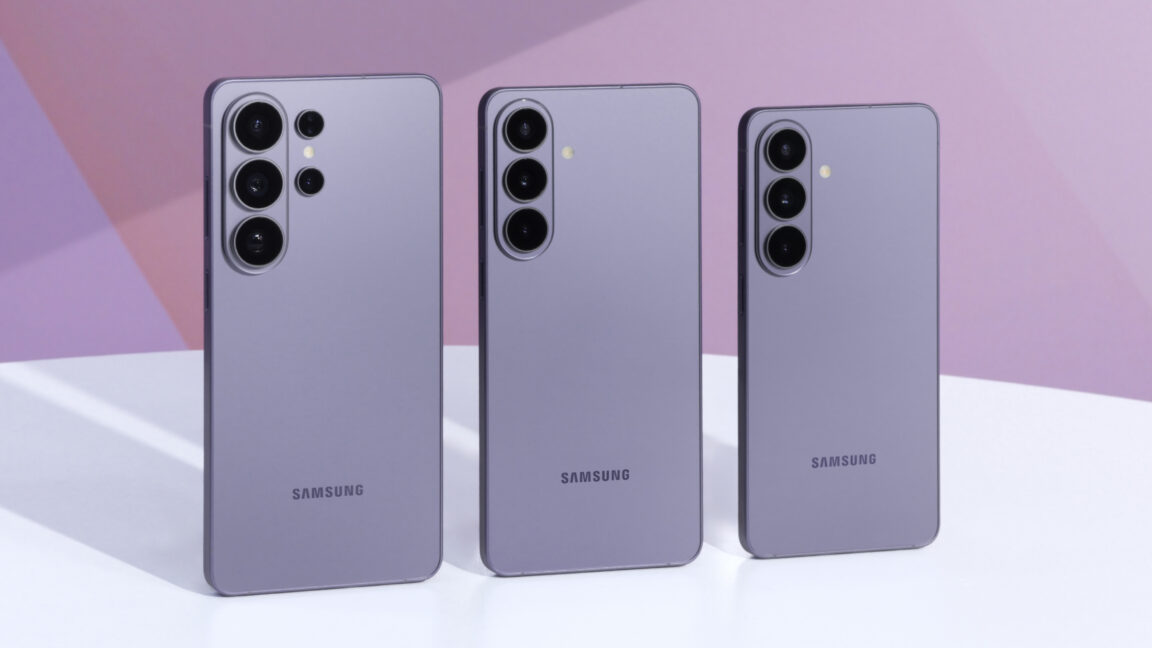
There was a time when many companies produced flagship Android handsets, but a mix of factors has whittled that list down. Today Samsung stands as the clear leader in the Android device space with its Galaxy S lineup. So it’s reasonable to conclude that today’s Unpacked introduced the Android phones most likely to dominate the coming year—the Galaxy S26 Ultra, Galaxy S26+, and Galaxy S26.
Samsung didn’t aim for a dramatic overhaul this cycle, instead offering phones with modest visual changes and upgraded internals. At the same time the company is putting more emphasis on AI, describing the S26 series as the first “Agentic AI phones.” Even with relatively small hardware changes, the reality of component costs in an AI-driven market has raised the price of the two cheaper models by $100 this year. The Ultra remains at a jaw-dropping $1,300.
Faster and more private
Viewed side-by-side with last year’s models, the Galaxy S26 family is easy to mistake for its predecessors. The camera bezel is altered and the dimensions of the smallest and largest phones are only slightly changed. You probably wouldn’t notice at a glance, but the S26 Ultra has moved from titanium back to aluminum—a similar reversal Apple made with its latest premium phones. The Ultra also continues to include the S Pen stylus.
| Key specs: Samsung Galaxy S26 series | |||
|---|---|---|---|
| Galaxy S26 ($900) | Galaxy S26+ ($1,100) | Galaxy S26 Ultra ($1,300) | |
| SoC | Snapdragon 8 Elite Gen 5 (3 nm) | Snapdragon 8 Elite Gen 5 (3 nm) | Snapdragon 8 Elite Gen 5 (3 nm) |
| Memory | 12GB | 12GB | 12GB, 16GB |
| Storage | 256GB, 512GB | 256GB, 512GB | 256GB, 512GB, 1TB |
| Display | 6.3-inch OLED, 10-bit color, 2340×1080, 1-120Hz | 6.7-inch OLED, 10-bit color, 3120×1440, 1-120Hz | 6.9-inch OLED, 10-bit color, 3120×1440, 1-120Hz, S Pen support |
| Cameras | 50MP primary, f/1.8, 1.0 μm; 12MP ultrawide, f/2.2, 1.4 μm, 10MP 3x telephoto, f/2.4, 1.0 μm; 12MP selfie, f/2.2, 1.12 μm | 50MP primary, f/1.8, 1.0 μm; 12MP ultrawide, f/2.2, 1.4 μm, 10MP 3x telephoto, f/2.4, 1.0 μm; 12MP selfie, f/2.2, 1.12 μm | 200MP primary, f/1.4, 0.6 μm; 50MP ultrawide, f/1.9, 0.7 μm; 10MP 3x telephoto, f/2.4, 1.12 μm; 50MP 5x telephoto, f/2.9, 0.7 μm; 12MP selfie, f/2.2, 1.12 μm |
| Software | Android 16 | Android 16 | Android 16 |
| Battery | 4,300 mAh | 4,900 mAh | 5,000 mAh |
| Connectivity | Wi-Fi 7, Bluetooth 5.4, USB-C 3.2, Sub6 5G | Wi-Fi 7, Bluetooth 5.4, USB-C 3.2, Sub6 and mmWave 5G | Wi-Fi 7, Bluetooth 5.4, USB-C 3.2, Sub6 and mmWave 5G |
| Measurements | 71.7×149.6×7.2 mm, 167g | 75.8×158.4×7.3 mm, 190g | 78.1×163.6×7.9 mm, 214 g |
All three models again ship with the current Snapdragon flagship processor (for North America, Japan, and China) with Samsung-specific customizations. The Snapdragon 8 Elite Gen 5 for Galaxy is built on a 3 nm process, features third-gen Oryon CPU cores, an Adreno 840 GPU, and a robust Hexagon NPU for on-device AI tasks. Samsung touts double-digit performance improvements across the lineup—claims it frequently makes each year.
Samsung’s flagship hardware is extremely fast, which shows up in benchmarks, but these phones often run hot and throttle under prolonged loads. That may be less of an issue with the S26 range: Samsung says it has installed its largest vapor chamber to date to improve thermal control.
