
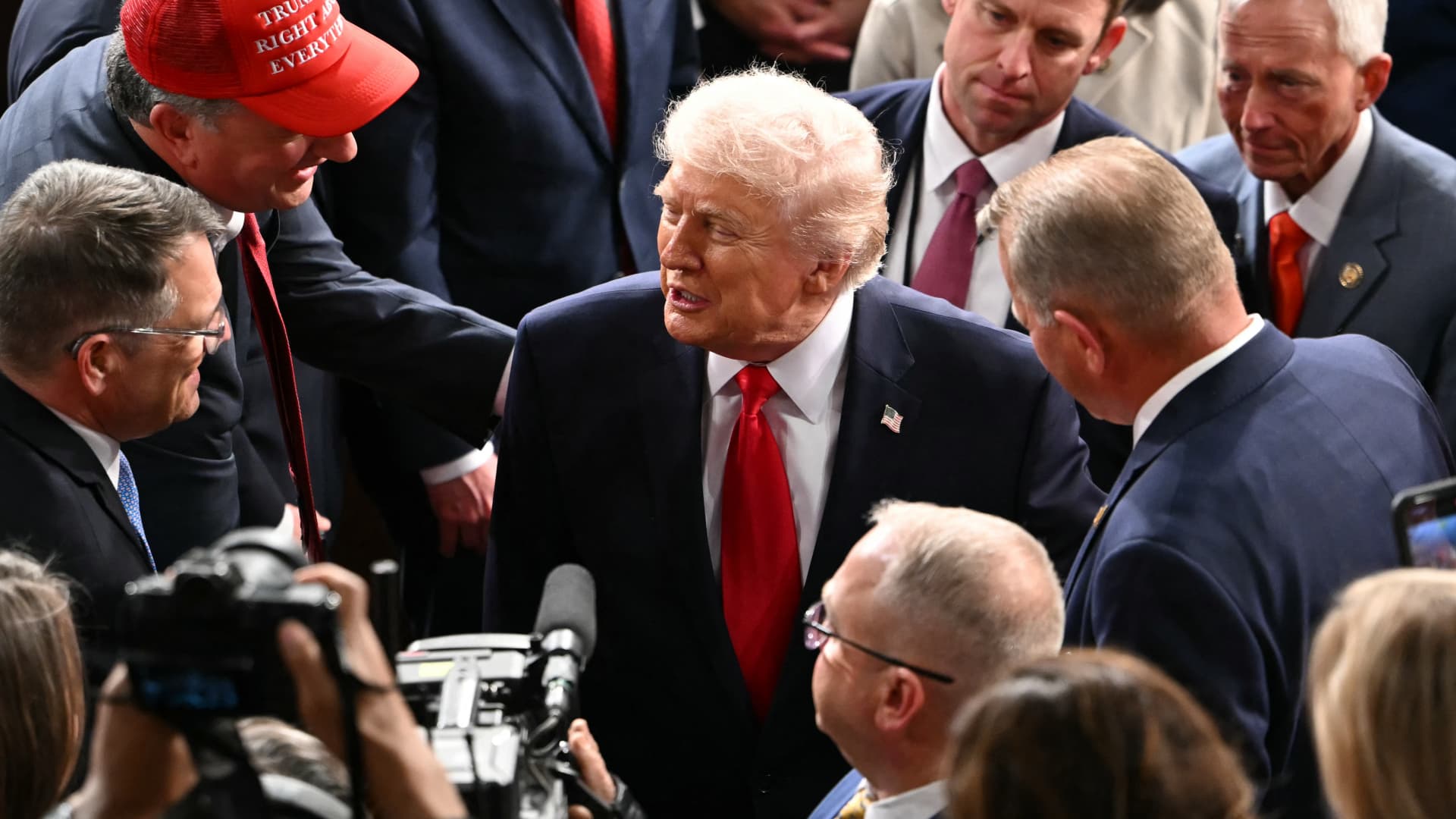

President Donald Trump presented a nearly two-hour State of the Union speech on Tuesday, placing significant emphasis on the economy, which he proclaimed was on the verge of thriving.
The president gave his hallmark annual address while observing his approval ratings on the economy decrease ahead of the 2026 midterm elections, which are less than nine months away. These elections pose a risk of transferring congressional power from Republicans and jeopardizing Trump’s influence in Washington.
Here are five key points from Trump’s State of the Union:
1. 401(k)s for everyone
Trump advocated for the establishment of a government-supported 401(k)-like initiative for U.S. employees lacking a retirement matching program from their employers.
“My administration will provide these often-overlooked American workers—wonderful individuals, the backbone of our nation—access to the same retirement plans available to every federal worker,” Trump stated. “We will match your contribution with as much as $1,000 each year.”
He mentioned that the initiative would “guarantee that all Americans benefit from a rising stock market.”
Trump and his administration have often faced criticism for highlighting stock market achievements as proof of a thriving economy, while millions of Americans remain outside the market.
A White House official, who requested anonymity to address the initiative, indicated it would provide eligible employees access to savings options resembling the Thrift Savings Plan already available to federal employees, which they explained “offers an effective savings program that includes a government match and provides diversified, index-based investment choices and portfolio options.”
The initiative would utilize an existing program referred to as the “Savers Match” tax credit established under the 2022 Secure 2.0 law, designed to provide an annual match of up to $1,000 for low-income workers beginning in 2027.
2. Trump reaffirms his request to prevent private equity from acquiring homes
The president reiterated his plea to Congress to enact laws prohibiting large institutional investors from purchasing single-family homes, requesting Congress to formalize an executive order he previously signed.
“I am urging Congress to make this restriction permanent, because homes are for people, and that’s what we truly desire,” Trump stated. “We want homes for individuals, not corporations; corporations are thriving.”
Trump’s appeal to restrict institutional buyers from acquiring homes aligns with populist proposals from the progressive left, which has criticized the president regarding affordability. Democrats unveiled another strategy earlier Tuesday to limit the capacity of larger investors to purchase homes, right before the State of the Union.
3. Trump claims the economy is thriving
Trump asserted that the economy is “booming like never before,” although polls consistently indicate a decline in voter approval of his economic management, with Democrats criticizing him and Republicans regarding affordability.
The president also took credit for what he claimed was the reduction of inflation, the bane of his predecessor and rival, former President Joe Biden.
“Inflation is sinking,” Trump declared. “In just 12 months, my administration has lowered core inflation to its lowest point in over five years.”
The consumer price index, a crucial metric for inflation, increased by 2.4% in January compared to a year prior, according to the Bureau of Labor Statistics’ latest figures. This was down from 2.7% in December and lower than anticipated. Excluding volatile food and energy, the core CPI rose by 2.5%, marking the lowest figure since April 2021.
4. Democrats exhibit some, but not significant, resistance during the address
Democrats expressed their discontent with the president during certain sections of the speech but largely refrained from overtly disrupting his statements.
Trump challenged Democrats for remaining seated when he requested lawmakers to “stand up and show your support” if they concurred that the government’s primary obligation is “to safeguard American citizens, not illegal immigrants.”
This led to a brief exchange between Trump and Representatives Ilhan Omar, D-Minn., and Rashida Tlaib, D-Mich. Omar hails from Minnesota, where two U.S. citizens were fatally shot this year by federal immigration agents executing Trump’s deportation agenda.
Representative Al Green, D-Texas, was removed from the chamber for the second consecutive year during Trump’s speech after he displayed a sign reading “Black People Aren’t Apes.” Trump’s personal social media account recently shared an overtly racist video portraying the Obamas as apes.
5. Trump primarily concentrates the address on domestic issues
Trump centered most of his speech on domestic policy and political matters, avoiding delving into his foreign endeavors.
Nevertheless, the president did briefly mention Iran, where he has initiated a substantial military buildup and hinted at a potential strike.
“We are in talks with them. They seek a deal, but we haven’t received those covert words: ‘We will never possess a nuclear weapon,'” Trump indicated regarding Iran. “I prefer to resolve this issue through diplomacy. However, one thing is sure, I will never permit the world’s leading supporter of terrorism, which they undeniably are, to attain a nuclear weapon.”
Trump’s focus on home affairs likely reflects the political landscape. Democrats have gained an early advantage in polling for the midterms and have largely won the 2025 off-year elections by concentrating on affordability and household matters.
Republicans seemed to welcome the lifeline.
“What I was hoping he’d discuss were the concerns that parents worry about when they lie down at night unable to sleep. And he did,” remarked Senator John Kennedy, R-La, following the address.
— CNBC’s Justin Papp and Eamon Javers contributed to this report.