

On Friday evening, President Donald Trump announced that he had enacted an executive order implementing a new 10% “global tariff,” mere hours after the Supreme Court dismissed his extensive “reciprocal” import duties in a significant critique of his trade policies.
According to Trump, the “Section 122” tariffs will be enacted “almost immediately,” as noted in a post on Truth Social.
These new tariffs are in addition to the levies that remain unaffected by the high court’s ruling, which nullified the tariffs Trump had instituted under the International Emergency Economic Powers Act, or IEEPA.
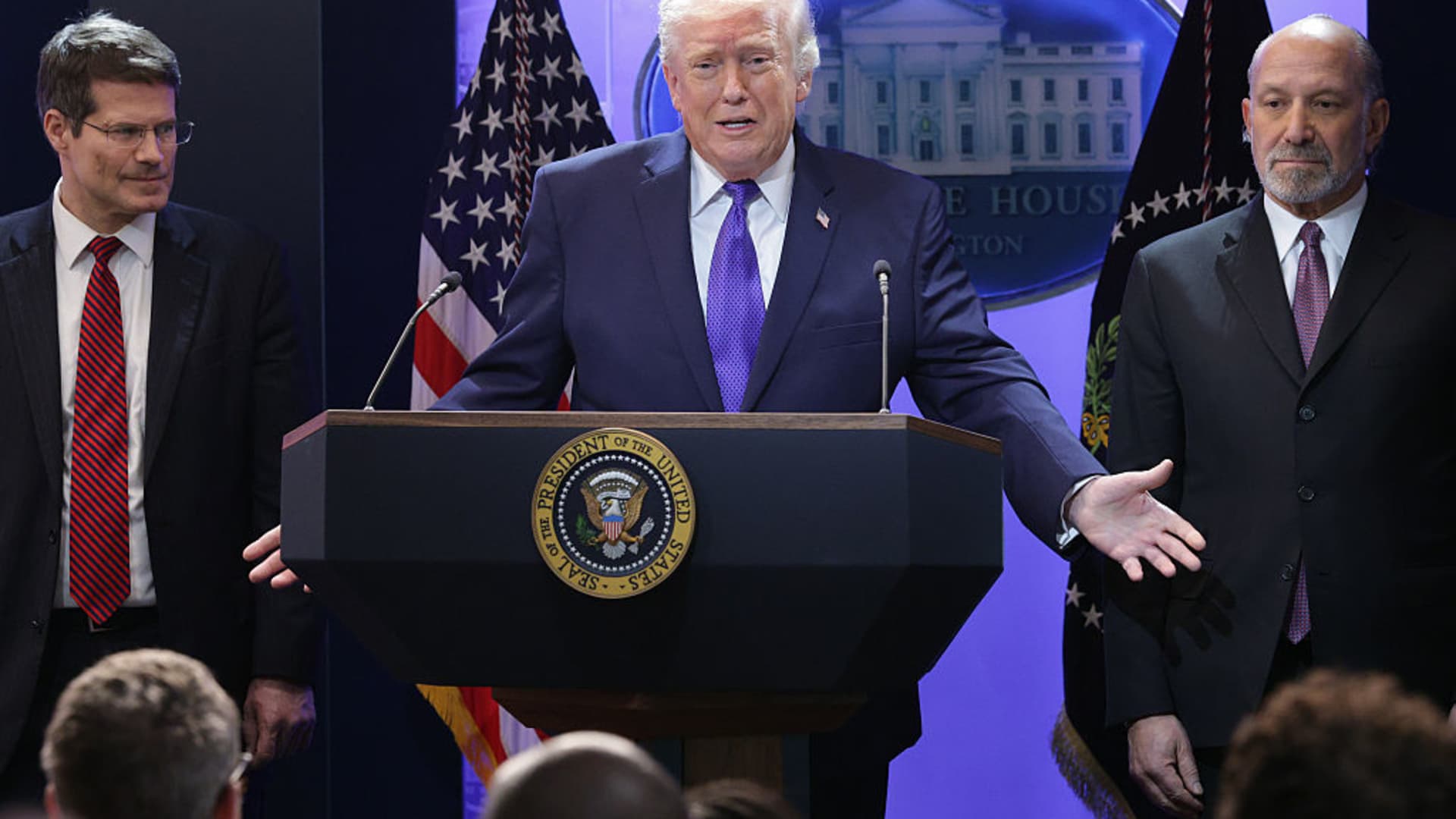
During a press briefing at the White House on Friday afternoon, Trump expressed his frustration with the “deeply disappointing” 6-3 decision.
“I feel shame for certain justices of the court, absolutely ashamed for lacking the bravery to do what’s best for our nation,” Trump remarked.
This ruling undermined the legal foundation of many tariffs that Trump has claimed are vital for the U.S. economy and for revitalizing the nation’s declining manufacturing sector.
Both Trump’s reciprocal tariffs and his drug-trafficking-related duties relied on his administration’s broad interpretation of IEEPA. Nonetheless, the court’s majority determined that IEEPA “does not permit the President to impose tariffs.”
The new 10% global tariffs, which come with a time restriction of 150 days, are set to replace the IEEPA duties, a White House representative informed CNBC later on Friday.
This development could lead to reduced U.S. tariff rates for certain countries that either established trade agreements with the Trump administration or were engaged in ongoing negotiations.
Many of these nations and regions had previously faced U.S. tariffs exceeding 10% under those arrangements. For instance, the European Union had consented to a 15% tariff as part of its trade agreement with the U.S.
These tariffs were largely enacted under IEEPA, which means they were nullified due to the Supreme Court’s decision.
The alteration could be particularly impactful for China, which had been subjected to two sets of 10% IEEPA-based U.S. tariffs in addition to a 25% duty that is still active. Trump’s new global tariff will supplant those IEEPA tariffs, resulting in a total rate of 35% for China, according to the White House representative relayed to CNBC.
Trump asserted he will seek alternative avenues for imposing tariffs without needing Congress. The White House official also indicated that while the administration explores additional legal methods for tariffs, the rates applied to specific countries might revert to their previous higher levels.
When questioned during Friday’s press conference about his reluctance to collaborate with the legislative branch, Trump stated, “I am not required to. I possess the authority to impose tariffs.”
His comments shifted between bold defiance and harsh criticism. He even took aim at Justices Neil Gorsuch and Amy Coney Barrett, both of whom he had nominated, after they sided with the majority.
“In my opinion, their decision was awful,” Trump declared. “It’s truly an embarrassment for their families, just to be honest. The two of them.”
The new tariff order cites Section 122 of the Trade Act of 1974. Tariffs established under this statute can last only for 150 days, and any extensions require the approval of Congress.
When asked at the press conference about that time limitation and the necessity of securing congressional approval, Trump replied, “We have the authority to essentially do whatever we wish.”
Furthermore, Trump stated that all tariffs presently in effect under statutes identified as Section 232 and Section 301 will continue “without interruption.”
The Trump administration is also utilizing Section 301 to initiate multiple investigations into potentially unfair trade practices, which may lead to the imposition of additional new tariffs, Trump stated.
Last year, the majority of U.S. tariff revenue stemmed from the IEEPA duties.
“Different alternatives will now be implemented to substitute the duties that the court wrongly dismissed,” Trump asserted on Friday.
“We will generate more revenue, and we will emerge significantly stronger as a result,” he expressed.
Treasury Secretary Scott Bessent, speaking at the Economic Club of Dallas shortly after Trump, confirmed that the administration plans to replace the disapproved IEEPA tariffs by utilizing several other existing tariff laws.
This approach “will yield virtually unchanged tariff revenue in 2026,” Bessent stated. “No one should anticipate a decrease in tariff revenue.”
— CNBC’s Eamon Javers contributed to this report.