
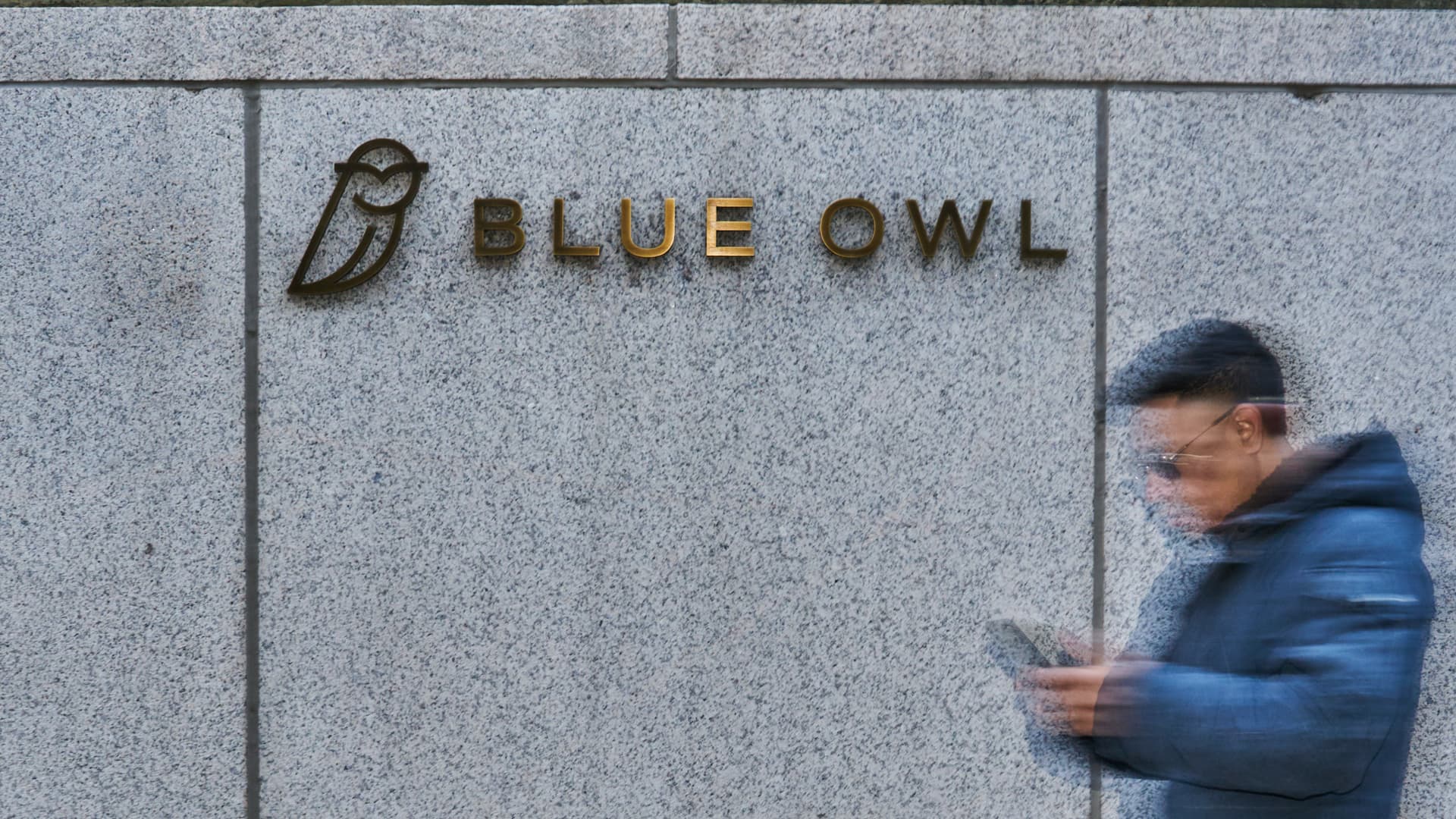

The private credit surge is encountering a fresh challenge following Blue Owl Capital’s decision to permanently limit withdrawals from one of its retail-oriented debt funds.
Shares of Blue Owl Capital dropped nearly 6% on Thursday after the private market and alternative assets manager divested $1.4 billion in loan assets from three of its private debt funds.
The largest portion of the divestment stemmed from a semi-liquid private credit fund aimed at U.S. retail investors, known as Blue Owl Capital Corporation II, which will cease offering quarterly redemption options to its investors, sparking renewed discussions about whether strain was beginning to resurface in one of Wall Street’s rapidly growing sectors.
“This acts as a warning light,” said Dan Rasmussen, founder and adviser at Verdad Capital, to CNBC. “The private markets bubble is finally starting to deflate.”
The overarching worry is that years of extremely low interest rates and narrow yield spreads have prompted lenders to take on riskier behavior, funding smaller, more leveraged companies at yields that seemed appealing in comparison to public markets, as per market analysts.
“Years of very low rates and spreads, alongside very few bankruptcies, led investors to venture further along the risk spectrum in credit,” Rasmussen remarked. “This exemplifies the classic case of ‘fool’s yield,’ where high yield fails to convert into high returns due to borrower riskiness.”
Private credit, which typically consists of direct loans issued by non-bank lenders to companies, has ballooned into a global market worth about $3 trillion.
In prosperous times, cashflows accommodate regular redemption requests. In adverse times, requests spike, leading to a scramble.Michael ShumCascade Debt
Publicly traded business development companies, or BDCs, investment entities that lend to small and mid-sized private firms, are increasingly backed by retail investors instead of institutions, as reported by Duke University’s Fuqua School of Business.
The Fuqua study, released in September, indicated that the institutional ownership of BDC shares has consistently decreased over time, dropping to around 25% on average by 2023.
“This pattern signifies that retail investors are assuming a larger role in offering equity capital to publicly traded BDCs,” the researchers noted.
In 2025, the eight largest members of the S&P BDC Index presented dividend yields that could reach 16%, with Blue Owl’s exceeding 11%. In contrast, the S&P Global’s U.S. high yield corporate bond index’s 1-year, 3-year, and 5-year returns hover around 7.7%, 9%, and 4%, respectively.
“Most of the loans in private credit funds that individual investors typically hold are high yield loans, which are inherently somewhat risky,” stated Guy LeBas, chief fixed income strategist at Janney Montgomery Scott.
“Over the cycle, one should expect some significant defaults across these funds,” he added.
Escalating risks?
Concerns regarding private credit have recently resurfaced as investors became apprehensive that AI advancements could disrupt traditional enterprise software models, a key borrower group for the sector, adding to existing worries over climbing leverage, unclear valuations, and the likelihood that isolated borrower pressure may unveil deeper systemic vulnerabilities.
The collapse of First Brands Group last September revealed risks in private credit after the heavily leveraged auto-parts maker faced challenges, illustrating how aggressively structured debts accumulated quietly during periods of easy financing.
This incident heightened concerns that similar risks might be concealed throughout the market, prompting JPMorgan CEO Jamie Dimon to caution that private credit hazards were “hiding in plain sight,” predicting that “cockroaches” will probably emerge once economic conditions worsen.
The core issue with private market transactions is the multi-year commitments that don’t align with quarterly redemption requests, according to Michael Shum, CEO of Cascade Debt, which develops infrastructure software for private credit and asset-based lenders.
“When conditions are favorable, cashflows handle standard redemption requests. When conditions deteriorate, requests soar, resulting in a race to the bottom,” he noted.
Blue Owl did not promptly reply to CNBC’s inquiry for a comment.