
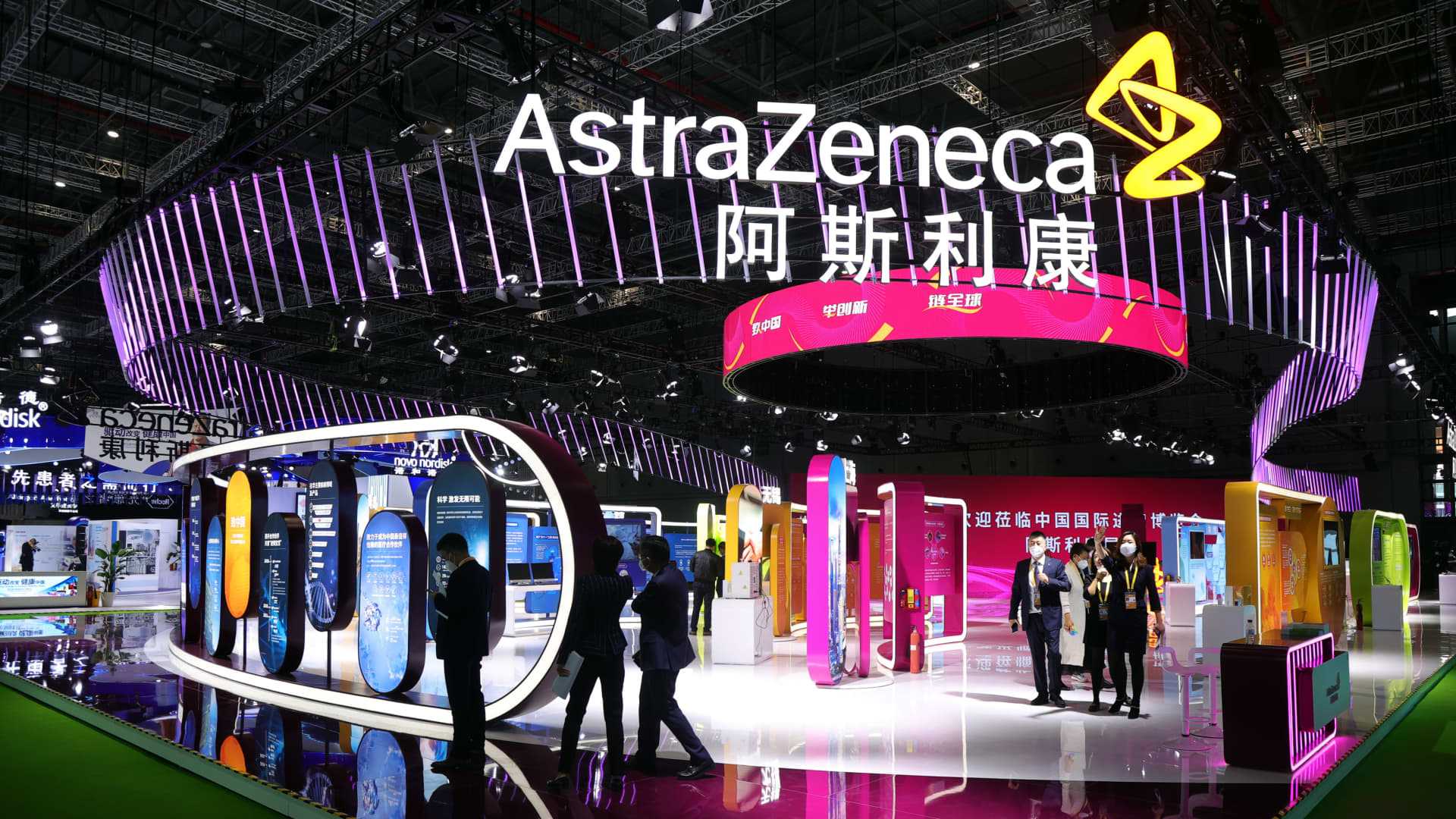

Pharmaceutical leader AstraZeneca is set to debut on the New York Stock Exchange on Monday, shortly after making significant announcements on the other side of the globe.
Similar to its peers in Big Pharma, the firm faces a balancing challenge. It desires a strong connection with the U.S., its largest market, and the listing aims to enhance investment in that region.
At the same time, innovation-driven China is drawing pharma firms that urgently seek to create new medications to substitute the blockbuster products whose patents are nearing expiration in the upcoming years. Pricing issues in the U.S. add further pressure.
AstraZeneca has declared it will invest billions in China and collaborate with a Chinese biotech on weight-loss treatments, just prior to the listing of its shares in the U.S. on Monday.
This news emerges at a pivotal moment for the pharmaceutical sector, as companies increasingly turn to the east for innovation to replace the income from existing blockbuster medications losing patent protection in the next few years. Pricing issues in the U.S. market, which represents the majority of profits for most major pharmaceutical companies, are heightening the pressure on Big Pharma.
On Thursday, AstraZeneca announced its intention to invest $15 billion in China by 2030, aiming to enhance both manufacturing and research and development, coinciding with Keir Starmer being the first UK prime minister to travel to the country in eight years.
“These investments cover the entire value chain, from drug discovery and clinical development to manufacturing, and introduce Chinese innovation to the global stage,” the company stated, while emphasizing a series of additional collaborations with biotechs in the area.
In a separate announcement on Friday, the UK’s largest firm would collaborate with Hong Kong-listed CSPC Pharmaceuticals to bolster its obesity drug portfolio. The partnership includes eight of CSPC’s preclinical and early-stage programs, which feature a once-a-month injectable. CSP’s stock dropped 10.2% following the announcement.
AstraZeneca will provide CSPC with $1.2 billion upfront and an extra $17.3 billion upon meeting specific regulatory, research, and sales targets, an AstraZeneca representative confirmed to CNBC on Friday. The company opted not to elaborate further on its geographical priorities.
The announcements arrived just ahead of AstraZeneca’s listing on the New York Stock Exchange on Monday, alongside its recently disclosed $50 billion investment in the U.S. aimed at alleviating U.S. pharmaceutical tariffs.
“What we can derive from this is that the U.S. and China will be the two critical regions for the company in the foreseeable future,” said Camilla Oxhamre, portfolio manager at Rhenman & Partners, in an email to CNBC.
AstraZeneca’s balancing act
The U.S. market is by far AstraZeneca’s largest, and the firm indicated last year that it would terminate its American depositary shares program to pursue a direct listing on the New York Stock Exchange, while retaining its listings in London and Stockholm, saying it sought a more global investor base.
“It’s the leading pharmaceutical firm [in China], and when they opt to list in the U.S., there will always be questions regarding their commitment to China, especially considering they faced several inquiries last year,” said Rajesh Kumar, head of European life sciences and healthcare equity research at HSBC, to CNBC. In 2025, AstraZeneca encountered several investigations by Chinese authorities regarding unsettled import duties.
“Thus, they are quite clearly communicating their dedication to China through this action,” Kumar added.
China also ranks as AstraZeneca’s second-largest market. Oxhamre, whose fund maintains a substantial long position in Astra, noted that the Chinese market would “continue to gain significance over time, in terms of both revenue and research.”
Moreover, Astra is not the only pharmaceutical company seeking innovative assets in China. GSK, listed in London, finalized a pact with Hengrui Pharma valued at up to $12 billion in July, largely dependent on meeting certain development and commercialization benchmarks.
China’s vibrant biotech landscape
Collaborations between Big Pharma and Chinese biotech firms, such as the one between AstraZeneca and CSPC, have surged in recent years, with 57 such collaborations recorded in 2025, according to data from Biopharma Dive.
“These collaborations illustrate the success of China’s enduring endeavor to ascend the biopharma value ladder, transitioning from fast followers to unique assets capable of competing on a global stage,” PitchBook analysts remarked in a report published last month.
Read more
China’s ascendancy as a frontrunner in preclinical and early-stage development occurs as funding for biotech in other regions has declined in recent years and is facilitated by the quick pace at which early human trials can be executed there. A reverse brain drain, where Chinese scientists are coming back home, is also bolstering the country’s biotech industry, according to Kumar.
“China’s biopharma sector has redefined itself around next-generation therapies, complemented by efficient clinical-trial frameworks to mitigate risks associated with these assets,” PitchBook analysts stated.
“Multinational and mid-cap biopharma companies are increasingly sourcing assets from China, encompassing both significant megadeals and smaller licensing agreements. Notably, this activity is leaning towards complex biologics instead of traditional modalities.”
A report from the Harvard Belfer Center for Science and International Affairs in June indicated that “China possesses the most immediate potential to outpace the United States in biotechnology” and that this could lead to a “rapid shift in the global power dynamic.”
However, late 2025 experienced a substantial increase in U.S. biotech funding.
“Innovation will continue to emerge from both regions,” Kumar remarked. “The landscape has altered… China has been catching up to the U.S., and now the U.S. will re-accelerate.”
– CNBC’s Evelyn Cheng contributed to this report