

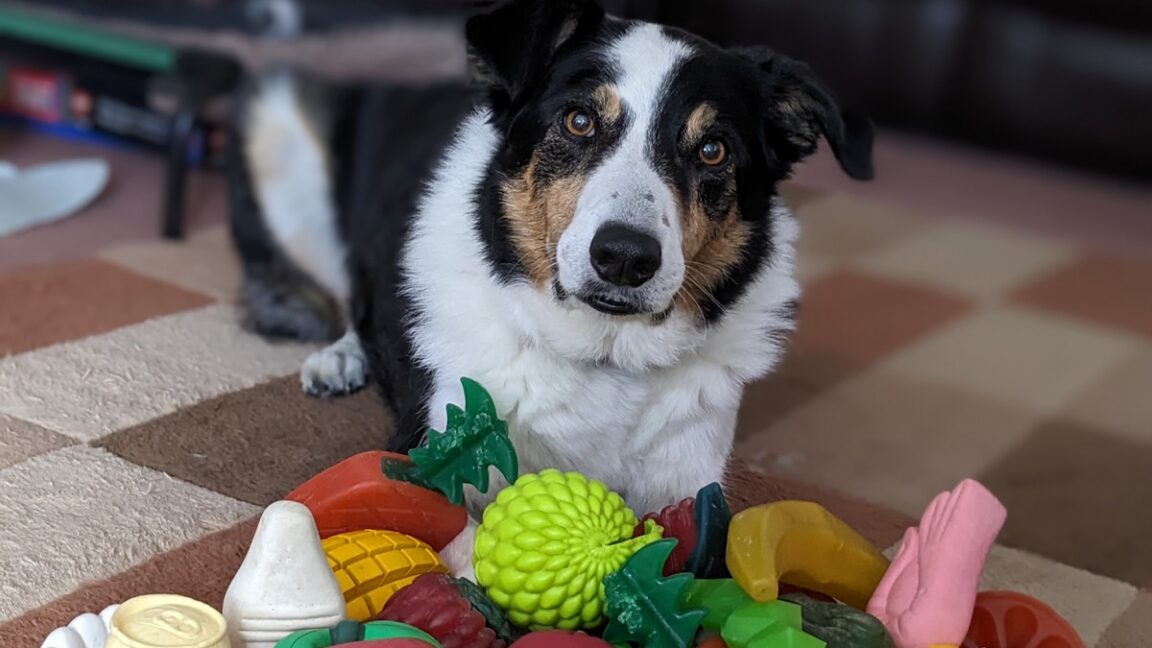
Next, the whole experiment was run again with one key change: during the training phase, instead of addressing the dogs directly when introducing new toys, the dogs merely observed as their owners named the toys while talking to another person, never being spoken to themselves.
The outcome: 80 percent of the dogs correctly selected the toys in the direct-address condition, and 100 percent did so in the overhearing condition. Altogether, the findings indicate that GWL dogs can acquire new object labels simply by overhearing interactions, whether they are active participants or passive observers—much like what is seen in children of about eighteen months.
To determine whether temporal continuity (a nonsocial factor) influences label learning in GWL dogs, the researchers implemented a third variation. The owner showed the dog a new toy, placed it into a bucket, allowed the dog to remove it, then returned it to the bucket. The owner then lifted the bucket so the dog could not see inside and repeatedly used the toy’s name in a sentence while alternating gaze between the dog and the bucket. This was followed by the standard testing phase. The authors concluded that temporal continuity was not required for forming object–label mappings. When the same dogs were retested two weeks later, those mappings remained intact; the dogs remembered.
However, GWL dogs are extremely rare, and the results did not generalize to typical dogs, as the team found when they ran both versions of the experiment with 10 non-GWL border collies. There was no evidence of genuine learning in these typical dogs; the authors suggest their behavior reflects a canine preference for novelty in toy choice rather than the ability to form object–label associations.
“Our results indicate that the socio-cognitive processes enabling word learning from overheard speech are not uniquely human,” said co-author Shany Dror of ELTE and VetMedUni universities. “Under the right conditions, some dogs show behaviors strikingly similar to those of young children. These dogs offer an exceptional model for probing cognitive abilities that helped humans develop language. But we are not claiming that all dogs learn in this way—far from it.”
Science, 2025. DOI: 10.1126/science.adq5474 (About DOIs).