
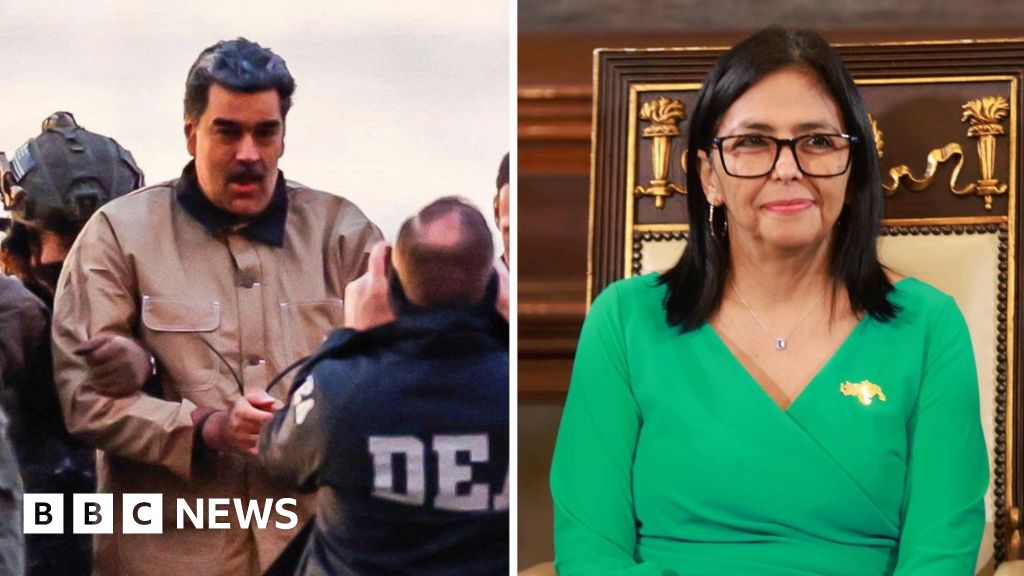
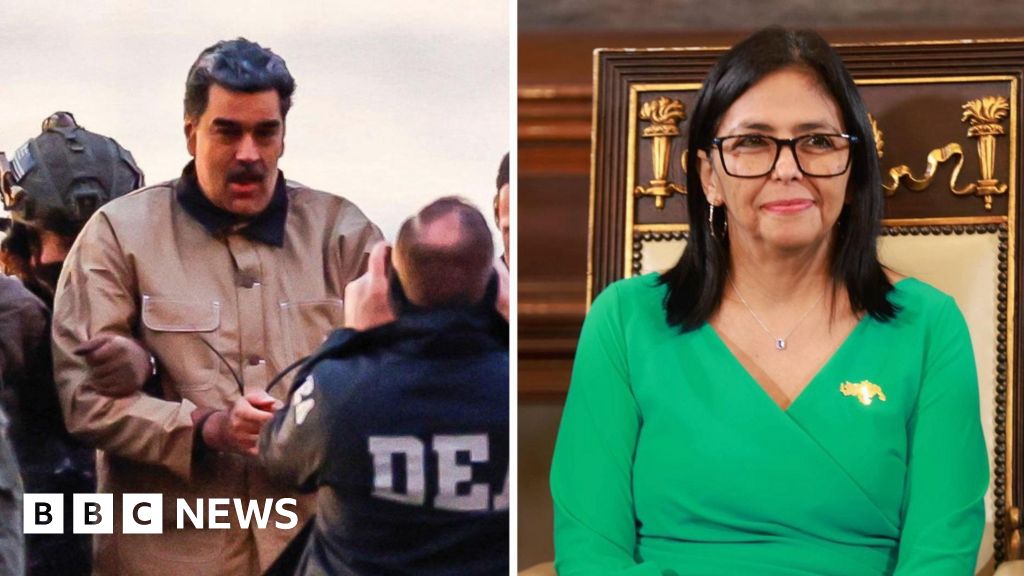
Delcy Rodríguez assumed her role as Venezuela’s interim president during a parliamentary session that commenced with calls for the release of ousted leader Nicolás Maduro from US detention.
Rodríguez, aged 56 and vice president since 2018, expressed her sorrow over what she termed the “abduction” of Maduro and his spouse, Cilia Flores, who were taken by US forces in a nighttime operation on Saturday.
In a tense moment in a New York courtroom two hours prior, Maduro asserted his position as the still-valid president of Venezuela, entering a plea of not guilty to four charges related to drug trafficking and terrorism.
Meanwhile, the US encountered significant backlash at the UN, but the US ambassador asserted that the world’s largest energy reserves should not be managed by an illegitimate leader, referring to him as a “fugitive from justice”.
Prior to the court session, the UN Security Council convened an emergency assembly to deliberate on the Venezuelan crisis.
Venezuelan ambassador Samuel Moncada indicated that his nation was subject to an “unlawful armed attack with no legal grounds”.
The US envoy to the UN, Mike Waltz, rationalized the invasion by labeling Maduro an “illegitimate alleged president”.
Waltz further noted that the US conducted a “targeted law enforcement action” to detain Maduro, whom he classified as a “fugitive from justice”.
Maduro faces allegations of conspiracy in narco-terrorism, conspiracy in cocaine trafficking, possession of automatic weapons and explosive devices, and conspiracy related to these items.
During the court proceeding on Monday afternoon, a member of the audience began shouting in Spanish to Maduro that he would “pay” for his actions.
Maduro responded, stating he was a “kidnapped president” and “prisoner of war” before being led out in handcuffs along with his spouse through the back exit of the courtroom.
“I am an upright man. I am still the president of my nation,” Maduro asserted earlier in the 30-minute session.
Judge Alvin Hellerstein, at the age of 92, interrupted to inform Maduro that there would be an appropriate “time and place to address all of this”.
Hours after the assault on Saturday—during which over 150 aircraft and 200 US personnel entered Venezuelan airspace—Trump declared that the US would “manage” Venezuela until a “safe, proper, and judicious transition” could occur.
Later on Monday, following a two-and-a-half-hour confidential briefing at the US Capitol, Senate Minority Leader Chuck Schumer described the US strategy for governing Venezuela as “vague, based on unrealistic hopes, and unfulfilling”.
“I did not receive any commitments that we won’t attempt to implement similar actions in other nations,” he remarked.
“When the United States engages in such regime change and so-called nation-building endeavors, it ultimately undermines the United States.”
House Speaker Mike Johnson refuted the notion that the US was orchestrating a regime change, insisting it was “a demand for a change in behavior from a regime”.
Referring to the operation as “decisive and warranted”, he affirmed that the US has “consistently held the right to utilize force to safeguard our national interests, ensure the safety of the American populace, and avert continuing threats to its security”.
“We possess means of influence,” Johnson remarked, “as their oil exports have been confiscated, and I believe this will lead the nation towards new governance in a very short timeframe.”
Trump has also pledged that US oil companies would enter the nation to repair infrastructure “and begin generating revenue for the nation”.
However, despite the assertions made by the US president, Maduro’s supporters remain in control.
In remarks to The Atlantic magazine on Sunday, once it became evident that Rodríguez would take her oath, Trump cautioned that she could “face severe consequences, possibly greater than Maduro” if she “fails to act correctly”.
During a cabinet meeting, Rodríguez indicated her administration would be open to some collaboration with the US, stating: “We extend an invitation to the US government to collaborate with us on a cooperative agenda focused on shared development within the framework of international law.”
Numerous Venezuelans congregated outside the Federal Legislative Palace to express solidarity with Maduro, his spouse, and interim president Rodríguez during her swearing-in ceremony.
Following her oath, Rodríguez informed the National Assembly that she did so “with sorrow” due to the hardship caused by “illegitimate military aggression”.
She pledged to ensure the nation’s peace, “the spiritual calm of our citizens, and the economic and social stability of our populace”.
The assembly also heard from Maduro’s son, who expressed his backing for his parents, asserting that they “will return” to Venezuela.
He also extended his “unconditional support” to Rodríguez.
The next court session regarding Maduro’s case is set for 17 March.
