

I feel awful … I’ve left the kids at home and Seiffen, affectionately known as Spielzeugdorf (The Toy Village), is truly a festive paradise. Every street is aglow with shimmering fairy lights and gentle candle illumination. Countless tiny wooden figures, train sets, and toy creatures adorn shop windows, along with wooden pyramids towering above doorways and vibrant nutcracker figures. Dismiss those elves up north; this is the authentic Santa’s workshop. For centuries, this village of Seiffen has been home to wood turners and carvers who have crafted traditional wooden Christmas toys, distributing them globally.
Located close to the Czech Republic border, Seiffen is famously referred to in the German-speaking realm as the “home of Christmas,” yet it has largely been overlooked by English-speaking holiday visitors. Nestled within the Ore Mountains, roughly an hour and a half’s drive south of Dresden, accessing it via public transport isn’t straightforward – the nearest train station lies in Olbernhau, nearly 7 miles (11 km) away. Though buses are an option, we choose to rent a car and head into the hills, arriving right after the first snowfall of the year. The roads are promptly cleared, but the snow clings to the spruce tree branches, and while we half-expect to encounter the Gruffalo’s child, we only catch sight of a rust-colored fox navigating a fresh blanket of snow.
The nearby forests that we drive through are vital for Seiffen’s sustainability. (Our visit stems from a recommendation by a kind German forester who insisted it was a must-visit.) The Ore Mountains – or Erzgebirge in German – were designated a UNESCO World Heritage site in 2019 due to their extensive mining heritage. For eight centuries, the region was molded by intense silver and tin extraction (and eventually uranium).
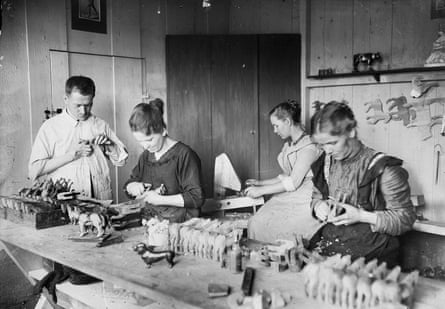
Established in the 1300s just beneath the mountain ridge, Seiffen is enveloped by spruce, pine, and beech forests. Mining and forestry have always gone hand in hand. Timber was crucial for creating pit props to support mine ceilings and for tool production. Consequently, when the tin supply diminished and miners had to seek alternative livelihoods, they turned to the timber readily available around them, adapted their machinery, and first crafted wooden bowls and spoons before venturing into what would earn them renown – toys. One artisan showcased his toys at a nearby Christmas market and returned home with pockets full of coins, leading to a flourishing legacy. Families throughout the village started producing small animals and figurines in their homes, with everyone contributing to the carving and painting process.
With a town aglow with twinkling lights and inviting shops, it’s challenging to know where to begin, but visiting the toy museum (Erzgebirgisches Spielzeugmuseum, €9) seems reasonable. Since its inception in 1936, it narrates the saga of Seiffen’s toy-making customs. The brief video is suggested as it provides the only information available in English. Despite the language hurdle, the 5,000 exhibits – from nutcrackers to train sets, Noah’s arks to tiny matchbook carvings (including the “smallest kitchen in the world”) – will, if you have a penchant for such things, captivate you for hours. There are also traditional wooden toys available for little ones (or adults) to engage with. Even today, Seiffen maintains its toy-making legacy and proudly hosted the European Toy Maker festival earlier this year.
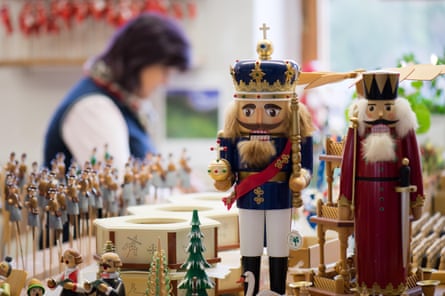
To witness the toy-making process firsthand, we proceed to the Seiffener Volkskunst workshop for the toy-decorating activity we’ve scheduled. We stroll through the store, captivated by the tiny figures and moving candle wheels, and continue past the viewing area where wood-turners and toy-painters are at work. The art of wood turning here is truly remarkable. In the 1800s, artisans developed a technique called hoop-turning, where a specially designed lathe shapes a piece of wood into a thick ring with distinctive notches and grooves. Once sliced, the figure of the animal or toy is revealed. This method allowed for the mass production of figurines, contributing to Seiffen’s economic prosperity throughout the 19th century. Presently, only a handful of individuals globally still employ this technique.
For our decorations, I select a festive-looking toadstool to paint, while my partner opts for a charming duck; we also choose a forest house to build with the kids. Our small ornaments are crafted from local birch, beech, maple, and linden wood. We sit alongside skilled toy painters, who are busy decorating nutcrackers and snowmen, and a sense of slow mindfulness envelops us.
One decoration that particularly captivates me is the candle arch, or schwibbogen. These elegantly designed pieces celebrate the village’s history, often showcasing the local church above and miners at work below. Heritage holds great significance in Seiffen, and each year, as the advent season begins, a miners’ parade takes place featuring costumes reminiscent of those worn 400 years ago.
Next, with our decorations safely packed, we stroll through the village streets and discover that each shop possesses its unique style and character. Some toymakers specialize in nutcrackers, while others focus on angels or Räuchermänner, incense-burning figures. The more contemporary artisans’ shops, like Wendt & Kühn, are intriguing to explore, boasting elegantly adorned spaces, though the prices of the toys reflect this charm. In fact, even in the modest establishments, one could easily shell out hundreds of euros, with some pyramids exceeding €2,000.
After enjoying a delightful bowl of leek soup called Heidi (€7.80) at Hotel Seiffener Hof, we head to the church, known for its unusual octagonal shape, which appears in many of the arches and decorations sold here, and take a moment to listen to the organ’s music.
As the Christmas season draws near, the sun sets early, prompting us to sample a shot of heisse holunderbeere, hot elderberry mixed with vodka and topped with whipped cream to warm ourselves. We then grab two cups of red glühwein for a walk up the hill leading to the historic miners’ trail. The snow up here remains untouched, crunching beneath our feet as we advance toward the Binge, formerly the opencast site for tin extraction, now an amphitheater for the community. The white wooden benches arranged in a semi-circle seem to be the only noise we hear today, accompanied only by the gentle sound of melting snow.
We press on up the steps onto the hill composed of leftover mining waste. It’s now home to thriving birch trees, and we gaze down over the valley as the lights in the houses begin to flicker on.
As the cold intensifies, we savor rostbratwurst (grilled sausage) from a street vendor and enjoy another mulled wine outside the central Hotel Erbgericht Buntes Haus. It’s quite chilly now. The shops are closing, and the paths are freezing over, prompting us to start our ascent back to the hotel, pausing occasionally to admire the twinkling lights below. We are greeted at the Panorama Berghotel Wettiner Höhe (rooms from €79), where we cozy in for the night, thoroughly prepared for the festive season to come.