
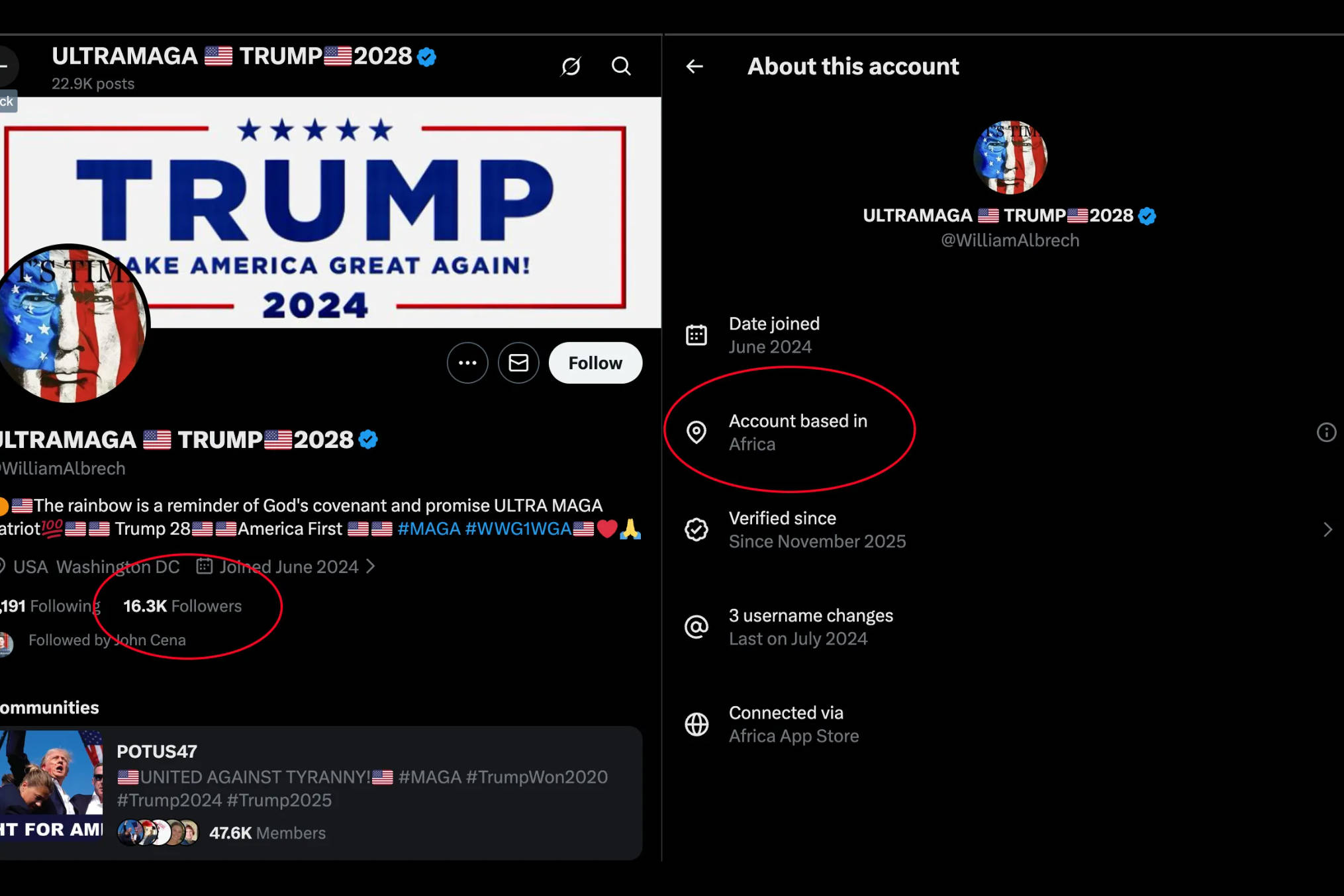

It has long been established that X (and Twitter previously) serves as a significant platform for foreign influence efforts aiming to interfere in American politics. Much attention has been directed towards Russian troll farms, which the US government has targeted on numerous occasions. However, the introduction of X’s About This Account feature may have unveiled the extent and geographical diversity of its foreign troll issue.
Shortly after the feature was launched, users began to observe that many inflammatory accounts targeting US politics were seemingly operating from outside the US. Accounts with names like ULTRAMAGA🇺🇸TRUMP🇺🇸2028 were discovered to be based in Nigeria. A confirmed account impersonating border czar Tom Homan was linked to Eastern Europe. And America_First0? Reportedly from Bangladesh. A whole network of “Trump-supporting independent women” purporting to be from America was actually situated in Thailand.
Threads rapidly began to emerge, compiling all the pro-MAGA trolls that asserted to be American, but were truly foreign agents from various parts of the world. Some right-wing figures wasted no time in leveraging the evidence that various left-wing X users were also not who they professed to be. Before long, X was inundated with individuals exposing the seemingly infinite array of fake and troll accounts intent on igniting political strife.
Soon after the feature’s launch, X eliminated the information regarding the locations of account creation. Additionally, disclaimers were added to the locations of accounts, indicating that travel, VPNs, and proxies could result in misleading information. While this might hold true for certain accounts, it is highly improbable to be applicable to the majority of those under scrutiny.
Some of these troll accounts are likely part of state-sponsored influence strategies. Foreign nations like Russia and China have a vested interest in instigating discord within the American political landscape. Nevertheless, it’s also plausible that many are motivated by financial rewards. While earnings from monetization on X can be minimal by Western estimations, they can be transformative in developing countries.