
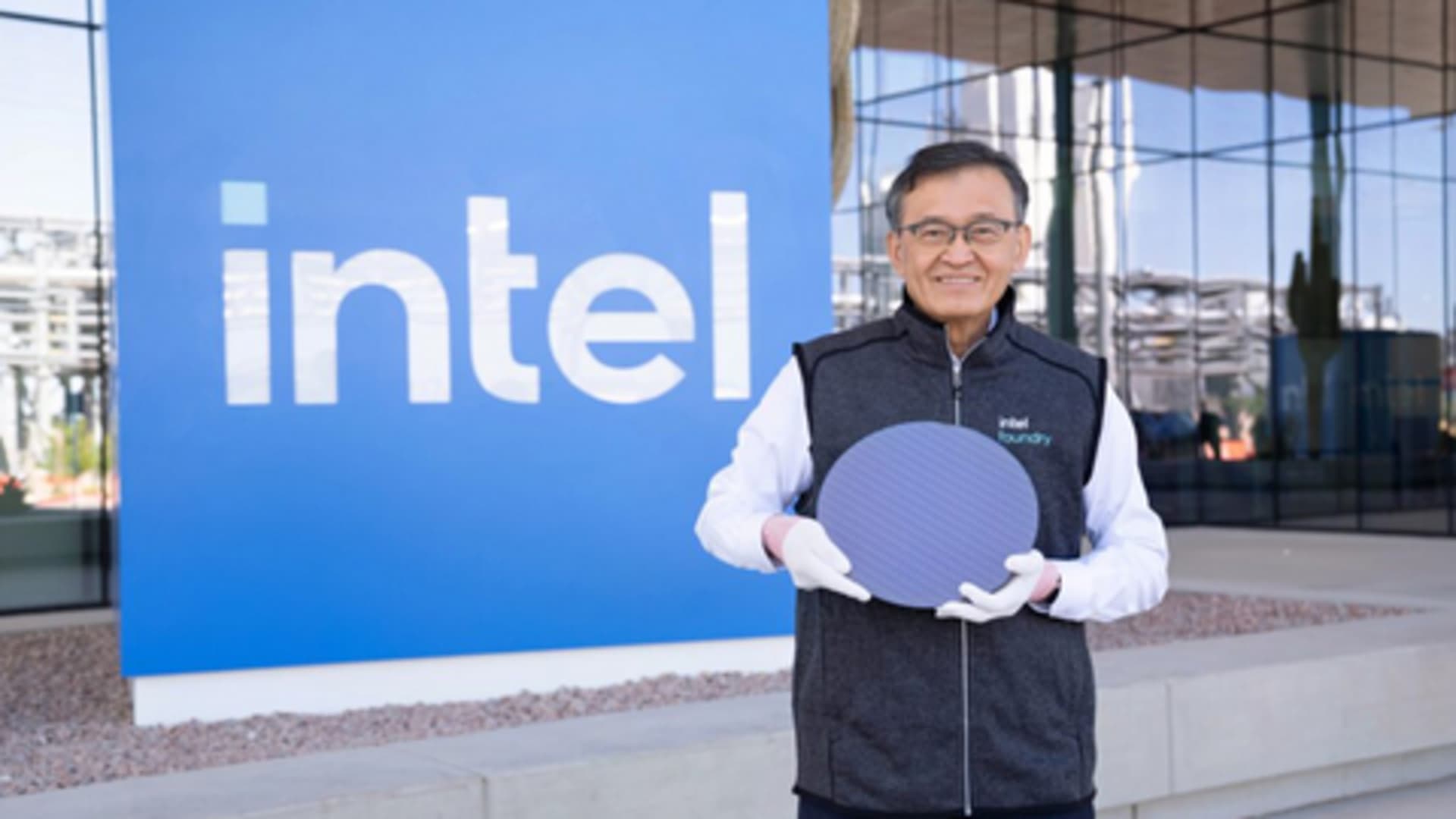

Intel disclosed its first-quarter earnings on Thursday, surpassing Wall Street’s forecasts, showcasing signs of a turnaround for the beleaguered chipmaker.
Shares of the American chipmaker soared by 20% in after-hours trading.
Here’s a comparison of the company’s performance against analysts’ estimates gathered by LSEG:
- Adjusted earnings per share: 29 cents versus an expected 1 cent
- Revenue: $13.58 billion compared to the projected $12.42 billion
Intel has recently emerged as a favorite on Wall Street, with its stock soaring more than 80% this year as of Thursday’s close, after a remarkable 84% rise in 2025. The Trump administration has supported the chipmaker by making the U.S. government its largest shareholder last year, aiming to bring chip production back to the U.S. Nvidia and SoftBank have also invested heavily in Intel.
However, the company struggled against competitors Nvidia and Advanced Micro Devices during the early phase of the AI boom, lacking substantial momentum.
This trend appears to be shifting. Revenue rose by 7.2% from $12.67 billion year-over-year. This comes after experiencing revenue declines in five of the last seven quarters.
Intel indicated that it anticipates second-quarter revenue between $13.8 billion and $14.8 billion, with adjusted earnings per share projected at 20 cents. This is significantly higher than analyst forecasts, which estimated revenue of $13.07 billion and EPS of 9 cents.
The data center segment witnessed the strongest growth for Intel, as it begins gaining traction in AI, fueled by a surge in demand for central processing units (CPUs). Revenue in this area rose 22% to $5.1 billion.
The once-quiet CPU market has surged as workloads shift beyond Nvidia’s dominant graphics processing units (GPUs) in AI. This rising demand for CPUs has supported Intel’s recent $14 billion acquisition of a 49% stake in its Ireland chip facility that it had previously sold to Apollo Global Management.
“The CPU is reasserting itself as the essential foundation of the AI era,” declared Intel CEO Lip-Bu Tan during the earnings call. “This isn’t merely our optimistic perspective; it’s what we are hearing from our clients.”
Intel continues to operate at a loss. The company reported a widening net loss of $4.28 billion, or 73 cents per share, up from $887 million, or 19 cents per share a year ago.
Intel’s approach to chip production is distinctive. As an integrated device manufacturer, Intel produces its own products while also fabricating the silicon that powers them. In contrast, most chipmakers delegate the intricate and pricey manufacturing process to major fabrication plants operated by Taiwan Semiconductor Manufacturing Company.
Intel’s foundry revenue climbed 16% from a year ago to $5.4 billion, although much of this foundry business comprises producing its own chips.
Intel’s Core Ultra Series 3 processors began shipping in PCs in January, while its latest Xeon 6+ data center processors were released in March. Shortly thereafter, Google pledged to utilize multiple generations of Intel CPUs to manage AI workloads in its data centers.
The latest Intel processors for PCs and data centers are manufactured on the 18A process node at a colossal new facility in Arizona. Presently, Intel is the sole major client of its 18A chip fabs, even though it is technologically akin to TSMC’s 2-nanometer node.
The real challenge will be persuading long-time TSMC clients to transition.
Intel is in the process of recovering from years of delays on prior nodes, and some 18A wafers experienced defects, resulting in a diminished number of usable chips per wafer, commonly referred to as yield.
Some analysts await signs of promising yields from Intel’s next-generation 14A technology, anticipated for 2028 or later. After earlier signaling that Intel would delay moving forward with the costs of ramping up the new technology until a significant customer emerged, Tan stated on X in January that Intel is “going all in on 14A.”
On the earnings call, Tan mentioned that “multiple clients” are currently “evaluating the technology,” and that its development is progressing at a quicker rate than what was observed with the 18A technology.
A potential major customer could be Elon Musk, although specifics remain unclear. Intel announced earlier this month its collaboration with Musk’s Terafab chip complex in Austin, Texas, to assist in “designing, fabricating, and packaging ultra-high-performance chips at scale” for SpaceX, xAI, and Tesla.
During Tesla’s first-quarter earnings call on Wednesday, Musk indicated that Tesla intends to leverage Intel’s upcoming 14A process for chip production at the facility, which aims to manufacture chips for Tesla’s vehicles and robots, as well as future orbital data centers for SpaceX.
Musk noted that 14A is still under development by Intel but, “by the time Terafab scales up, 14A will likely be quite mature or ready for prime time.”
On Intel’s call, Tan expressed that “Elon and I share a firm belief that the global semiconductor supply is not keeping up with the swift rise in demand,” adding that together they are “exploring unconventional methods to enhance manufacturing efficiency.”
Intel’s renewed emphasis on producing chips for others began when Pat Gelsinger became CEO in 2021. Gelsinger was ousted in 2024 and replaced by Tan in early 2022.
Intel cut 15% of its workforce in July and shelved chip fabrication projects in Germany and Poland. In Ohio, the launch of Intel’s massive new chip facility has been postponed to 2030, shifting from initial plans for production to start this year. Tan noted in a memo during the layoffs that, “In recent years, the company invested excessively, too quickly – without sufficient demand.”
The latest projections may appear strong due to another aspect of the chip-making process where Intel excels: advanced packaging. This involves connecting individual chip dies to a comprehensive system. Intel stands as one of just three global companies that offer the most sophisticated form of packaging, creating a fresh bottleneck in the race to produce enough chips for AI.
CFO David Zinsner informed CNBC that he is confident advanced packaging will yield billions of dollars per customer, after previously estimating significantly lower figures in the hundreds of millions. Intel’s advanced packaging clients include Amazon, Cisco, and the recent commitment from SpaceX and Tesla.
—CNBC’s Kristina Partsinevelos contributed to this report.
WATCH: Nvidia secures capacity for a critical component of AI chip production