
Saleem Ali, an environmental systems scientist at the University of Delaware who also advises the United Nations on critical metals, argues that deep-sea mining should be included in conversations about the green transition. He coauthored a 2022 analysis, funded by The Metals Company, that compared waste from land-based mines with that from seabed resources. (Ali states he has never received direct funding from The Metals Company.) For instance, the paper examined how terrestrial mine tailings affect water quality and local biodiversity, and considered expected pollution from nodule extraction, such as seabed sediment stirred into the water column by harvesting equipment. It finds that both terrestrial and deep-sea mining will impact biodiversity, but suggests deep-sea mining could generate less waste and pose fewer community risks than land-based mining. The authors caution, however, that their findings are constrained by “substantial uncertainty” about the effects of sediment plumes.
Ali also notes that the International Seabed Authority has been gathering data for at least three decades, which he believes should be enough to craft rules and regulations for seabed mining even if long-term impacts remain unclear and it is uncertain whether environmental outcomes would be better or worse than those from terrestrial mining.
“I’m not saying that we should go ahead with it. I’m saying that it deserves to be considered in this broad context of very difficult choices we have to make,” he says.
But critics pushing for moratoriums or bans point out that the same study cited by The Metals Company as showing rapid recovery ultimately drew more cautious conclusions from its full dataset. “The effects of polymetallic nodule mining are likely to be long term,” the authors wrote, and their analyses “show considerable negative biological effects of seafloor nodule mining, even at the small scale of test mining experiments.” Scientists worry that deep-sea species, adapted to a dark, quiet, and sparsely populated environment, will struggle with mining-related noise and light. These organisms could also be exposed to toxic metals and sediment plumes that disrupt feeding and respiration. The Metals Company did not reply to multiple requests for comment.
Credit:
ROV TEAM / GEOMAR (CC-BY 4.0)
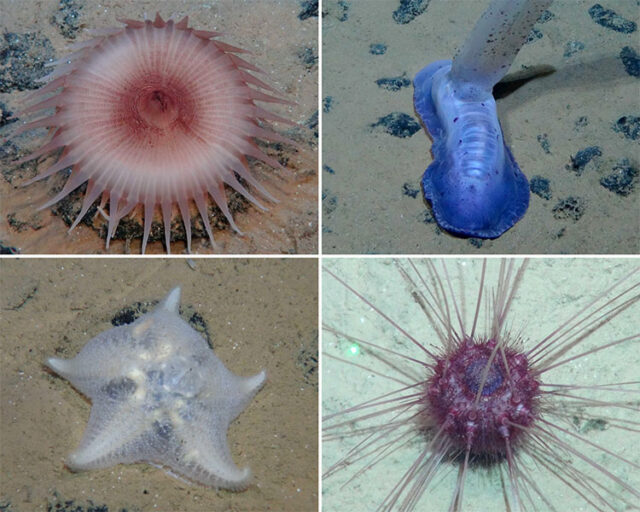
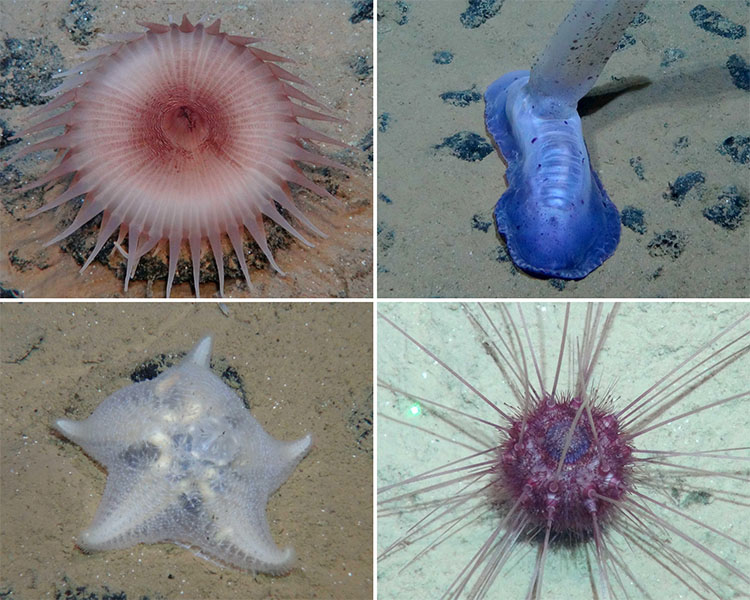
The seafloor of Clarion-Clipperton Zone hosts a variety of animals, some visible here: an anemone (top left), a sea cucumber, Psychropotes longicauda (top right), a sea urchin Plesiodiadema sp (bottom right), and a starfish (bottom left). Because the biology and ecology of these depths are still poorly known, predicting the ecological consequences of deep-sea mining is difficult.
Credit:
ROV TEAM / GEOMAR (CC-BY 4.0)
Given these uncertainties, mining regulations should not be hurried, says Anna Metaxas, a deep-sea ecologist at Dalhousie University in Canada who coauthored a 2025 review of the possible impacts of mining on the deep-ocean ecosystem in the Annual Review of Environment and Resources. Metaxas is active in the Deep-Ocean Stewardship Initiative, an international nonprofit network of specialists that advises on deep-sea policy and governance. She notes that she previously led a project bringing together experts in terrestrial and deep-sea mining to create a framework for comparing environmental impacts across land and seabed mining. Yet in 2024, she and her coauthors found that current data remain too limited to make those comparisons.
“Our knowledge gaps are really large,” concurs Matthias Haeckel, a marine biogeochemist at the GEOMAR Helmholtz Centre for Ocean Research in Kiel, Germany. He is among 30 researchers and technical specialists appointed by the International Seabed Authority in 2024 to establish values for monitoring and evaluating mining impacts. The team examined issues such as toxicity from heavy metals, turbidity from sediment disturbed by harvesting machines, and underwater noise and light pollution. They are expected to deliver an initial draft of standards and guidelines later this year.
Seeking answers—and soon
The International Seabed Authority Council—its executive arm—met in Jamaica in early March and will meet again in July to discuss, and possibly approve, mining regulations. The Metals Company is still awaiting U.S. approval to begin commercial operations in the Clarion-Clipperton Zone. It says it expects to obtain a permit by year’s end and to commence mining soon after.
In the meantime, scientists such as Haeckel are rushing to organize more research cruises to collect essential data that will guide choices about seabed mining and the mining code. Haeckel leads a European project called MiningImpact that will revisit research sites later this year where, in 2021, it monitored parts of the mining tests conducted by Global Sea Mineral Resources, a subsidiary of the Belgian firm DEME. The third phase of MiningImpact aims to assess ecosystem condition five years on and to deepen knowledge of abyssal ecology.
“The Clarion-Clipperton Zone is a large area, and there are still many, many open questions,” Haeckel says. He questions how mining in the region could be effectively regulated when scientists still lack basic knowledge of the species that inhabit those depths and how they interact.
