
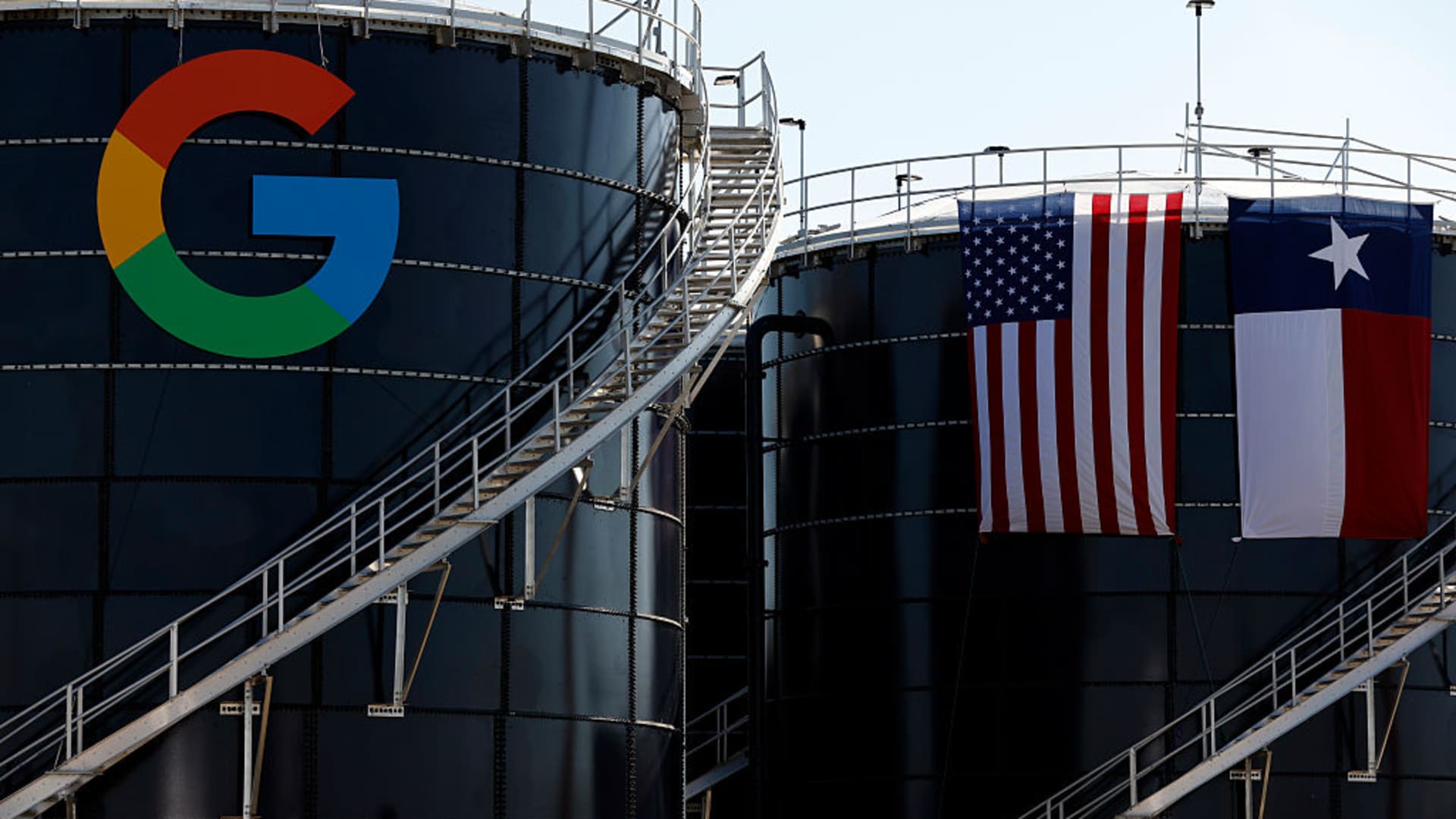

Alphabet, Microsoft, Meta and Amazon are anticipated to invest nearly $700 billion collectively this year for their AI advancements.
For cash-loving investors, some caution lights might be illuminating.
As the central tech earnings season concludes this week, Wall Street gains a clearer understanding of how the race for artificial intelligence is set to gain momentum in 2026. The four hyperscalers are now expected to boost capital investments by over 60% from the unprecedented levels seen in 2025, as they stockpile pricey chips, construct new colossal facilities, and acquire the networking technologies to integrate everything.
Achieving these figures will necessitate compromises in terms of free cash flow. Last year, the four largest U.S. internet firms generated a combined $200 billion in free cash flow, a decline from $237 billion in 2024.
The more significant decline seems imminent as companies heavily invest upfront, anticipating future ROI. This translates to margin pressures, decreased cash generation in the short term, and possibly needing to further access equity and debt markets. Alphabet conducted a $25 billion bond issuance in November, and its long-term debt ballooned to $46.5 billion in 2025.
Amazon, which indicated on Thursday that it expects a $200 billion expenditure this year, is now projecting negative free cash flow of nearly $17 billion in 2026, as per Morgan Stanley analysts, while Bank of America analysts estimate a shortfall of $28 billion. In a filing with the SEC on Friday, Amazon informed investors it may pursue equity and debt financing as its expansion continues.
Despite exceeding revenue expectations for the quarter, Amazon’s stock declined nearly 6% on Friday, marking a 9% decrease for the year. Microsoft has dropped 17%, the steepest in the group, while Alphabet and Meta have seen slight increases.
While Amazon outlined the most ambitious spending strategy among the megacaps, Alphabet is not far behind. The company is focusing on its cloud infrastructure as well as its Gemini models, envisioning up to $185 billion in capex this year. Morgan Stanley managing director Brian Nowak informed CNBC’s “Power Lunch” that he’s forecasting even greater expenditures in the forthcoming years, with Alphabet potentially spending up to $250 billion in 2027.
Pivotal Research predicts a staggering nearly 90% drop in Alphabet’s free cash flow this year to $8.2 billion from $73.3 billion in 2025. Mizuho analysts noted in a report that investors with a bearish outlook might interpret the potential doubling of capex this year as “leaving limited FCF in 2026 with uncertain” returns on investment.
Nonetheless, the analysts remain optimistic, keeping their buy ratings on the corresponding stocks. Longbow Asset Management CEO Jake Dollarhide is aligned with their views. He considers Amazon as his largest investment, with Alphabet in fourth place and Microsoft in ninth.
“If you’re going to invest all this money into AI, it will decrease your free cash flow,” Dollarhide remarked. “Do they need to reach out to the debt markets or seek short-term financing for the ideal balance of equity and debt? Absolutely. That’s the reason CEOs and CFOs earn their salaries.”
‘Somewhat surprising’
Barclays analysts now project a nearly 90% fall in Meta’s free cash flow, following the social media giant’s announcement last week that capex for this year could reach $135 billion. They maintained their overweight rating despite forecasting an even grimmer cash outlook for the next two years.
“We are now predicting negative FCF for ’27 and ’28, which is quite startling to us but likely what we will eventually observe for all firms in the AI infrastructure battle,” the analysts stated in a note after the earnings report.
When Meta’s CFO Susan Li was queried during the earnings call about capital allocation and the company’s future buyback intentions, she stated that prioritizing investment in AI is “the highest order priority.”
At Microsoft, where capital expenditures are rising but at a slower pace compared to its technology counterparts, Barclays anticipates a 28% reduction in free cash flow this year before rebounding in 2027.
Representatives from Alphabet, Amazon, Microsoft, and Meta chose not to comment.
A significant advantage that the tech sector’s top-valued companies have over emerging AI competitors like OpenAI and Anthropic is their substantial cash reserves accumulated in recent years. By the end of the last quarter, the four leaders held a combined total of over $420 billion in cash and equivalents.
Analysts from Deutsche Bank remarked in a Thursday report about Alphabet, stating that the company’s infrastructure expansion is generating a “significant moat.” This view is widely shared among industry leaders and experts who regard AI as a generational prospect with revenues likely reaching trillions.
Currently, businesses are testing and creating new AI agents for various tasks, including developing applications with mere text prompts. All these advancements demand considerable computing power, which cloud providers assert is resulting in insatiable demand for their solutions.
“Considering what’s transpiring in business and enterprise — they are all building upon these AI giants Google, Meta, Amazon,” Futurum Group CEO Daniel Newman told CNBC in an interview. “These are fundamental technologies.”
Morgan Stanley’s Nowak mentioned that Alphabet is “noticing significant signals regarding return when considering Google Cloud, Google search, and YouTube.” Moreover, Amazon CEO Andy Jassy stated during his company’s earnings call that growth at Amazon Web Services has been “the fastest we’ve encountered in 13 quarters.”
However, numerous uncertainties persist, and some skeptics express concerns that a failing at OpenAI, which has announced over $1.4 trillion in AI agreements, could trigger a market contagion since a significant portion of the AI industry’s growth momentum is linked to the ChatGPT developer.
“The reality is, we are on the cusp of a new technological transition, and it is quite challenging to ascertain the sustainability of top-line growth,” stated Michael Nathanson, co-founder of the equity research firm MoffettNathanson, during a CNBC interview. “We are entering uncharted waters, and forecasting top-line results has become markedly more complicated. There’s a plethora of unexpected developments occurring.”
— CNBC’s Deirdre Bosa, Jordan Novet, Annie Palmer, and Jonathan Vanian contributed to this article.
WATCH: Megacap tech stocks plunge as AI spending surpasses revenue growth