
This article was first published in The Algorithm, our weekly newsletter focused on AI. To receive stories like this directly in your inbox, sign up here.
I made the decision to attend CES quite spontaneously. During the holiday season, I received numerous messages from contacts in China about their travel arrangements. After the umpteenth inquiry of “Are we meeting in Vegas?” I finally said yes. As a tech writer covering China and based in the US, I have one week each year where my entire field of interest converges without the need for a 20-hour flight.
CES, or the Consumer Electronics Show, is the largest technology expo in the world, where firms unveil new devices and share innovations, taking place every January. This year’s event drew over 148,000 participants and more than 4,100 exhibitors. It spans the Las Vegas Convention Center, the largest exhibition venue in the city, and extends into neighboring hotels.
China has consistently had a presence at CES, but this year, it made a significant impact. Chinese exhibitors made up almost a quarter of the total companies present, and in sectors like AI hardware and robotics, China’s representation felt particularly strong. On the exhibition floor, I observed numerous Chinese industry representatives milling about, along with a notable contingent of Chinese venture capitalists. Several seasoned CES attendees mentioned this is the first post-covid CES where China’s presence is unmistakable. While the previous year might have been leaning in that direction as well, many Chinese participants reportedly faced visa rejections. Now, AI serves as the universal rationale and motivation for the trip.
As anticipated, AI emerged as the dominant theme this year, evident on every booth wall. It’s the primary topic of conversation and also a highly perplexing marketing ploy. “We integrated AI” is plastered on everything from the sensible (PCs, phones, TVs, security systems) to the absurd (slippers, hairdryers, bed frames).
Consumer AI devices still seem to be in their infancy and vary greatly in quality. The most prevalent categories are educational tools and emotional support toys—which, as I’ve mentioned lately, are all the rage in China. Some standouts include: Luka AI, which produces a robotic panda that scurries around and watches over your baby. Fuzozo, a cute keychain-sized AI robot, functions as a digital pet in a tangible form. It is equipped with a built-in personality and responds to how you interact with it. The companies behind these products merely hope you won’t dwell on the privacy issues involved.
Investor Ian Goh from 01.VC stated that China’s manufacturing prowess provides it with a distinctive advantage in AI consumer electronics, as many Western companies feel they simply cannot compete in the hardware domain.
Another field where Chinese firms appear to lead is in household electronics. The products they create are becoming increasingly advanced. Home robots, 360-degree cameras, security systems, drones, lawn maintenance machines, pool heating systems … Were you aware that two Chinese brands essentially control the home cleaning robot market in the US, significantly outpacing Dyson and Shark? Did you know that nearly all the suburban yard technology available in the West originates from Shenzhen, despite the fact that such a backyard-centric lifestyle is hardly present in China? This technology is so polished that you wouldn’t recognize it as Chinese unless you actively sought it out. The old stereotype of being “cheap and repetitive” doesn’t capture what I witnessed. I left CES feeling the need for a significant upgrade in my home appliances.
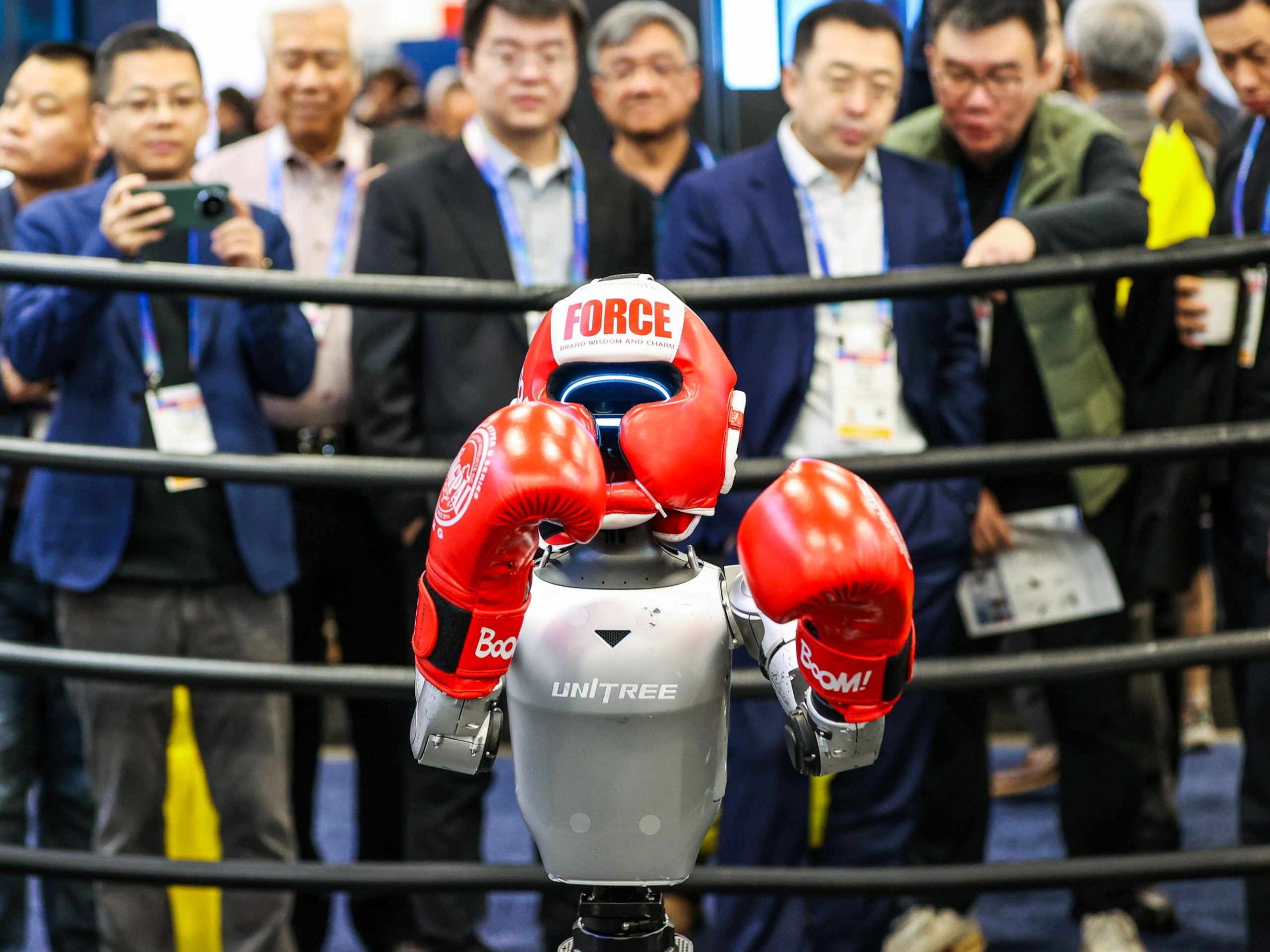
Of course, appliances represent a secure, established market. On the more interactive side, humanoid robots attracted massive crowds, and Chinese firms put on quite a display. Every robot seemed to be dancing, showcasing styles from Michael Jackson to K-pop to traditional lion dancing, some even executing backflips. Unitree, based in Hangzhou, even created a boxing ring where visitors could “challenge” its robots. These robot contenders were about half the size of an adult human and the matches frequently concluded with a robot being knocked out, but that wasn’t really the main focus. What Unitree was genuinely demonstrating was its robots’ stability and balance: they were pushed, stumbled across the ring, and managed to remain standing, recovering mid-action. In addition to demonstrating dynamic movements like these, there were also impressive displays of finesse: Robots were seen folding paper pinwheels, doing laundry, playing the piano, and even crafting latte art.

However, the majority of these robots, even the more advanced ones, tend to be specialized. They are tailored for a specific function on the exhibit floor. I attempted to get one to fold a T-shirt after I had flipped the article around, and it quickly became bewildered.
Still, they’re generating considerable excitement as a promising next frontier since they could facilitate moving AI from text interfaces into the tangible world. As LLMs evolve, vision-language models seem to be the logical subsequent phase. But then you face the significant issue: There is significantly less data from the physical world compared to text data to train AI models. Humanoid robots serve as both applications and mobile data-gathering devices. China is uniquely placed here due to its supply chains, manufacturing capabilities, and benefits from related industries (such as EVs, batteries, motors, sensors), and it is already forming an industry focused on training humanoid robots, as reported by Rest of World recently.
Many Chinese firms believe that the ability to manufacture at scale enables innovation, and they are not mistaken. Much of the confidence in China’s fledgling humanoid robot sector and further advancements rests less on a singular breakthrough and more on the notion of “We can iterate faster than the West.”
Chinese companies are not merely offering gadgets, though—they’re developing every layer of the technology stack. This includes not just end products but also frameworks, tools, IoT enablement, spatial data. The culture of open-source seems deeply rooted; engineers from Hangzhou inform me that AI hackathons occur weekly in the city, which is home to China’s new “little Silicon Valley.”
In fact, the headline innovations at CES 2026 were not centered on devices but rather in cloud technology: platforms, ecosystems, enterprise implementations, and “hybrid AI” (cloud + on-device) solutions. Lenovo hosted the most talked-about main-stage events this year, and while there were PCs, the main narrative focused on its cross-device AI agent system, Qira, along with a collaborative offering with Nvidia targeting AI cloud service providers. Nvidia’s CEO, Jensen Huang, introduced Vera Rubin, a new data center platform, asserting it would significantly reduce costs related to AI training and operation. AMD’s CEO, Lisa Su, presented Helios, another data center system designed to handle large AI workloads. These innovations highlight the expansion of AI computational demands in data centers, pointing to the true competition of making cloud services affordable and efficient enough to keep pace.
As I engaged with attendees linked to China, the overall sentiment I perceived was one of cautious optimism. At a gathering I attended, VCs and founders from China mingled seamlessly with Bay Area transplants. Everyone was in the process of building something. Almost nobody aims to merely profit from Chinese consumers anymore. The new norm is: Build in China, market to the world, and consider the US market as the testing ground.
