
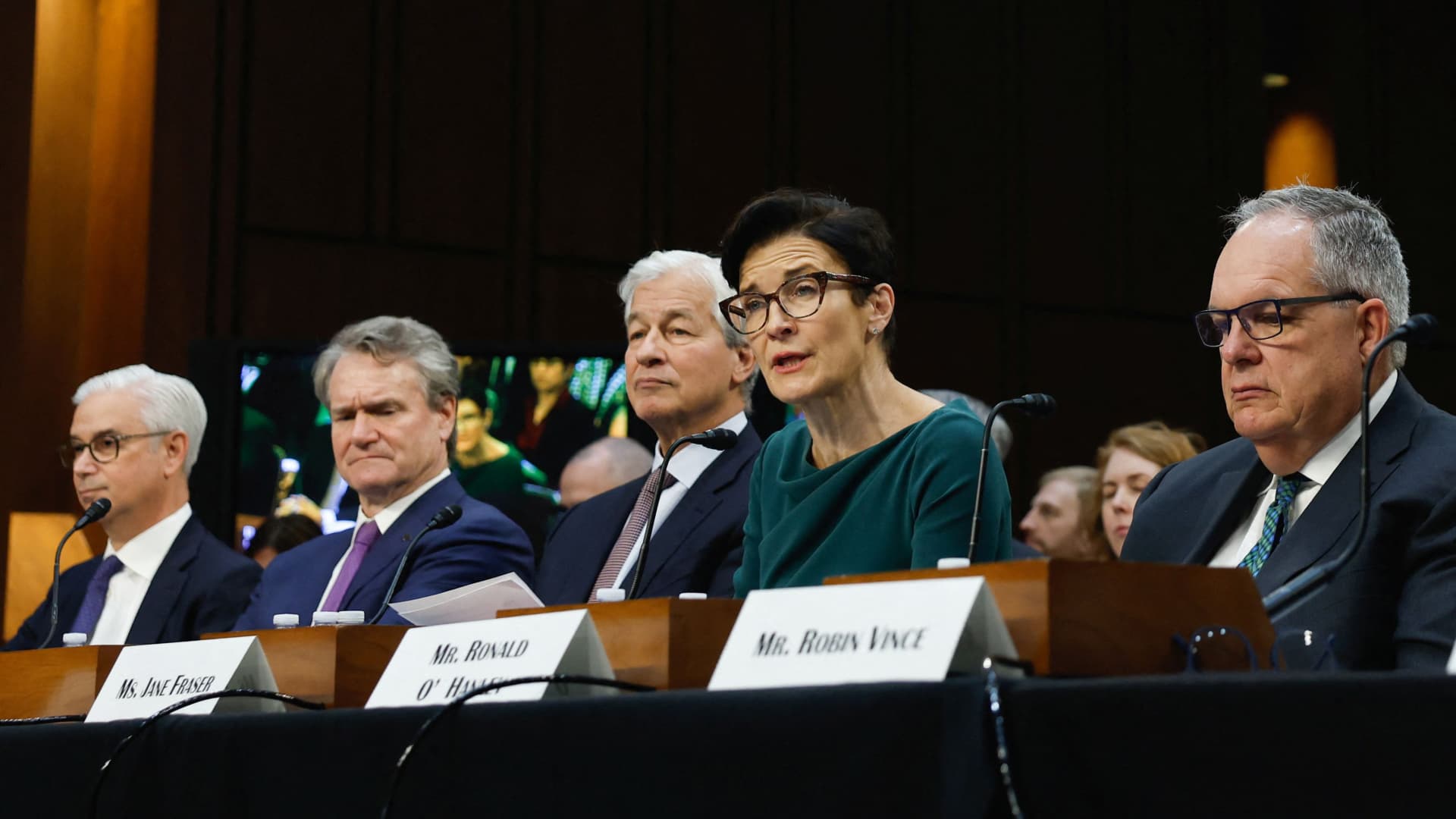

Bank leaders were thrown into turmoil over the weekend following President Donald Trump‘s announcement late Friday that U.S. credit card firms would face a 10% limit on the interest they are allowed to charge clients.
This change caused stock prices of major banks, including Citigroup, JPMorgan Chase, Wells Fargo and Bank of America to decrease between 1% and 3% on Monday. Companies that are more closely tied to the card sector, such as Visa, Mastercard and American Express also saw declines. Capital One, with a loan portfolio heavily reliant on credit cards, dropped almost 7%.
Trump suggested a one-year interest rate cap starting January 20. While how this would be implemented remains uncertain, the industry has a clear stance: the proposal could lead to unforeseen repercussions for consumers and the U.S. economy.
The proposal could render vast sections of the credit card market unprofitable, especially for clients with less-than-ideal credit histories, as noted by banks and analysts. The national average credit card rate currently stands at 19.7%, according to a recent Bankrate.com survey, with rates for subprime borrowers and retailer-specific cards reaching even greater levels.
To avoid offering unprofitable products, the industry might choose to halt access for customers with subprime credit ratings, alongside other significant modifications to card services, including scaling back rewards, insiders report. Consumers would either reduce their spending or turn to alternative forms of unsecured loans, many of which have even steeper interest rates than credit cards, they assert.
“We cannot provide products at a loss; there’s no situation in which we would maintain our entire portfolio at 10%,” commented an individual familiar with a major bank’s operations, who requested anonymity for candidness. “It’s not unrealistic to claim this could swiftly damage the economy.”
The economic impact from reduced spending could be particularly pronounced for airlines, retailers, and dining establishments, which would need to compensate for decreased card income by “potentially increasing their prices” for services, said KBW analysts led by Sanjay Sakhrani and Chris McGratty in a January 11 research note.
The industry’s associations released a unified statement late Friday outlining their position.
“Data indicates that a 10% interest rate limit would hinder credit accessibility and be catastrophic for the millions of American families and small business owners who depend on and appreciate their credit cards, the very individuals this proposal aims to support,” stated the trade groups.
‘Opening bid?’
This is not the first occasion the industry has faced potential price controls. Last year, a bill was presented by Sen. Josh Hawley of Missouri and Sen. Bernie Sanders of Vermont that sought to limit card APRs to 10% for five years.
While that legislation remains stalled in Congress, a report released Monday by the Electronic Payments Coalition assessed the consequences of a 10% cap, concluding that nearly 90% of current users, or 175 million Americans, would find their accounts closed. Most accounts with credit scores under 740 would be closed, the report indicated.
Further complicating the situation, bankers are unclear about how Trump’s interest rate cap would be implemented.
The clearest route, through congressional legislation, is not feasible by the anticipated January 20 implementation date, said Tobin Marcus, head of U.S. policy at Wolfe Research.
Other possibilities for enforcement, such as through banking regulators including the Consumer Financial Protection Bureau, could also be explored. However, the Trump administration has consistently aimed to close down that agency, and the industry has been successful in overturning CFPB regulations in federal courts.
“I’m unaware of any authority they can utilize to execute this unilaterally in any sweeping capacity,” Marcus stated. “From my perspective, giving them a deadline of January 20 seems like a tactic to apply pressure and encourage voluntary compliance.”
Although the specific method Trump might employ to enforce an interest rate cap is still ambiguous, card issuers are now confronted with the risk of facing lower rates in a potential negotiated settlement with the government, KBW’s McGratty noted in an interview.
“Is 10% a starting point?” he queried. “There’s a significant gap between 10% and the rates companies currently charge.”
As of the third quarter of last year, Americans collectively held $1.23 trillion in credit card debt, based on data from the Federal Reserve Bank of New York. Balances have been rising as many Americans deplete the savings accumulated during the global coronavirus pandemic.
Correction: This article has been revised to rectify the spelling of Capital One.