
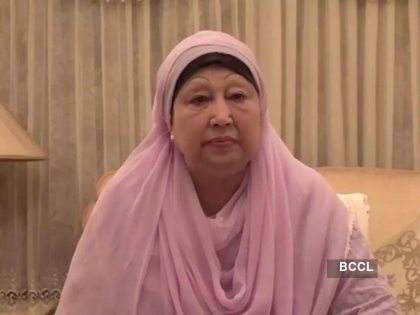
Khaleda Zia, the first female prime minister of Bangladesh, has passed away at 80 following a lengthy illness.
Zia became the inaugural female head of government in Bangladesh in 1991 after steering her party to triumph in the country’s first democratic vote in two decades.
Doctors indicated on Monday that her state was “extremely critical”. She was placed on life support, yet delivering multiple treatments simultaneously was not feasible due to her age and overall fragile health, they noted.
In spite of her declining health, her party previously stated that Zia intended to run in the general elections anticipated in February, which would be the first since the uprising that resulted in the removal of her opponent, Sheikh Hasina.
Bangladeshi politics has long been characterized by the intense rivalry between these two women, who alternated roles between government and opposition.
“Our beloved leader has departed. She left us at 6 am this morning,” announced Zia’s Bangladesh Nationalist Party (BNP) on Facebook on Tuesday.
Following the news of her death, crowds congregated outside Evercare Hospital in Dhaka, where Zia had been admitted. Images show police attempting to prevent them from entering the hospital grounds.
Zia first gained public attention as the spouse of former president Ziaur Rahman, often perceived as a quiet presence beside him. After his assassination during a military coup in 1981, Zia entered the political arena and subsequently rose to lead the BNP.
Regarded as an “unyielding leader” for sidelining herself from a contested election under military ruler General Hussain Muhammad Ershad in the 1980s, Zia navigated a male-dominated political scene and emerged as one of Bangladesh’s most formidable political figures.
Her initial term received widespread commendation for initiatives aimed at enhancing women’s education and social development, with her government reinstating parliamentary democracy by amending the constitution with cross-party backing.
Her subsequent term in 1996, albeit brief, faced backlash for conducting a biased election despite opposition demands for an impartial caretaker authority—a measure parliament had adopted before its dissolution.
Zia returned to the role of prime minister in 2001, stepping down in October 2006 in anticipation of a general election. Her administration was met with fierce criticism over corruption allegations.
In the past 16 years, under the Awami League rule, Zia emerged as a prominent emblem of opposition against a regime perceived to be increasingly authoritarian.
She boycotted the 2014 election after her opponent Hasina eliminated the caretaker government framework—a rule designed to ensure impartiality during national elections. Subsequently, Zia was convicted on corruption charges and imprisoned, denying any wrongdoing and asserting that the charges were politically driven.
She was released last year soon after widespread anti-government demonstrations in Bangladesh led to Hasina’s resignation and subsequent exile. The BNP indicated in November that Zia would participate in the forthcoming general elections.
The BNP is aiming for a return to power, and if successful, Zia’s son Tarique Rahman is anticipated to become the new leader of the country.
Rahman, aged 60, had only returned to Bangladesh the previous week after spending 17 years in self-imposed exile in London.
During the last month, Zia was hospitalized for treatment related to kidney damage, cardiovascular disease, pneumonia, and other ailments.
Despite being distanced from public life due to her health issues, Zia continued to be a figurehead for opposition movements.
In her final days, interim leader Muhammad Yunus called upon the nation to pray for Zia, labeling her a “source of profound inspiration for the country”.
In a Tuesday statement, Yunus expressed his condolences for Zia’s demise, referring to her as a “symbol of the democratic movement”.
“The nation has lost a formidable guardian… Her contributions to the struggle for democracy, a multi-party political system, and the rights of the people in Bangladesh will be eternally commemorated,” he stated.
India’s Prime Minister Narendra Modi expressed his “deep sadness” at Zia’s passing and honored her contributions toward Bangladesh’s development and its relations with India.
“We hope that her vision and legacy will continue to influence our partnership,” he posted on X.
Zia’s family, including Rahman, his spouse, and his daughter, were with her during her final moments, according to the BNP.
“We pray for her soul’s forgiveness and urge everyone to pray for her departed spirit,” the party stated in its announcement on Tuesday.