

Artificial intelligence is progressing rapidly, necessitating a reevaluation of how the energy-intensive servers driving this growth can coexist with — and utilize less from — the environment.
Data centers are fundamental to the internet, supporting nearly every digital service. However, these facilities demand vast amounts of energy and water, frequently viewed as undesirable and a strain on the communities that accommodate them. As more AI workloads are integrated into these centers, demands on power supply chains will escalate.
Simone Larsson, Lenovo’s head of enterprise AI, informed CNBC that a “tipping point” is approaching, beyond which current data center architecture will lose its efficacy.
Confronted with an impending digital infrastructure dilemma, technology giants and infrastructure developers are seeking sustainable and innovative solutions.
Data spas and villages
Conventional data centers are struggling to adequately support AI workloads and are not meeting sustainability objectives or regulatory requirements, as noted in the November report “Data Center of the Future”, conducted by Lenovo in collaboration with Opinium.
The report revealed that most IT decision-makers prioritize technology partners that minimize energy consumption, yet only 46% of respondents indicated that their existing data center designs aligned with sustainability targets.
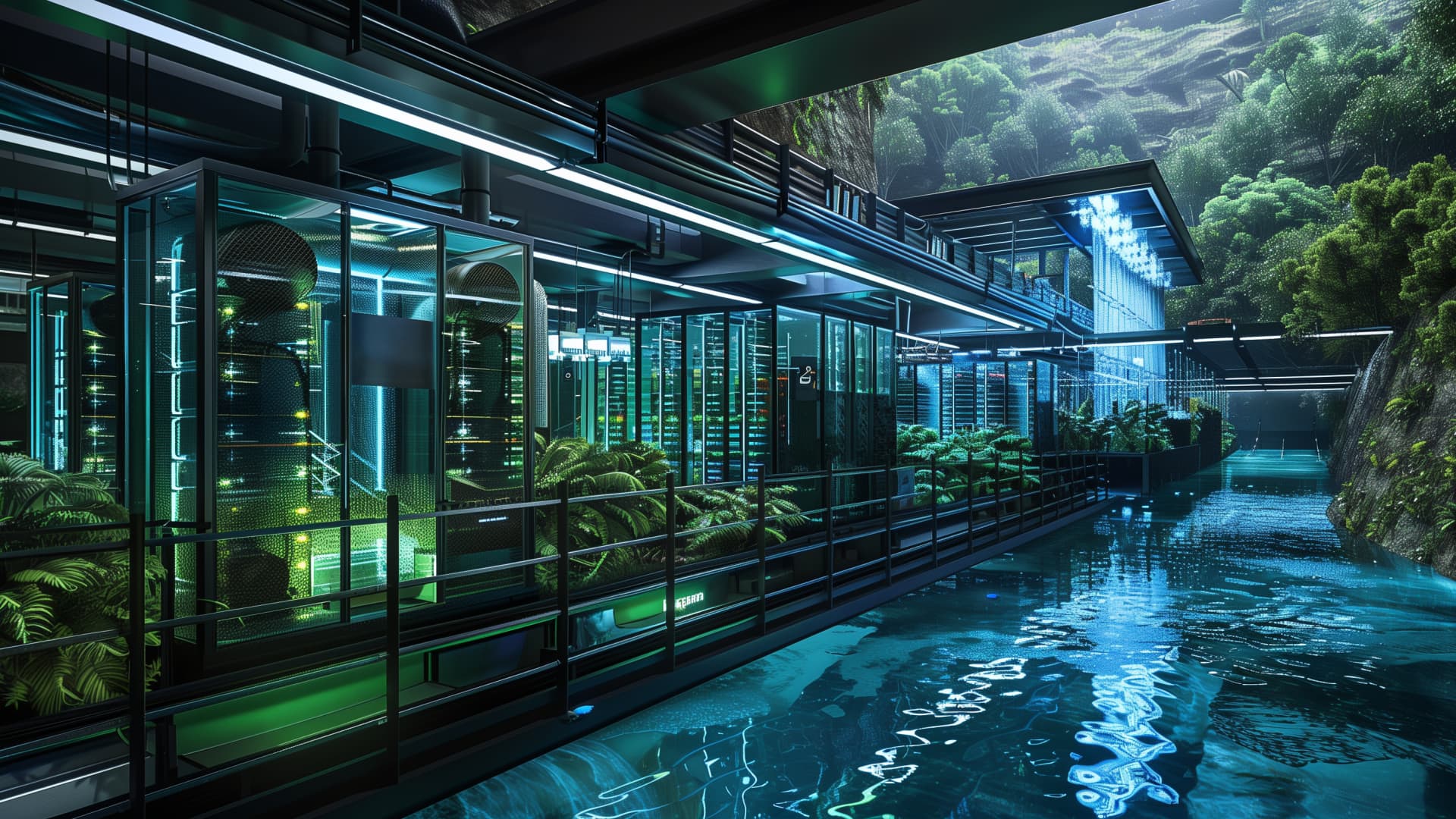
To address these issues, Lenovo has partnered with architects from Mamou-Mani and engineers from AKT II to create data centers that better integrate with the environment and tackle energy constraints. The result: designs that place data centers underground in repurposed tunnels or bunkers, or elevate them to utilize around-the-clock solar energy.
In the proposed data villages, servers are arranged in a modular configuration close to urban centers, enabling excess heat from data centers to be redirected to supply local facilities such as schools or residences. Likewise, data center spas would repurpose surplus heat from data centers for wellness applications, with the heat produced by the spa potentially powering the data center’s cooling systems.
However, there’s a drawback: even Lenovo acknowledges that its designs may not be practical until 2055 or beyond.
The company stated that its study aims to provoke dialogue and recognized that substantial regulatory reforms would be essential before any designs could be implemented. Cost and engineering intricacies of certain concepts, along with legal and scalability issues, also present hurdles.
Adoption rates would differ significantly by region. For instance, the U.S. is more inclined to embrace large-scale, ultra-high-density campuses due to heightened demand, more available land, and a relatively accommodating regulatory landscape, according to Perkins Liu, senior research analyst at S&P Global’s 451 Research. Conversely, Europe is faced with a more restricted grid and stringent regulations, he noted.
However, it’s important to note that innovative data center designs are not entirely novel. In 2018, Microsoft launched an underwater, submarine-like data center at a depth of 117 feet below sea level to utilize the cooling advantages of seawater and tidal energy to ensure the project relied entirely on renewable power.
There are also numerous instances of operators repurposing heat from facilities to heat nearby housing. Last summer, excess heat from an Equinix data center was utilized to heat the Olympic swimming pools in Paris.
Servers in space
From Google’s “moonshot” Suncatcher initiative to Alibaba and Zhejiang Lab’s “Three-Body Computing Constellation” project, and to Nvidia‘s Starcloud — competition for orbital data centers is escalating. Smaller entities like Edge Aerospace and Loft Orbital are also investigating this technology.
This may sound like science fiction — indeed, Google refers to a short story by Isaac Asimov for inspiration regarding the concept of harnessing solar energy — but these ideas are being explored pragmatically by industry leaders.
The EU-supported ASCEND study, in conjunction with Thales Alenia Space, assessed the practicality of deploying centers into orbit using robotic technologies.
Thales Alenia Space is currently advancing the technology required for this endeavor, aiming to conduct an initial in-orbit demonstration mission by 2028. In November, Starcloud, the Nvidia-backed startup, launched a chip into space that boasts a performance level 100 times greater than any previously deployed GPU compute in space.
Since 2020, approximately 70 million euros ($82 million) of private investment has been poured into projects focused on space-based data centers, based on a report from the European Space Policy Institute (ESPI).
Nonetheless, in the short term, orbital data centers remain unattainable due to the substantial expenses associated with launching such equipment into space.
“Developing radiation-hardened hardware, managing cooling in the vacuum of space, and the exceedingly high cost of deploying large, power-efficient compute systems into orbit present significant challenges,” stated S&P Global’s Liu. Additional hurdles include maintaining reliable high-speed communication, mitigating space debris, and addressing maintenance challenges, he commented.
ESPI’s financial model for data centers relies on the successful reduction of launch costs by Starship to as low as $10 million.
“If you were to ask me currently, this seems unrealistic in the near term,” remarked Jermaine Gutierrez, research fellow at ESPI. “However, the long-term question pertains to whether innovations on Earth and the resulting cost reductions can outstrip the savings gained from establishing operations in space.”
‘Faceless mega-juggernauts’
Larsson from Lenovo emphasized that the visionary data center concepts prioritize coexistence and “symbiosis.” This includes utilizing some heat from the data centers for community benefit and other stakeholders involved.
James Cheung, partner at Mamou-Mani, shared with CNBC that another aim is to enhance the aesthetics of the facilities, preventing them from being perceived as “faceless mega-juggernauts of boxes.”
He elaborated on how the architects employed techniques such as biomimicry to discover how natural algorithms can reveal the most efficient methods for heat dissipation.
“We engage with [data centers] on a daily basis, through our computers and smartphones. Yet this gentle giant, quietly operating, exerts massive pressure on water and our resources,” he stated.
Future proofing
For many of these advancements to materialize, experts informed CNBC that regulations must be revised and new policies enacted to tackle the escalating energy demands posed by AI and data centers.
“Data center operators might choose to adopt eco-friendly technologies at their discretion, but financial justification is necessary,” said Liu from S&P Global. He added that the power grid must be modernized and renewable energy infrastructure rapidly established for this to come to fruition.
