


If circumstances had turned out differently, Serena would likely be adjusting to the realities of an empty nest now. After raising seven kids, she and her husband might have been relishing a bit more financial freedom and personal time. However, currently, three of their grown children reside at home: the 23-year-old wrapping up his studies; the 28-year-old who teaches and is saving for a property deposit; and the 34-year-old, following a mental health struggle. At 63, Serena returns home from her social worker position to a heap of laundry, while a spare room on the ground floor has been converted into a bedroom.
Having a full house is “really good fun,” she remarks, enriching their lives and making them more dynamic. Adapting to partners spending the night took some getting used to – “I’m not prude, but you don’t always want to witness that side of life with your kids, do you?” – and recently, she has sensed the absence of a significant milestone. “I feel like I’ve aged without really realizing it, as I’ve remained in parent mode for so long,” she reflects. “It’s just dawned on me that I missed the common transition that occurs when kids leave in your 40s and 50s – it just hasn’t happened for me. It feels strange.”
And she isn’t alone in this experience. Robert and his wife intended to travel next year after retiring, aiming to rediscover their individual identities during this new child-free chapter. Yet their eldest has returned home after finishing university this summer without securing a job in a challenging year for graduate recruitment, and his parents are hesitant to leave him alone to navigate discouraging job interviews. “It’s tough to determine where our responsibilities for an adult child start and stop,” Robert admits. “If he were 18 I would be much more engaged, but I’m trying not to be – I want to take an interest in his activities while also maintaining boundaries. He doesn’t appreciate being told what to do.”

Children departing from home was once perceived as a definitive end, marking a permanent shift in family dynamics. However, it is increasingly seen as the start of a new, flexible period, where adult offspring come and go for potentially years. Research by the Institute for Social and Economic Research (ISER) at the University of Essex revealed that 15% of individuals aged 21 to 35 returned home at least once after moving out from 2009 to 2020, frequently due to a breakup or job-related setbacks.
For numerous families, keeping an open door is a natural reaction to exorbitantly high rents, escalating youth unemployment and the perception that Generation Z simply cannot achieve the lifestyles their parents enjoyed at the same age. However, prolonging support for children, and at times postponing retirement or downsizing ambitions to accommodate this, comes with implications.
According to a study of middle-aged parents across 17 European nations conducted by researchers at the London School of Economics, those whose homes unexpectedly filled up again experienced a decrease in their quality of life akin to dealing with an age-related disability. Taking on family duties again after experiencing freedom may have felt like “a violation” of this life stage, the researchers concluded.
Nevertheless, for their children, moving back home is becoming increasingly commonplace. While for some it may invoke frustration or even embarrassment, the stigma surrounding it appears to wane as 43% of 25-year-olds in the UK cohabitate with their parents, as noted by the Institute for Fiscal Studies. TikTok is filled with humor regarding sneaking into the parental fridge and crashing their extravagant holidays. Meanwhile, the lines between Generation Z and their often surprisingly accommodating Generation X parents appear to be fading, as more families willingly accept multigenerational living arrangements.
“The empty nest phase was pure agony. It was one of the hardest experiences for me,” Barbara, a widowed mother of 23-year-old twins who have recently graduated and returned home in London to seek employment, shares. Initially, she felt sorrow for her sons for not being able to leave home, but lately she has begun questioning whether flat-sharing is as necessary a phase as it once seemed. “Just because we were capable of renting and then buying a property at that age doesn’t mean they necessarily have to do the same. I tell them: ‘There are many things you have that we didn’t.’ The world has changed. It helps that all their friends find themselves in similar situations.” She appreciates the chance to meet her sons’ friends, connecting them with hers and growing close to them as adults. “It’s not just an extension of childhood; it’s a distinct kind of adulthood.”
Is “full nesting” solely a result of dire economic conditions? Or could it also be a response to a deeper longing for connection?
In his final university year, Julia’s oldest son is among the fortunate few in his class to secure a job offer. However, instead of moving into a shared flat, he will return to reside with his parents and two younger siblings to cut costs.
“When I graduated, my parents were like, ‘Off you go’ – moving home was never a consideration,” his mother reflects. “However, rents were significantly lower back then. You could simply check Loot to find a room in a shared house.” Julia could easily enjoy London’s lifestyle on her bookstore earnings, but those days are gone. “Going out is so pricey now. Dates can be expensive… I would love for him to move in with his friends, and I think that’s genuinely what he desires. But the costs are prohibitive.” She mentions friends who still help cover the rent or vacations for children in their late 20s who have left home.
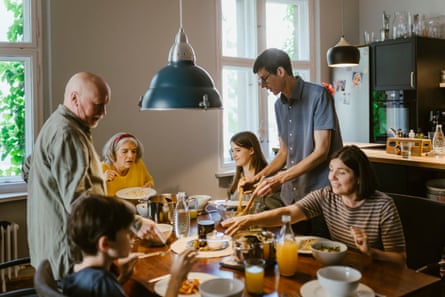
Julia intends to charge her son rent – in exchange for two meals daily, all laundry services, and the family cleaner’s assistance – but plans to set the money aside for him as a deposit for the future. “You do what you can to support them. I wouldn’t want to be 21 in today’s world,” she conveys.
She appreciates her son’s presence, yet the setup is not what she envisioned for this chapter of her life. Her spouse had aspired to buy a boat. She had envisioned quitting her PR role to retrain in a more creative field once the children departed. However, if the younger two follow suit, she’ll be in her 60s when all of them eventually leave, although she suspects her daughter may choose a different path. “It’s appealing to stay at home, enjoying central heating while having your mum do your laundry and your dad drive you to the pub now and then. But I feel that girls tend to be somewhat more independent.” This sentiment is backed by evidence: 61% of 18- to 24-year-olds residing at home are men.
Kate’s 19-year-old son is in his first year at a Birmingham university, commuting from home. His 17-year-old brother has similar ambitions. Both boys were apprehensive about incurring massive debts without a guaranteed job afterward, she states, and were eager to steer clear of maintenance loans. However, that’s not the sole advantage. “They return home to enjoy a shepherd’s pie, fresh laundry – they aren’t stuck in chilly halls dining on Pot Noodles.” In return, she relishes having them around longer. “I’ve been working out with my eldest sometimes, and it’s genuinely delightful to share experiences like that.” Kate has already informed them that when they do move out, they are welcome to return to save for a house deposit – the only realistic path she envisions for them to ever own a home.
Kate is concerned that they aren’t picking up the life skills usually gained through independence. “I initially thought, ‘Let’s start with how to make a stir-fry,’ but the reality is I still take care of everything. It’s just simpler. If you have a half load of white wash, you tend to check all the washing baskets to fill it up, right?” However, especially for her older son, who faced anxiety during the latter part of his schooling, she believes it offered reassurance knowing he wouldn’t have to leave home at 18 as she did.
Kate isn’t the only parent I encounter who mentions either mental health challenges or a lack of emotional readiness to depart from home, nor the sole one to instinctively associate this with growing up amid a pandemic.
“Remember how we were in lockdown, surrounded by each other nonstop? Well, we’ve grown accustomed to that. We’ve learned to be a cohesive unit in many ways; we truly figured out how to endure each other in intense situations,” Kate remarks. It makes cohabitation feel more natural, in her view – however, as was the case during lockdown, she worries about young individuals whose families can’t or won’t welcome them back. “In that case, you’re stuck, aren’t you? And your opportunities in life become limited.”
For many, home appears to be a crucial safety net. The ISER team at the University of Essex found that rather than feeling down about returning to their former teenage rooms, on average, those who boomeranged home saw improvements in their mental health scores, indicating they found it relieving. “Many young people living on their own are often in subpar housing, facing substantial stress, living in volatile private rentals,” remarks Prof Emily Grundy, a co-author of the study. Going back home may seem like a regression, but it often exceeds whatever challenges drove them back.
Fiona was 37 when she returned to her childhood home with her baby son following her partner’s sudden death from an illness. Still grappling with the loss, she discovered a small house in her hometown, located hundreds of miles from her previous residence in London; she intended to stay with her parents for a year during renovations. In reality, she remained for almost eight years.
Initially, she felt ashamed to admit that she had returned to the house she vacated at 17. “You feel as if you’re not genuinely an adult.”
However, cohabitating as adults has unexpectedly enriched her relationship with her parents. “Moving back home was a real revelation, viewing your parents as adults from an adult standpoint,” she reflects. “I’ve gained so much insight regarding my relationship with them and my identity.”
Fiona has struggled with food and weight issues, and returning home made her realize her mother faced similar challenges. Yet with this understanding came a stronger connection. “I know them so much better now, and after moving out again, having a bit of distance has granted me more empathy for them.” Her new home is just minutes away, so her parents still assist with childcare. As they age, she foresees spending more time caring for them. “In the past, I viewed the thought of them aging and needing care as a burden. Now, my perspective has completely shifted – owing to everything that’s transpired, I feel closer to them.”
What are the key principles for a successful experience of “full nesting”? At 77, Rob is a veteran in this regard: his daughter Jess has temporarily moved back in after university, again when she switched jobs, and is currently back yet again (this time with her five-year-old daughter, Evie) following her separation from her husband while her family home is on the market.
From what was formerly their office-spare bedroom over the phone, Rob expresses, while now “completely cluttered,” that he and his wife find immense joy in having their granddaughter around. However, he advises establishing guidelines regarding household responsibilities to prevent a return to child-like roles and implementing rent. “Every parent whose adult children moved back in will know that suddenly, adults slip back into being children again. You tend to assume that ‘whoever usually cooks will just continue to cook extra for me.’” They’ve also learned to compromise regarding the state of the household: “When Jess is here, she might say I’m overly tidy, and I would respond that she’s messy. Being open to compromise is essential.”
Yet while they have always had a good relationship, he notes that there may be deeper reasons for their family’s closeness. Jess was born a twin, and her sister passed away during the pandemic. “It brought us together in a significant way,” Rob states quietly. “There was no other option for us but to pursue this.”
Financial planner Jane Gow, on the other hand, cautions that parents should not compromise their retirement security by assisting their children.
“I advise: ‘You must secure your own oxygen mask first,’” says Gow, who has experienced all four of her adult children returning home at various times. Once children leave, she contends, parents have every right to downsize or rent out their old bedrooms if financially necessary; to cease paying for their phones and car insurance, and to request rent if the children come back. “This is the period when substantial pension contributions should be made, in the final years while we can still manage.”
For parents of younger children, she suggests fostering independence early by encouraging them to share household chores and save small amounts of allowance. If they are at university: “It involves budgeting with them, or getting them accustomed to paying bills.”
And if it’s too late for those measures? Perhaps hold off on any plans to redecorate.
“If I returned home in the 90s, my parents would have said: ‘We’ve turned your room into another space,’” Kate muses resignedly. “You wouldn’t think that now, would you?”
