
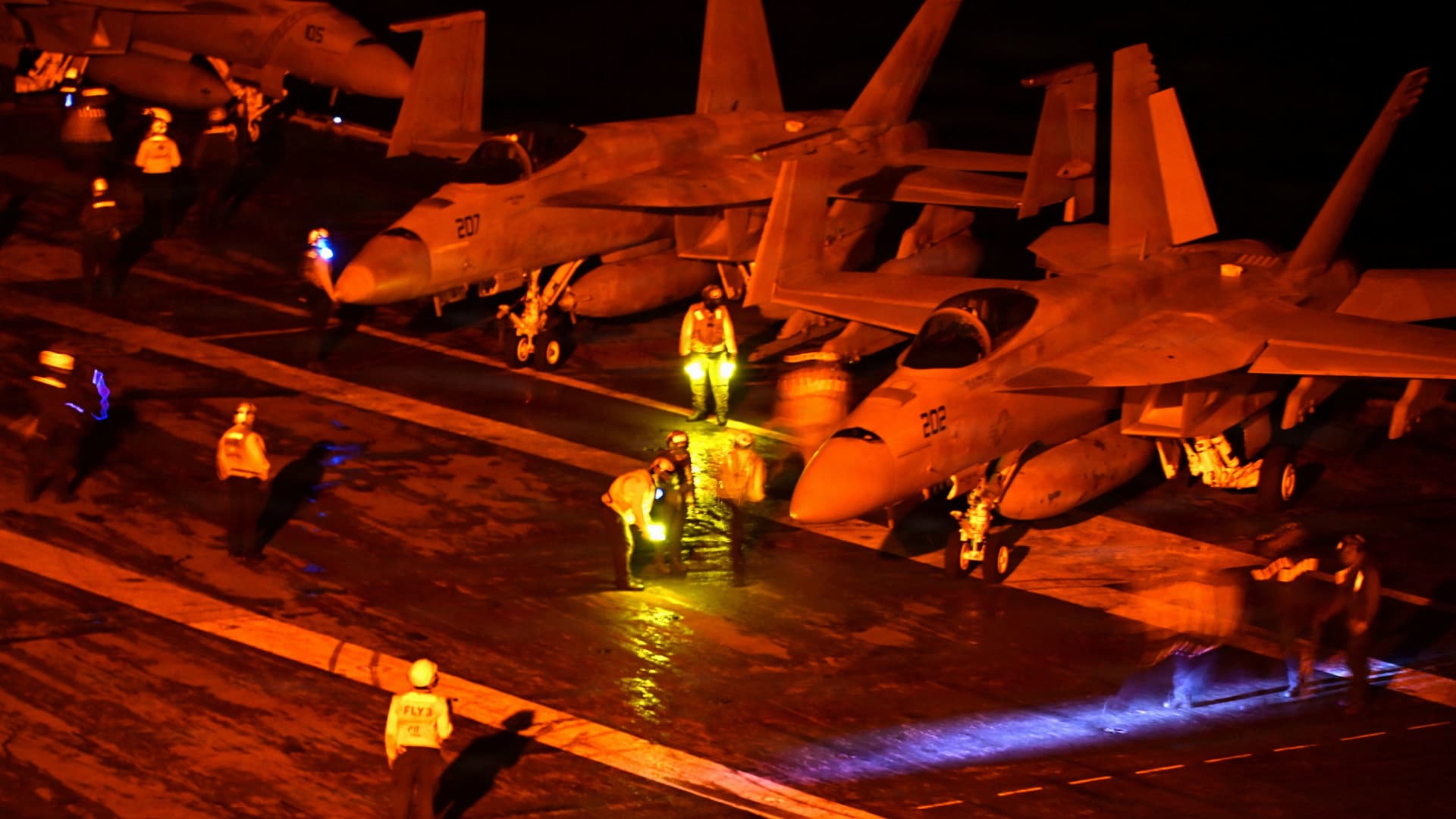

The U.S. and Iran have traded strikes for the first time in over a month, marking a major escalation in the conflict and renewing fears of further hostilities.
Iran’s Revolutionary Guard on Monday said it launched an attack on two U.S. bases in Jordan in response to a U.S. strike on Larak Island over the weekend, Iranian media reported.
American forces hit two Iranian rocket launchers on Larak Island on Sunday after the military said the Guard was preparing rockets carrying sea mines for launch into the Strait of Hormuz, U.S. Central Command confirmed to MS NOW.
Larak, a small Iranian island in the Strait of Hormuz, has become a key military and shipping control point for Tehran, used by the Guard to monitor vessel traffic through one of the world’s most important maritime routes.
“Earlier today U.S. forces struck two Iranian launchers on Larak Island. Islamic Revolutionary Guard Corps forces were observed preparing to launch rockets with sea mines into the Strait of Hormuz,” Navy Capt. Tim Hawkins, a U.S. Central Command spokesperson, said in a statement.
“Last week, CENTCOM completed clearing sea mines from the strait’s international shipping routes. U.S. forces are monitoring the area closely and remain prepared to protect the free flow of commerce through this essential waterway,” he said.
Sunday’s attack was the first publicly acknowledged U.S. strike on Iranian positions since late July. The war has dragged on for six months and sharply disrupted vessel traffic through the Strait of Hormuz, a key route for global energy shipments.
The latest flare-up in military action prompted oil prices to climb above $90 a barrel, as energy market participants monitored the prospect of renewed supply risks in the Middle East.
International benchmark Brent crude futures with November expiry traded 3.2% higher at $90.90 per barrel on Monday morning, while U.S. West Texas Intermediate crude futures with October delivery rose 3.5% to $86.28.
Meanwhile, U.S. President Donald Trump on Monday extended his military threats against Iran to Kharg Island, the country’s main oil export terminal. Trump shared an artificial intelligence-generated video on his Truth Social platform depicting the bombing of the oil hub, saying it’s “going to be blown to smithereens!”
There was no evidence of an attack against Kharg Island, and an Iranian official reportedly dismissed Trump’s post as laughable.
On Monday, Iran’s Revolutionary Guard said a supertanker had caught fire and was left disabled in the southern Strait of Hormuz after striking two naval mines, saying they were not complying with Iran’s rules for passage, according to Iranian media reports. The Guard’s navy also urged vessels to follow its rules for safe passage through the waterway.
Separately, Iran’s Foreign Ministry said Monday that the U.S. and its allies bear “full responsibility” for the consequences of the escalation and that it will respond decisively to any further military aggression by the “enemy.”
Attacks on bases in Jordan
The Guard said the U.S. attack on Larak Island killed and wounded several Iranian soldiers, and it has responded with attacks on American military bases in Jordan, according to Iranian media reports. The combined missile and drone operation targeted the King Hussein and Al Azraq bases, according to media reports.
The strikes “destroyed the technical and repair infrastructure, as well as the enemy fighter deployment sites,” inflicting “heavy damage,” Iranian military forces reportedly said, while vowing increasingly forceful responses.
Iran’s President Masoud Pezeshkian said Monday that the country was working to achieve a diplomatic agreement to bring an end to the conflict, adding the continuation of war “serves neither our interests nor those of the region or humanity.”
Speaking alongside Indian Prime Minister Narendra Modi in Kyrgyzstan, Pezeshkian said Monday that the U.S. side “has not fulfilled its commitments,” state media reported.
The U.S. Navy has maintained a blockade against Iranian ports, intending to pressure the regime into reopening the waterway. Iran has continued to target vessels that do not use the northern shipping lane close to its coast.
Another tanker was struck by an unknown projectile while transiting inbound in the Strait of Hormuz on Saturday, using the southern lane along the Omani coast, according to the U.K. Maritime Trade Operations Centre. The agency reported no casualties, while advising vessels to navigate the strait with caution.
