

Traders are stuck between preparing for a rapid agreement that concludes the conflict and a major escalation that could cause oil prices and bond yields to rise even more as they enter a holiday-thinned trading session.
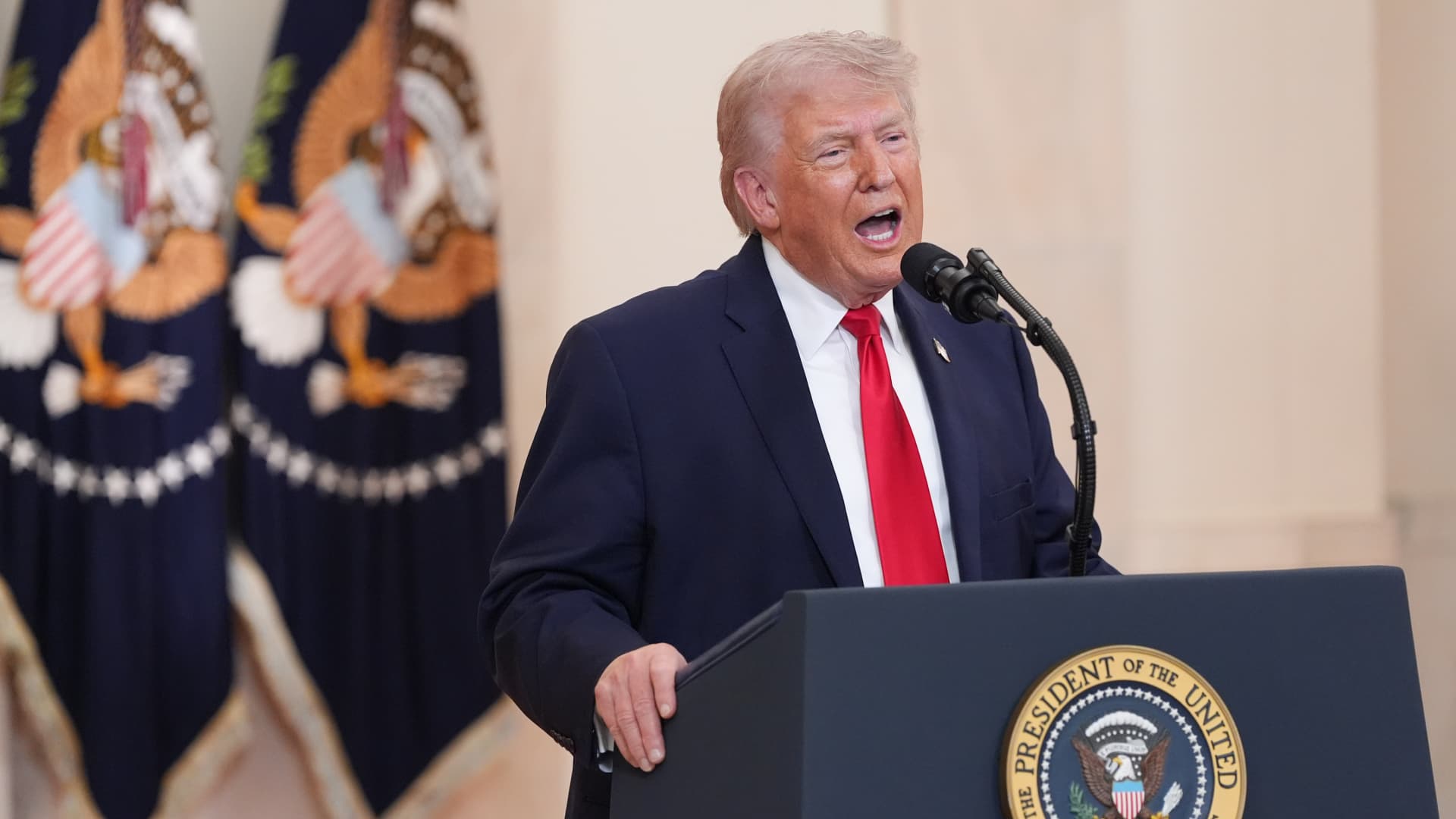
President Donald Trump put forth a harsh warning on Sunday, telling Iran it would be “living in Hell” unless the Strait of Hormuz is reopened by Tuesday, 8 p.m. ET, labeling it “Power Plant Day and Bridge Day combined.”
In a separate Fox News interview on Sunday, Trump expressed optimism that there was a “good chance” for an agreement to be made by Monday.
Mixed signals have created a week in which investors must prepare for sharply differing possibilities.
Meanwhile, Iran has dismissed Trump’s recent threats, stating that the vital waterway would only completely reopen once Tehran is reimbursed for the war’s damages, as it continued strikes throughout the Gulf over the weekend, including at Kuwait’s oil headquarters.
“Markets are anxious, as time is short and the possibilities are either a truce or escalation,” commented Rob Subbaraman, head of global macro research at Nomura. Trump’s rhetoric, however, indicated a sense of urgency from the White House to conclude the conflict, according to Subbaraman, as investors worked to “hedge against the risk of escalation.”
Trump has been oscillating between proclaiming talks with Iran as fruitful and imminent for a peace agreement, and indicating his willingness to increase military action against the Islamic Republic. He has consistently pushed back the deadline for Iran to reopen the Strait of Hormuz.
This inconsistent messaging has resulted in market fluctuations accompanied by unstable oil trading. The S&P 500 rose 3.4% last week, marking its strongest weekly gains since November as investors capitalized on the dip in hopes of a diplomatic solution. The Cboe Volatility Index surged from below 20 prior to the war to approximately 24 last week.
“Trump’s aggressive remarks [over the weekend] align with his strategy: unpredictable, headline-driven, and aimed at applying maximum pressure swiftly,” stated Mohit Mirpuri, an equity fund manager at SGMC Capital.
“Markets will have to adjust to this type of policymaking for the foreseeable future while he remains in office,” Mirpuri added.
Stagflation concerns persist
The prolonged conflict and the effective blockade of the Strait of Hormuz risk plunging the globe into one of its most extreme energy crises in history. Analysts warn that even a diplomatic breakthrough may not provide immediate relief to markets.
Brent crude prices surged to $109.77 per barrel on Monday, approximately 50% higher since the conflict commenced on February 28. U.S. West Texas Intermediate has skyrocketed by 66% and was trading at $111.2 as of 11 p.m. ET.
Despite a slight increase in the last few days, shipping traffic through the Strait of Hormuz — which previously facilitated nearly a quarter of the world’s seaborne oil and one-fifth of its liquefied natural gas before the war — remained 95% lower than levels prior to the war.
“Regardless of whether the Strait of Hormuz stays open, the damage to confidence and supply chains has already occurred — normalcy doesn’t just return instantly,” Mirpuri remarked. “Markets will likely be sensitive to headlines, with sharp fluctuations as narratives evolve.”
The OPEC+ decision on Sunday to increase production quotas by 206,000 barrels per day for May will hardly alleviate oil supply issues, given that the war has curtailed production and shipments from several of the globe’s largest crude exporters.
Subbaraman noted the war has “persisted long enough to create serious inflation spikes worldwide,” cautioning that “if the conflict escalates from this point, the inflation shock may quickly turn into a growth shock, leading to demand destruction and outright stagflation.”
Bond yields: an overlooked risk
The fixed-income sector is discreetly adjusting the inflation outlook. The 10-year Treasury yield reached 4.362% on Monday, up from 3.962% before the conflict began, hovering near the highest levels since mid-2025, as investors reduced their expectations for interest rate cuts from the Federal Reserve this year.
“One of the significant, yet underestimated risks is the shift in government bond yields,” mentioned Mirpuri. “Should this geopolitical shock translate into lasting inflation expectations, yields could rise again, tightening financial conditions at a moment when markets are already vulnerable.”
Wall Street strategist Ed Yardeni indicated that the fixed-income markets have been readjusting government securities to reflect the swiftly deteriorating inflation outlook, with “bond vigilantes taking matters into their own hands and tightening credit conditions.”
“Now we cannot dismiss the possibility of a bear market or even a recession. It all hinges on how long the strait remains closed,” Yardeni cautioned, compounding economic strains from the disruption in global energy flows.
Volatility driven by headlines
As investors brace themselves for Tuesday’s deadline, markets are anticipated to remain extremely volatile as they attempt to interpret every signal from Washington and Tehran.
Markets in Japan and Korea saw gains on Monday as Axios reported that the U.S., Iran, and a coalition of regional mediators were negotiating terms for a possible 45-day ceasefire that could pave the way for a permanent resolution to the war, although the report indicated that the likelihood of a partial agreement before the deadline was slim. Indian benchmark indexes were trading lower.
“We are [currently] in an event-driven market where the risk of headlines overshadows intraday movements, and positioning must consider binary outcomes,” remarked Hiroki Shimazu, chief strategist at MCP Asset Management.
He anticipates that both parties will lean towards a de-escalation facilitated by Oman, in the form of “a subtle reduction in strike frequency,” rather than a definitive resolution. “We are in an extended stalemate phase rather than nearing a clean solution,” Shimazu remarked, predicting a prolonged period of volatility in the upcoming weeks.
Investors are also looking forward to a series of vital economic reports from the U.S. this week. The February personal consumption expenditures index — the Fed’s favored gauge for inflation — is scheduled for Thursday and will provide an initial indication of whether the oil shock is influencing prices in the world’s largest economy.
Spot gold, which has lost about 12% since the war began, trading at $4,672.03 per ounce, faces a tug-of-war between safe-haven demand and geopolitical pressures from a stronger dollar and rising Treasury yields. A strengthening dollar has made gold priced in dollars less accessible for holders of other currencies, while higher yields have lessened the appeal of the non-yielding metal.
“Immediate uncertainty is evidently very high, and for the majority of investors, it’s just a matter of waiting and observing at this point,” stated Chetan Seth, APAC equity strategist at Nomura.