
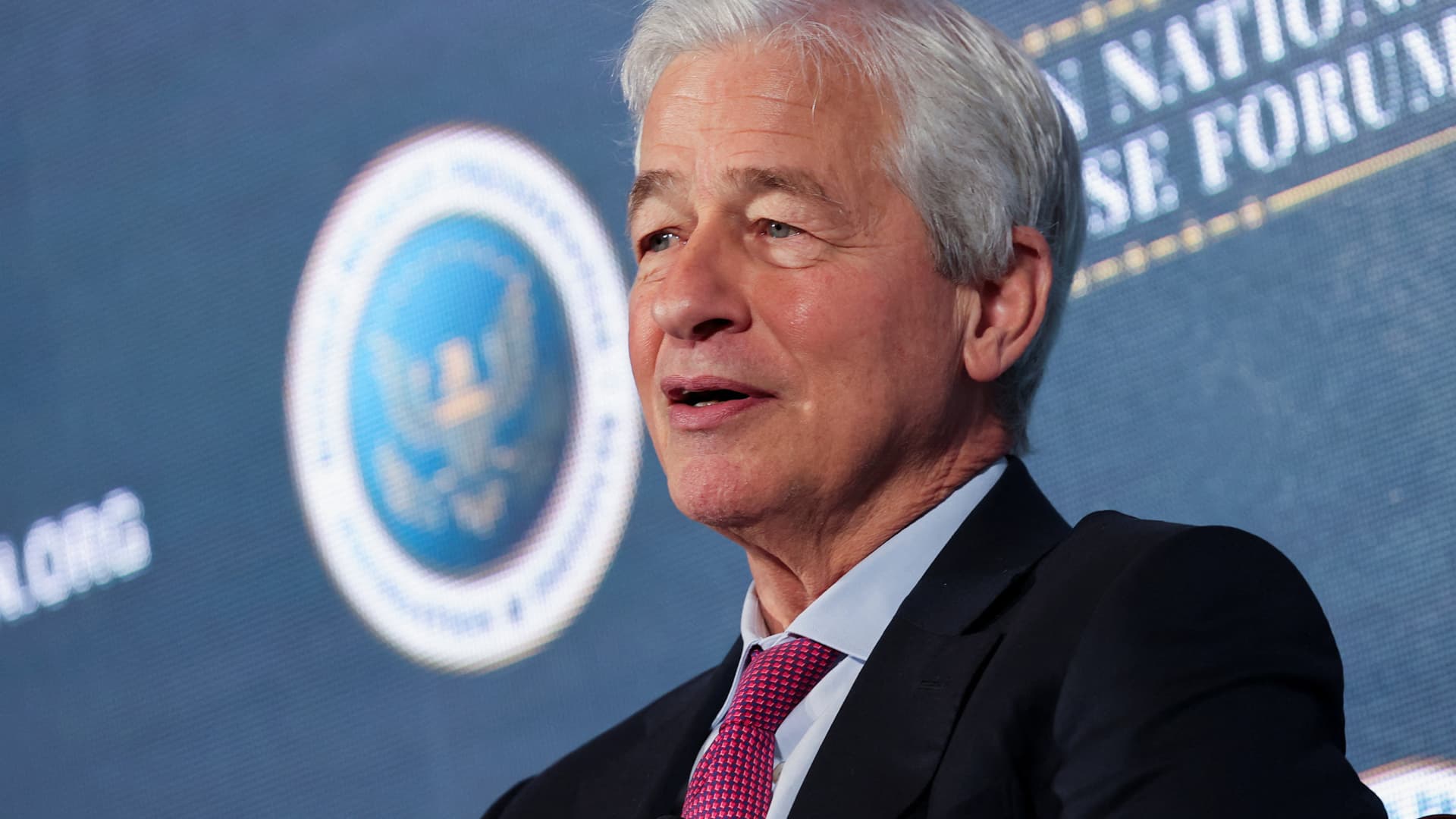

JPMorgan Chase CEO Jamie Dimon is urging a renewed commitment to American principles as his bank manages geopolitical instability, a fragile economy, and the groundbreaking effects of artificial intelligence.
In his letter to shareholders released on Monday, Dimon acknowledged the nation’s 250th anniversary as “an excellent opportunity to recommit ourselves to the ideals that shaped this amazing nation — freedom, liberty, and opportunity.”
“The hurdles we face are considerable. While the list is extensive, prominent among them are the ongoing horrors of war and violence in Ukraine, the current conflict in Iran, and broader conflicts in the Middle East, along with terror threats and increasing geopolitical strains, particularly concerning China,” Dimon remarked. “Even in challenging times, we trust that America will continue to do what it always has — rely on the values that have characterized our unique nation and upheld our status as a leader in the free world.”
Dimon, who leads the world’s largest bank by market capitalization, is one of the most vocal U.S. business leaders. His annual letter serves not just as a record of his company’s performance, but also as a narrative on global issues.
In the letter, he highlighted difficulties including international conflicts, persistent inflation, turmoil in private markets, and what he described as “ineffective bank regulations.”
Dimon mentioned that regulations established post the 2008 financial crisis “achieved some positive outcomes … but they also fostered a disjointed, sluggish system with costly, overlapping, and excessive regulations — some of which weakened the financial framework and hindered productive lending.”
He specifically pointed out the adverse effects of capital and liquidity rules, the current design of the Federal Reserve’s stress testing, and a “poorly managed” process at the Federal Deposit Insurance Corporation.
Dimon also expressed mixed feelings about JPMorgan’s response to recent proposals regarding the Basel 3 Endgame and a global systemically important bank (GSIB) surcharge — released by U.S. regulators last month.
“While it was encouraging to see that the latest proposals for the Basel 3 Endgame (B3E) and GSIB sought to lessen the capital hike from the 2023 recommendations, some components are frankly illogical,” Dimon stated.
The CEO noted that the cumulative proposed surcharges of roughly 5% would require the bank to maintain “up to 50% additional capital for most loans to U.S. consumers and businesses compared to a large non-GSIB bank for the same loan classes.”
“It’s simply not fair, and it’s un-American,” he asserted.
On trade and geopolitics
Dimon pointed to geopolitical tensions as the main danger facing his bank, specifically the conflicts in Ukraine and Iran and their repercussions on commodities and global markets — describing war as “a realm of uncertainty.”
“The results of current geopolitical situations could very well be the critical element determining how the future global economic order develops,” he noted. “However, it may also not play a significant role.”
He also mentioned a “realignment of economic relationships globally” prompted by U.S. trade strategies. President Donald Trump has made tariffs a focal point of his second term, imposing increased duties on various trading partners and import categories.
“The trade conflicts are far from resolved, and it is reasonable to anticipate that many countries are evaluating how and with whom they should establish trade partnerships,” Dimon stated. “While some of this is essential for national security and resilience, which are critical, predicting the long-term consequences remains complex.”
On private markets
Dimon also discussed the recent turmoil in private markets, as anxieties surrounding loans extended to software companies lead to substantial redemption demands at private credit funds.
“In general, private credit lacks transparency or strict valuation ‘marks’ for their loans — this heightens the likelihood that investors will choose to exit if they anticipate the market will worsen — even if actual realized losses remain largely unchanged,” Dimon noted.
The executive indicated that actual losses are already exceeding acceptable levels relative to the market conditions.
“Regardless of how this situation unfolds, it is likely that insurance regulators will mandate stricter assessments or markdowns, which will probably lead to calls for additional capital,” he added.
On AI
Dimon reiterated on Monday that the speed of AI integration is unprecedented compared to past technologies. He indicated that while its application will be “transformational,” it is uncertain how the AI revolution will play out.
“Overall, investing in AI is not a speculative fad; instead, it promises considerable advantages. Nonetheless, at this moment, we cannot foresee the ultimate beneficiaries and casualties in AI-oriented sectors,” Dimon explained.
“We will not ignore the implications. We will implement AI, similar to all technologies, to enhance our service for our customers (and employees),” he outlined.
JPMorgan has been leading among Wall Street firms in deploying AI throughout its operations. Last year, JPMorgan’s Chief Analytics Officer Derek Waldron provided CNBC with an early showcase of how it’s utilizing agentic AI to expedite tasks and enhance outcomes for clients and stakeholders.
In February, Dimon mentioned that AI was transforming JPMorgan’s workforce and that the bank was planning “major redeployment initiatives” for staff.
“We have concentrated on some of the ‘certain and anticipated’ as well as some ‘uncertain known’ occurrences,” he stated. “However, significant tech transitions such as AI invariably have secondary and tertiary effects that can profoundly influence society. … We ought to be vigilant for such transformations as well.”
— CNBC’s Leslie Picker and Ritika Shah contributed to this report.
