
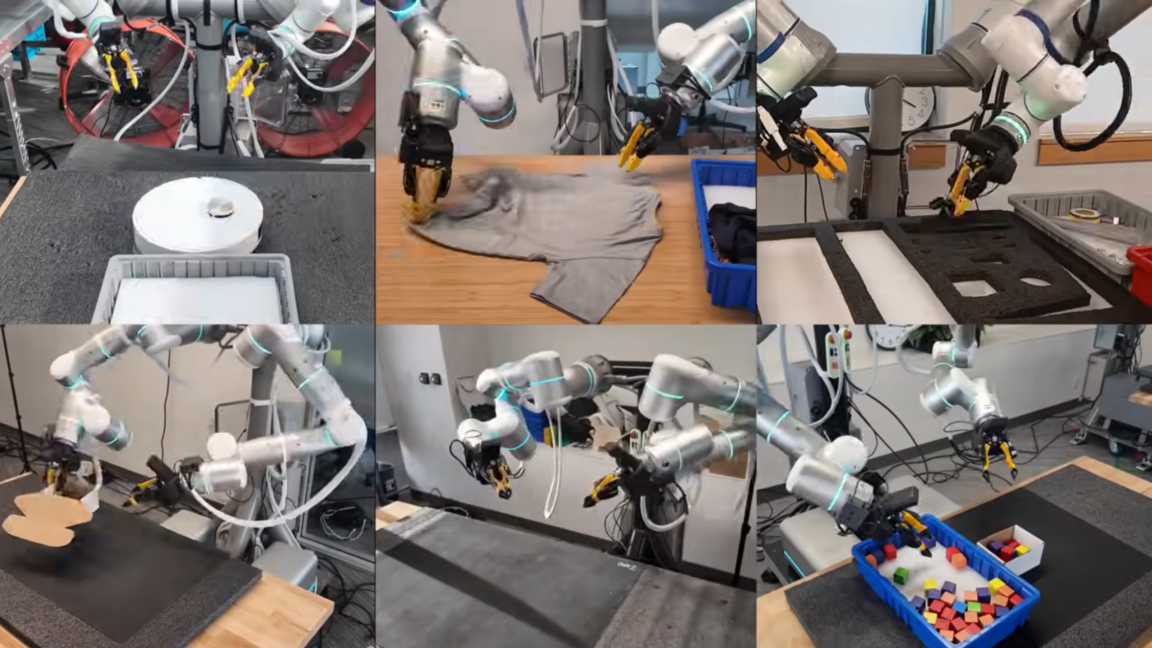
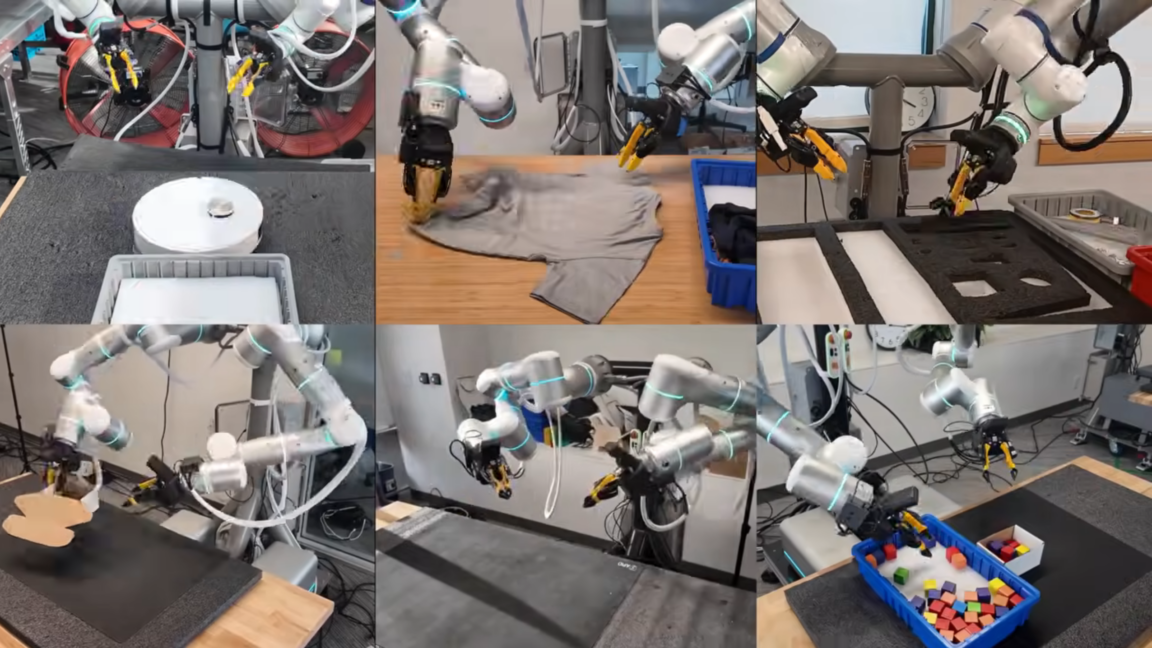
Robotics-focused machine-learning firm Generalist has unveiled GEN-1, a physical AI platform it claims “crosses into production-level success rates” across “a broad range of physical skills” that previously required the dexterity and muscle memory of human hands. Generalist also emphasizes the new model’s knack for reacting to disruptions by improvising fresh maneuvers and “connect[ing] ideas from different places in order to solve new problems.”
GEN-1 expands on Generalist’s earlier GEN-0 model, which the company promoted in November as a proof of concept for applying scaling laws to robotics training, demonstrating that more pretraining data and compute translate into better post-training performance. But whereas large language models have been able to process the trillions of words available online for training, robotic systems don’t have a comparable, easily accessible supply of high-quality examples of how humans manipulate objects.
To close that gap, Generalist has turned to “data hands”, wearable pincer devices that record micro-movements and visual cues as people perform manual tasks. The company says it has gathered more than half a million hours — and “petabytes of physical interaction data” — to train its physical model.
Take my money (from my wallet) (then put it back).
The outcome is an autonomous system precise enough to place cash into a wallet and versatile enough to fold laundry or sort auto parts. Generalist says the model now achieves 99 percent success rates on repetitive but delicate mechanical tasks — such as folding boxes, packing phones, and servicing robot vacuums — and operates at roughly three times the speed of GEN-0. The company adds that GEN-1 can reach these levels after only about an hour of adapting its pretraining to the “robot data” relevant to its specific robotic embodiment.
Recovering from mistakes
Historically, complex robotic systems have tended to rely on precisely preprogrammed motions or be trained to specialize in a single task with little variation. What Generalist says sets GEN-1 apart is a single model’s ability to improvise from prior experience and handle disruptions naturally, even when those situations are “well outside the training distribution.”
