
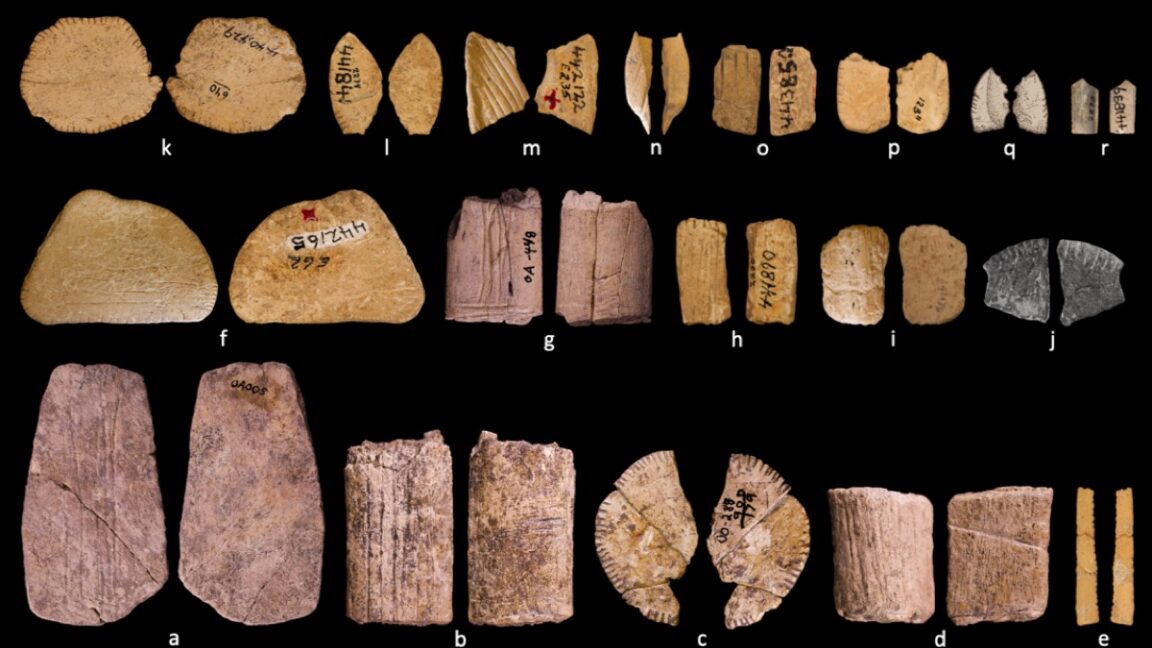
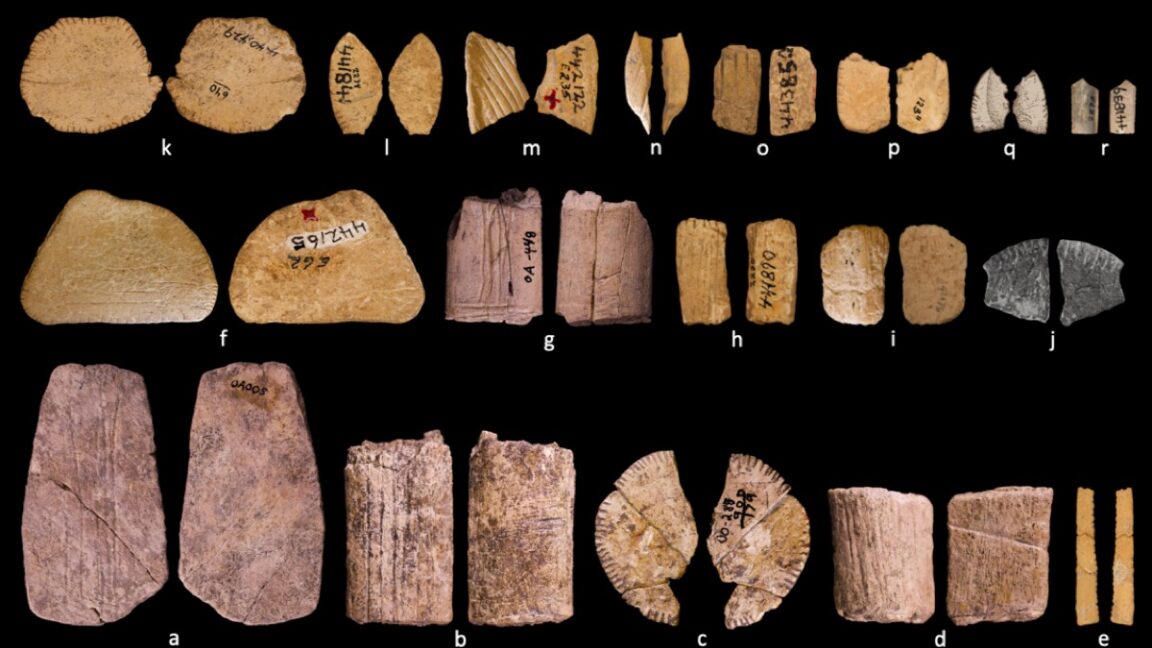
Madden definitively identified 565 Native American dice from 45 sites and classified another 94 artifacts as “probable” dice. Items with a drilled or pierced hole were left out of his survey because they could just as well be beads or other ornaments rather than dice. He also excluded pieces whose two faces could only be told apart by shape, without distinct markings, for the same reasons. The oldest examples, from Folsom deposits in Wyoming, Colorado, and New Mexico, date to the end of the last Ice Age, about 12,000 years ago.
According to Madden, dice and gaming in these cultures were not like modern gambling, where the house has an advantage; instead, they likely played a social role.
“These games are one-on-one; there’s no house,” said Madden. “They were fair contests, with everyone having equal opportunity and equal conditions, and they functioned as a means of exchange, particularly between groups that did not interact frequently and thus didn’t really know one another. It’s essentially a form of gifting over time that builds lasting reciprocal relationships. It’s not a commercial transaction where you and I swap something and then go our separate ways.”
The results also illuminate early Native American notions of probability. “When we see the origins of dice, we’re literally seeing the origins of probabilistic thinking,” said Madden. “That origin has typically been placed in the Old World during the Bronze Age, about 6,000 years ago. This study indicates that Native Americans were making dice, producing random outcomes and applying those streams of chance in games of luck 6,000 years earlier. So, to understand the history of probabilistic thought, we now need to investigate the Old World at the end of the last Ice Age.”
That said, “These findings don’t claim that Ice Age hunter-gatherers were doing formal probability theory,” Madden added. “But they were deliberately creating, observing, and relying on random outcomes in repeatable, rule-based ways that exploited probabilistic regularities, such as the law of large numbers. That matters for how we interpret the global history of probabilistic thinking.”
American Antiquity, 2026. DOI: 10.1017/aaq.2025.10158 (About DOIs).
