
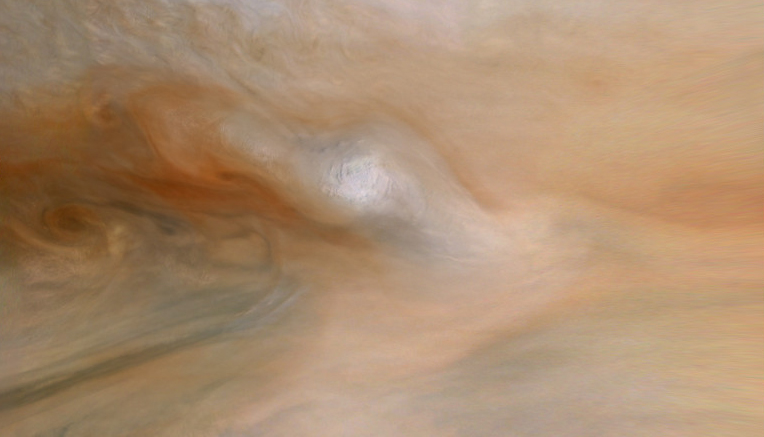
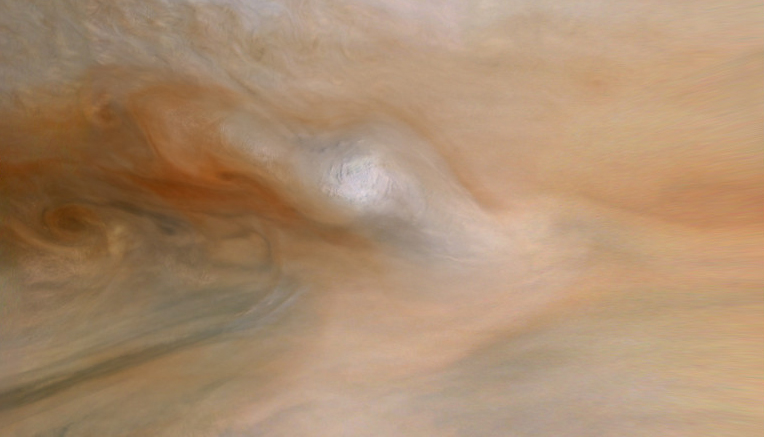
During 12 flybys, Juno recorded 613 microwave pulses from lightning, with energies ranging from roughly comparable to an Earth lightning bolt up to at least a hundred times stronger. Because of uncertainties in cross-planet comparisons, Jupiter’s flashes could potentially have been up to a million times more powerful than those on Earth.
Lightning on Jupiter likely originates from a process similar to Earth’s: ice particles within clouds gain electrical charges, and resulting voltage differences trigger lightning between clouds or between clouds and lower atmospheric layers.
There are important differences between the two planets. Jupiter has no solid surface, and its cloud ice contains both water and ammonia, whereas Earth’s ice is only water. Convection also behaves differently: on Jupiter moist air tends to sink because it is denser than the surrounding hydrogen-rich atmosphere, while on Earth—whose atmosphere is dominated by nitrogen, which is heavier than water—moist air tends to rise.
So Jupiter’s enormous storms aren’t explained solely by its size. Moving moist air upward requires much more energy, producing stronger winds and more powerful cloud-to-cloud lightning. Exactly what makes lightning so extreme on Jupiter remains unclear.
“Could the key difference be hydrogen versus nitrogen atmospheres, or could it be that the storms are taller on Jupiter and so there’s greater distances involved?” said Michael Wong, a planetary scientist at the University of California, Berkeley’s Space Sciences Laboratory. Wong is the lead author on the Jupiter lightning study.
“Or might more energy be available because moist convection on Jupiter demands a larger buildup of heat before a storm — and lightning — can form?” Wong said in a press release. “It’s an active area of research.”