

If you want a broader take on the new MacBook Pros, I’ll direct you to reviews of the M1, M3, and M4 generation models, as well as the one for the low-end 14-inch MacBook Pro with the standard M5 (it’s $100 pricier than before but now includes 1TB of base storage instead of 512GB).
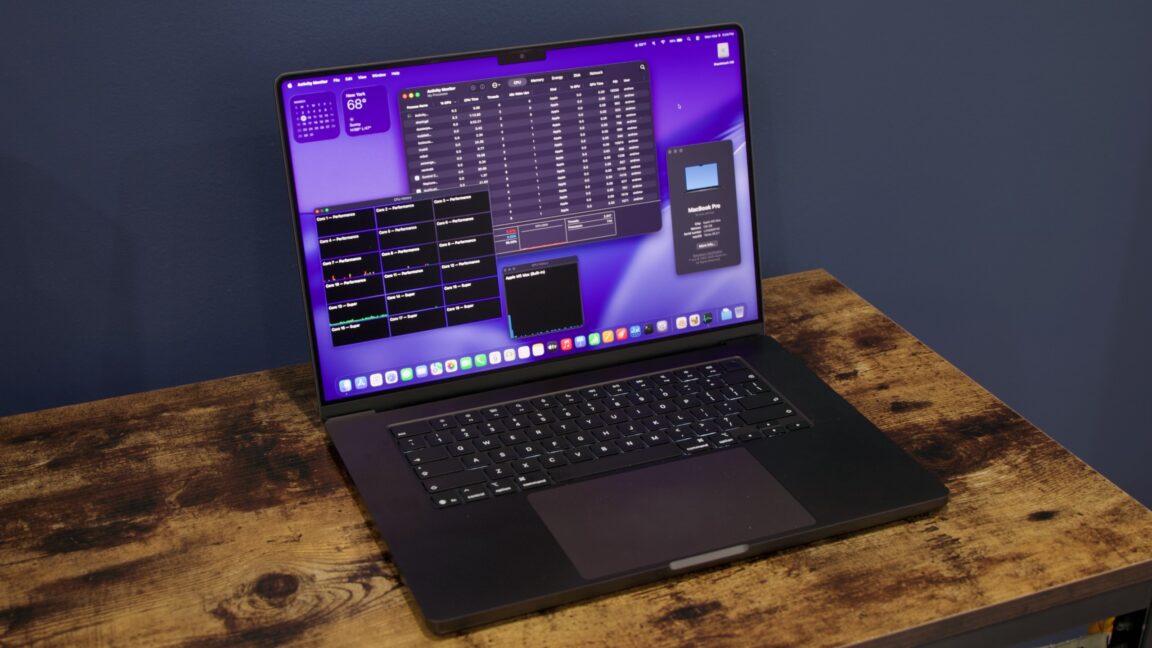
Apple is keeping the exterior design it introduced in 2021—the look has worn well, and we generally prefer it, especially when compared with the late-Intel MacBook Pros. There isn’t much new to say about the styling that hasn’t already been noted.
M5 Max benchmarks
In our testing, a fully enabled M5 Max posts roughly 10 percent better single-core results than the fully enabled M4 Max in last year’s 16-inch MacBook Pro. Gains in multi-core scores are less consistent (Cinebench R23’s ~30 percent jump looks like an outlier), but most benchmarks still show a modest 10–12 percent improvement.
Graphics gains are a bit stronger, generally landing between 20 and 35 percent depending on the test. Apple suggests you may see even more uplift on GPU compute workloads that can take advantage of the neural accelerator built into each M5-family GPU core.
The improvement from M4 Max to M5 Max, percentage-wise, isn’t as dramatic as some recent generational jumps—both the M3 Max and M4 Max represented larger leaps. That said, if you’re upgrading from an M1- or M2-based Pro, the performance increase is still significant. Worries about dropping from twelve top-performing CPU cores in the M4 Max to just six high-performance cores seem somewhat overstated based on these results.
Compared with the standard M5 in the 14-inch MacBook Pro, the M5 Max delivers similar single-core performance, which aligns with Apple’s usual approach: higher-end chips boost multi-core and GPU performance, but Apple typically doesn’t increase per-core clock speeds the way Intel or AMD often do with their top-tier processors.