
.jpg)
One feature set S. mirabilis apart from S. aegyptiacus. The name “mirabilis” is Latin for “astonishing.” What Sereno’s team found so astonishing was the large crest crowning the animal’s head, among the biggest ever found.
The scimitar crown
Rather than the knobby, fluted ridge of S. aegyptiacus, S. mirabilis carried a blade-like, scimitar-shaped bony crest that rose and swept back from the snout, peaking high above the eyes. This feature was made of solid bone, unlike the highly porous, pneumatic casques of some living birds. Still, the bone was marked by fine longitudinal striations and deep grooves, showing the bony core served mainly as a foundation.
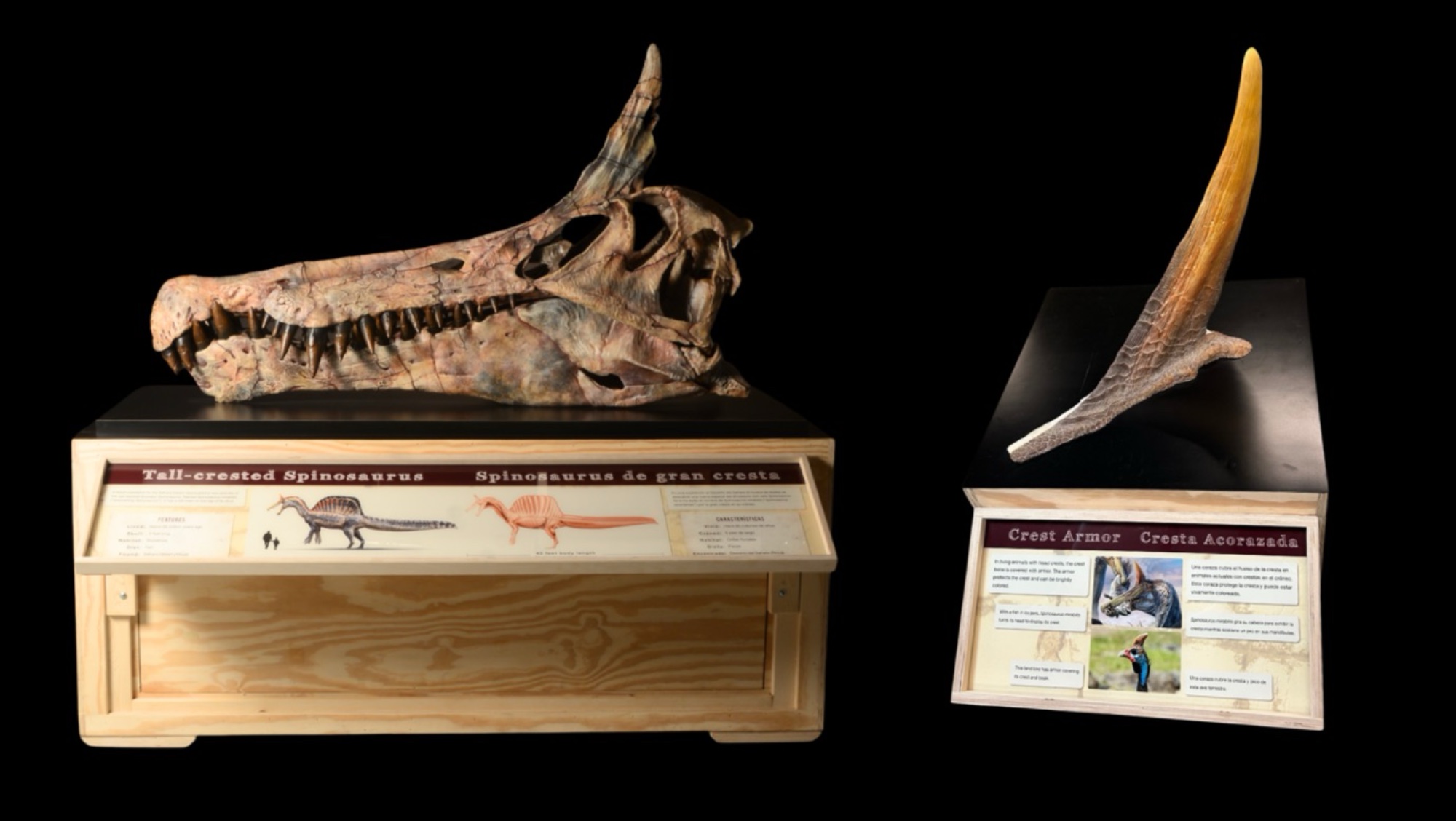
In life, the crest of S. mirabilis would have been covered and greatly extended by a keratinous sheath, much like the colorful growth seen in modern helmeted guinea fowls. Scaled to a full adult, the bony core alone would have been roughly 40 centimeters long; with the keratinous covering it might easily have topped half a meter. For Sereno, the role of this “astonishing” scimitar crown was akin to the crests of cranes and herons. “It was asymmetrical. It varied between individuals. So, I think it was solely for display,” Sereno explains.
His team proposes that visual signaling was the main function of both the cranial crests and the huge trunk and tail sails that characterize spinosaurids. Along crowded shorelines and riverbanks, a tall, brightly colored crest or sail would be an effective way to advertise size, maturity and genetic quality to rivals and potential mates without resorting to costly fights.
Still, when it came down to it, S. mirabilis, tipping the scales at well over 7 tons, could certainly brawl. “The Spinosaurus was enormous. I think it could have eaten anything it wanted even though its mainstay was fish,” Sereno says.
Crocodile jaw
Aside from the forehead ornament, S. mirabilis was a highly specialized predator. Its snout was low and with parallel upper and lower margins, ending in a mushroom-shaped expansion at the tip. The upper and lower teeth interlocked precisely—there was a distinct diastema, a gap in the upper tooth row, that accommodated the large lower teeth. The jaw anatomy resembles that of modern long-snouted crocodilians, suited to snatching aquatic prey with a swift, trap-like snap. Interestingly, S. mirabilis had wider spacing between teeth in the rear half of the snout than S. aegyptiacus, despite being otherwise very similar.
