
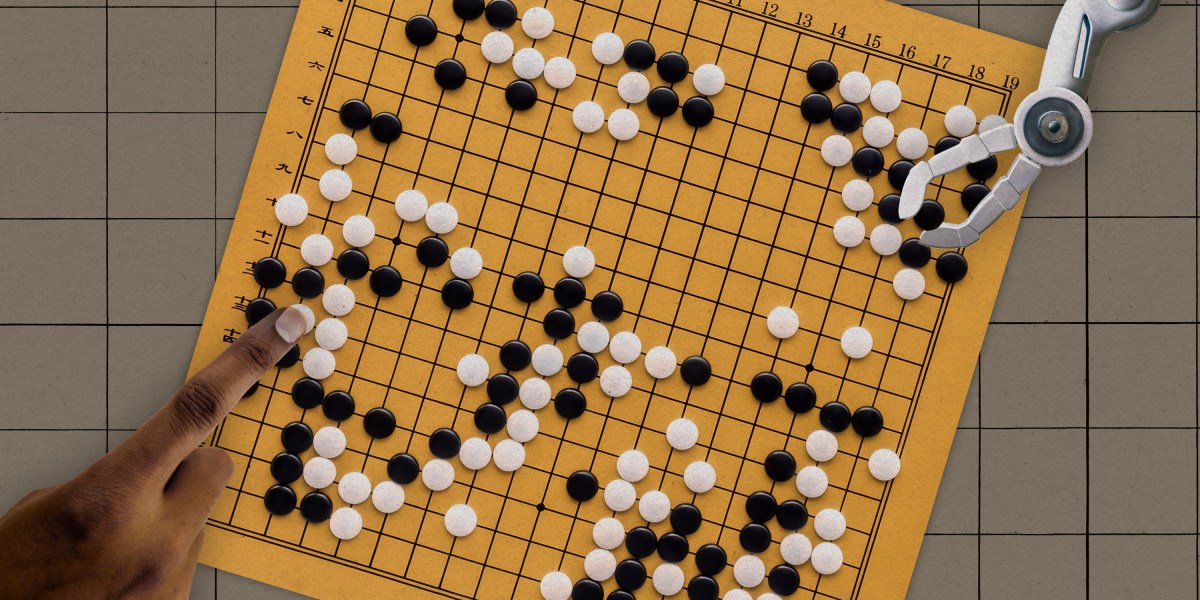

Tucked away in the quiet streets of Hongik-dong, a muted residential area in eastern Seoul, stands a weathered building adorned with “Korea Baduk Association,” the authority overseeing professional Go. This game, steeped in history, holds a revered place in South Korean culture.
However, within these walls, spaces that once resonated with the gentle sounds of hands reaching into wooden bowls of stones now reverberate with the clicking of mice. Players lean over their screens, revisiting their games with the aid of an AI program. Others gather around a Go board to deliberate the optimal next move, as coaches compare their strategies with those of the AI. Some stay quiet, observing AI programs compete against one another.
A decade ago, AlphaGo, the AI developed by Google DeepMind, shocked the world by defeating South Korean Go master Lee Sedol. In the subsequent years, AI has transformed the landscape of the game. It has revolutionized age-old strategies regarding the best plays and introduced entirely novel concepts. Players now focus on emulating AI’s moves as closely as possible, rather than creating their own, despite the mystery surrounding the machine’s thought process. Nowadays, competing at a professional level without AI is almost unthinkable. Some believe this technology has stifled the game’s creativity, while others argue there is still space for human innovation. At the same time, AI is making training more accessible, allowing a greater number of female players to rise in the ranks.
For Shin Jin-seo, currently the world’s highest-ranked Go player, AI serves as an indispensable training ally. Each morning, he fires up his computer to work with a program called KataGo. Known as “Shintelligence” due to how closely his moves align with those of the AI, he follows the glowing “blue spot” representing the program’s recommendation for the next best move, adjusting the stones on the digital board to grasp the reasoning behind the AI’s choices. “I’m constantly pondering why AI selected a specific move,” he admits.
While preparing for matches, Shin dedicates most of his awake hours to analyzing KataGo. “It feels almost like a form of asceticism,” he shares. A study from 2022 by the Korean Baduk League found that Shin’s moves align with AI’s 37.5% of the time, significantly higher than the 28.5% average found across all players.
“My approach to the game has evolved considerably,” Shin states, “because I must adhere to the suggestions made by AI to some degree.” The Korea Baduk Association has reportedly contacted Google DeepMind in hopes of facilitating a match between Shin and AlphaGo, commemorating the 10th anniversary of its match with Lee. A spokesperson from Google DeepMind mentioned that they could not disclose any details at this moment. However, should this match occur, Shin, who has been training with advanced AI systems, believes he stands a good chance of victory. “AlphaGo had some deficiencies at that time, so I think I could overcome it by exploiting those vulnerabilities,” he states.
AI reshapes the Go playbook
Go is an abstract strategy board game that originated in China over 2,500 years ago. Two players alternate placing black and white stones on a 19×19 grid, aiming to dominate territory by encircling their opponent’s stones. The game possesses striking mathematical intricacies. The potential configurations of the board—around 10170—far exceed the count of atoms in the universe. If chess is likened to a battle, Go resembles a war, suffocating your adversary in one corner while defending against an intrusion in another.
To train AI for Go, a vast dataset of human moves is inputted into a neural network, a computational framework that emulates the neural interconnections in the human brain. AlphaGo, later dubbed AlphaGo Lee after its win against Lee Sedol, was trained on 30 million Go moves and honed by engaging in millions of self-play games. In 2017, its successor, AlphaGo Zero, started learning Go from ground zero. Without examining any human games, it learned solely by playing against itself, basing decisions purely on the game’s rules. This blank-slate methodology proved to be more potent, free from the constraints of human understanding. After just three days of training, it defeated AlphaGo Lee 100 games to none.
Google DeepMind retired AlphaGo in the same year. Yet, a surge of open-source models inspired by AlphaGo Zero emerged. At present, KataGo is the most prevalent program among professional Go players in South Korea. It offers faster and sharper insights than AlphaGo. It has learned to predict not just potential winners, but also control of each point on the board over time. While AlphaGo Zero gained an understanding of the board by analyzing small sections, KataGo learned to interpret the entire board, acquiring a better grasp of long-term strategies. Instead of merely winning, it learned to optimize its scoring.
This software has transformed how the game is played. For centuries, professional Go players have navigated the game’s immense complexity by developing heuristics that substitute raw calculation. Graceful opening strategies imposed an abstract order on the blank grid. Early corner invasions were deemed unfavorable. Each generation of Go scholars contributed new principles to the collective wisdom.
However, “AI has revolutionized everything,” remarks Park Jeong-sang, a Go commentator from South Korea. “Essential moves once considered intuitive are no longer utilized, and strategies that were previously absent have gained popularity.”
The most pronounced change has occurred in initial moves. Go begins on an unmarked grid, and the first 50 plays were opportunities for abstract reasoning and creativity, where players expressed their identities and philosophies. Lee Sedol crafted audacious moves that stirred chaos. Ke Jie, a Chinese competitor who lost to AlphaGo Master in 2017, impressed with nimble, inventive plays. Now, players commit to memorizing a consistent series of efficient, calculated opening moves recommended by AI. The essence of the game has transitioned to the mid-game, where direct calculation has become more crucial than imagination.
Training using AI has led to a standardization of gameplay styles. Ke Jie lamented the fatigue of watching the same opening moves recycled incessantly. “I share the same sentiment as the fans observing. It’s extremely exhausting and painful to witness,” he stated to a Chinese news platform in 2021. Fans delight when a player deviates from the norm with unconventional moves, but these instances are becoming scarce. More than a third of moves by elite Go players mirror AI’s recommendations, according to a 2023 study. Many players assert that the initial 50 moves of each match often align with AI’s suggestions.
“Go has transformed into a mind sport,” asserts Lee Sedol, who retired three years post his 2016 loss to AlphaGo. “Before AI’s influence, we sought something more profound. I regarded Go as an art,” he shares. “Yet, if you are mimicking moves from a solution manual, it ceases to be art.”
Some players feel that engaging in Go is now less about discovering untraveled paths and more about adhering to the directives of a superhuman oracle. “I used to captivate fans by evolving the techniques of Go and offering a new paradigm,” Lee reflects. “The motivation behind my involvement in Go has dissipated.”
A perplexing intellect
Those who remain in the game are striving to redefine their craft. However, identifying the new underlying principles can prove challenging.
Unassumingly petite yet impressively composed, Kim Chae-young, one of the leading female Go players globally, learned the game from her father, who was also a professional Go player. Yet, when AI began altering the game, she found herself reverting to square one. “I required time to shed everything I had previously learned,” shares Kim, as she guided me through her screen, indicating the blue spots suggested by KataGo. “The intuition I had cultivated over the years was revealed to be erroneous.”
As she leaned closer to her screen, the blinking display illustrated the winning probabilities for each move, devoid of any explanations. Even elite players like Kim and Shin find that they don’t fully grasp all of AI’s strategies. “It feels as though it’s operating on a higher plane,” she remarks. When she attempts to learn from AI, she adds, “it’s less about thinking through each move logically, and more about nurturing an instinct—an intuition.”
Researchers are endeavoring to unearth the superhuman knowledge embedded in game-playing AI programs, enabling humans to learn it as well. In 2024, researchers at Google DeepMind extracted new chess concepts from AlphaZero, an advanced variant of AlphaGo Zero capable of also playing chess, and imparted them to chess grandmasters through puzzles. The Go concepts gleaned from AI systems thus far are “likely just a fraction of what could be learned,” states Nicholas Tomlin, a computer scientist at the Toyota Technological Institute at Chicago, who co-authored a study that examined Go concepts encoded in AlphaGo Zero.
However, extracting these insights poses a challenge. “Top-tier players have yet to figure out the overarching principles behind AI strategies,” says Nam Chi-hyung, a Go professor at Myongji University. While they can imitate AI’s moves, they have not yet identified a novel framework for the game since its reasoning remains an enigma, she explains. Go might currently be in a state of epistemic limbo.
Even though AI functions as an opaque educator, it remains an egalitarian one. It has greatly enhanced training for female Go players, historically the underdogs within the game. For years, training entailed learning beneath leading male players, and the most competitive matches occurred in male-dominated circles that were hard for women to penetrate, according to Nam. “Female players never had that experience,” she states. “Now they can utilize AI for training, which has vastly improved their learning environment.” More broadly, AI has attempted to bridge the divide between players by assisting everyone in perfecting their initial moves.
Female players have ascended the ranks in recent years as a consequence. In 2022, Choi Jeong, then the leading female player, became the first woman to reach the finals of a major international Go tournament. Known as “Girl Wrestler” for her fierce and combative playing style, she faced off against Shin. Although she lost, the match marked a significant milestone for women in Go. In 2024, Kim garnered attention for winning the postseason playoffs of the Korean Go League, being the sole female participant in the tournament.
Training with AI has imbued Kim with newfound confidence. Analyzing the moves of male players with AI has dispelled the illusion of their infallibility. “In the past, I couldn’t assess just how formidable the top male players were—they seemed untouchable. Now, I realize they make errors, and their moves aren’t always exceptional,” she explains. “AI dismantled that psychological barrier.”
Go players redefine their identity
Although AI has surpassed human prowess in Go, fans still prefer to watch human players compete. “A Go match between AI programs doesn’t provide much entertainment for audiences,” asserts Park, the Go commentator. Matches like these are too intricate for fans to follow and too flawless to evoke excitement, he states.
Players can emulate AI’s opening strategies, but during the middle game—where the board’s possibilities expand beyond memorization—they rely on their judgment. Fans appreciate witnessing players make blunders and stage comebacks, showcasing individual personalities with each stone placed. Shin’s playing style is aggressive yet marked by a machine-like composure. Kim adeptly maneuvers through the most chaotic situations on the board.
“In Go, every move represents a choice from you, met with a corresponding decision from your opponent,” mentions Kim Dae-hui, 27, a Go enthusiast and amateur player. “Observing this exchange unfold is fascinating.”
With fans like Kim still engaged, Shin finds purpose in his game. “I can execute a form of Go that narrates a story only a human can convey,” he states.
After his retirement, Lee sought a new profession where he could leverage his human edge. He began designing board games, delivering speeches, and teaching students at a university. “I’m in search of a new field that I can enjoy and excel within,” he conveys.
Recently, however, he has grown more optimistic about the game he left behind. “It’s every Go player’s aspiration to engage in a masterpiece game,” he shares—a match characterized by technical brilliance, with no mistakes, waged between equally matched opponents. “It feels like a mirage,” Lee chuckles. “Perhaps AI can assist us in achieving a masterpiece.”
Shin hopes to realize that ambition. To him, AI represents a mentor, a companion, and a guiding star. “I may be among the most formidable human players, but with AI present, I can’t afford to be arrogant,” he remarks. “AI impels me to continually strive for improvement.”