
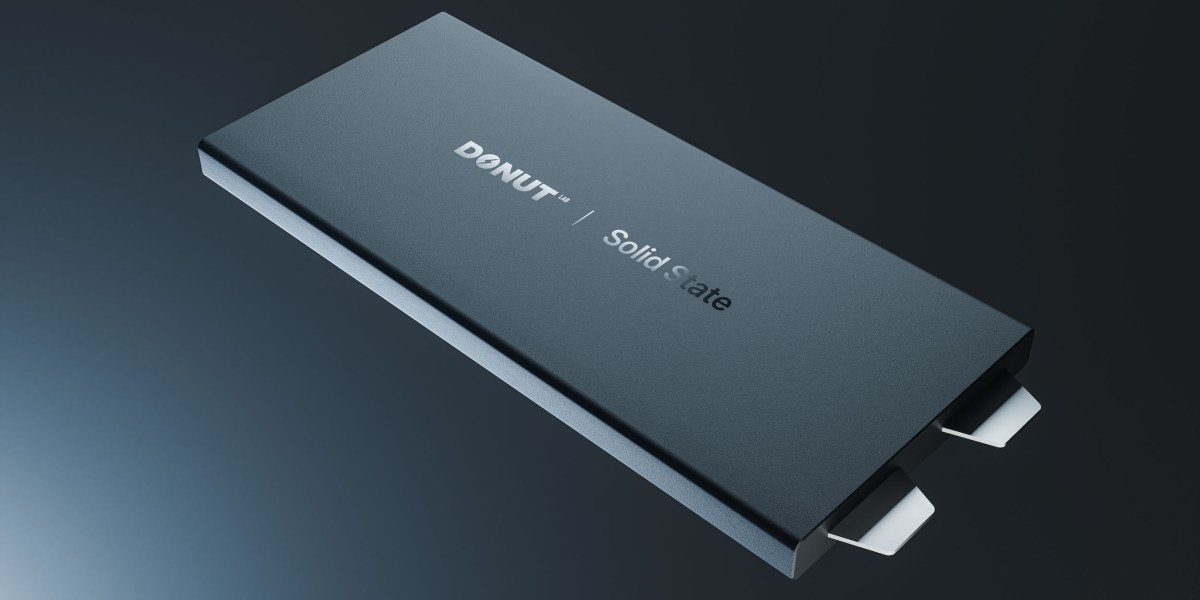

When a company asserts it has developed what can be seen as the ultimate battery, questions are inevitable.
Excitement has been building since Donut Lab, a Finnish firm, declared last month that it had introduced a novel solid-state battery technology, primed for mass production. The company stated that its batteries offer rapid charging and possess a high energy density, enabling ultra-long-range electric vehicles (EVs). Moreover, it asserted that the cells can function safely in both severe heat and cold, incorporate “sustainable and plentiful materials,” and would be less expensive than current lithium-ion batteries.
It sounded incredible—this kind of innovation could revolutionize the EV sector. However, many quickly questioned whether it was too good to be true. Now, Donut Lab is producing a series of videos asserting they will demonstrate that their technology has the crucial elements. Let’s explore why this company is in the spotlight, why numerous experts harbor doubts, and what this signifies for the battery market at this moment.
Solid-state batteries could usher in the next wave of EVs. Instead of using a liquid electrolyte (the substance through which ions travel inside a battery), the cells utilize a solid substance, allowing for greater compactness. This implies a markedly extended range, potentially increasing interest in driving EVs.
The challenge lies in making these batteries operational and manufacturing them at the scale necessary for the EV market, a task that hasn’t been straightforward. Some of the world’s largest automakers and battery manufacturers have spent years attempting to bring this technology to fruition. (Toyota once claimed it would have solid-state batteries in vehicles by 2020 but now aims for 2027 or 2028.)
Although it has been a lengthy journey, there seems to be a stronger sense that solid-state batteries are nearing realization. A lot of the advancements to date have been with semi-solid-state batteries, which employ substances like gels as electrolytes. Nevertheless, some companies, particularly several in China, are progressing towards true solid state. The leading battery manufacturer, CATL, intends to produce small quantities by 2027. Another significant Chinese car manufacturer, Changan, plans to initiate testing of all-solid-state batteries in vehicles this year, with mass production expected to begin the next year.
Nonetheless, Donut Lab astonished the battery sector when, in a video shared in early January before the Consumer Electronics Show in Las Vegas, the company claimed it would introduce the world’s first all-solid-state battery in production vehicles.
One of the most attention-grabbing assertions was that the cells would achieve an energy density of 400 watt-hours per kilogram (current top commercial lithium-ion batteries are around 250 to 300 Wh/kg). They also claimed that cells could charge in as little as five minutes, endure 100,000 cycles, and maintain 99% of capacity at both high and low temperatures—while being cheaper than lithium-ion cells and constructed from “100% sustainable and plentiful materials available globally.”
Immediate skepticism emerged from many experts. “In the solid-state domain, the technical hurdles are exceedingly high,” remarked Shirley Meng, a molecular engineering professor at the University of Chicago, during our conversation last month. She had recently been at CES and visited Donut Lab’s exhibit. “They had zero demonstration, so I don’t buy it,” she expressed. “Consider me cautious, but I prefer to proceed carefully than regret it later.”
“It’s a situation where no one has an idea—they’ve emerged unexpectedly,” stated Eric Wachsman, a professor at the University of Maryland and co-founder of solid-state battery firm Ion Storage Systems, in a January interview. “They appeared seemingly out of nowhere.”
Donut Lab has disclosed very little concerning what precisely this technology entails. It’s not unusual for battery firms (or any startup, for that matter) to remain tight-lipped about technical specifics until they can secure patents to safeguard their innovations. However, the combination of claims did not appear to align with any recognized chemistries, leading experts to speculate and, in numerous instances, doubt Donut Lab’s assertions.
“All the parameters are contradictory,” stated Yang Hongxin, chairman and CEO of the Chinese battery giant Svolt Energy, in comments to the media in January. For instance, there is typically a trade-off between high energy density, which necessitates thicker electrodes capable of storing more energy, and rapid charging, which demands that ions traverse cells swiftly. Additionally, high-performance batteries are normally expected to be expensive, yet Donut Lab insists its technology will be more economical than lithium-ion alternatives.
In a recent video launched last week, Donut Lab co-founder and CEO Marko Lehtimäki announced the introduction of a video series titled “I Donut Believe,” which is intended to validate their claims. As a header on the corresponding website proclaims: “Fair enough. Here it is.”
Upon the website’s launch last week, it featured a countdown timer leading to Monday, February 23, when the company presented results from its initial third-party assessment: a fast charging trial. This test indicated that a single cell could charge from 0% to 80% capacity in about four and a half minutes—remarkably swift and quite remarkable findings. (One possible caveat to note is that the cells heated up noticeably, meaning thermal management may be crucial in designing vehicles utilizing these batteries.)
Even with the initial technical test outcomes, I remain with numerous queries. How many cycles could this battery sustain at this charging rate? Can this same cell fulfill the company’s other performance commitments? (I have attempted to contact Donut Lab multiple times over the past month, both via the company’s press email and through LinkedIn leadership, but I have yet to receive a reply.)
The company has certainly generated substantial interest and attention with its launch, and the drama is not over yet. There’s another countdown timer on Donut Lab’s website, which concludes on Monday, March 2.
I am the first to get enthusiastic about a groundbreaking battery technology. Nevertheless, there’s a sentiment that I’ve seen repeatedly emerge online, one that I can’t shake as I continue to monitor this narrative: “Extraordinary claims necessitate extraordinary evidence.”
This article is from The Spark, MIT Technology Review’s weekly climate newsletter. To receive it in your inbox every Wednesday, sign up here.
