
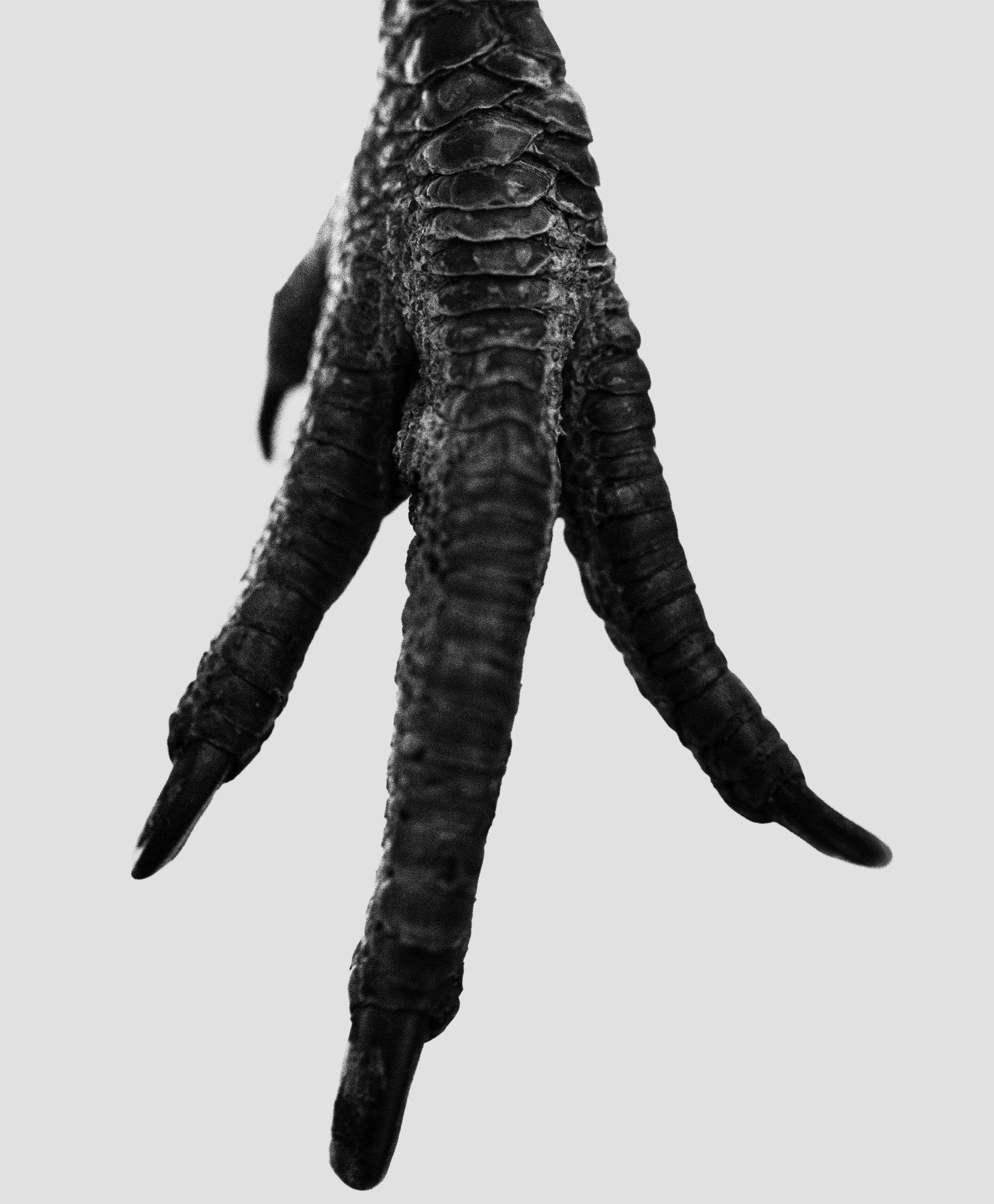
The avian creature is a stunning silver-gray, and as she succumbs, twitching in the lasernet, I find gratitude for two things: Firstly, that she remained silent. Secondly, that this will be the final instance.
Known as corpse doves—because the deepest hue of their gray feathers encircles the lighter shade, creating an illusion that skeletal faces are lurking behind trash cans and bushes—and their offense lies in their potential to transmit diseases that could affect humans. I open my palm, prompting my imprinted handheld to display, and capture an image to confirm the extermination. A beep from my palm indicates I’ve met my daily quota and, consequently, for the year.
I consider giving this one a proper send-off, a real burial accompanied by sacred words and some flowers, but then I hear a group of streetrats hooting nearby. My city-issued vest is reflective and nanopainted, emitting a subtle glow. I’m uncertain if it’s meant for our safety as claimed, or if it’s just to allow civilians to keep an eye on us ex-cons performing court-mandated labor. Regardless, everyone treats us like we’re invisible—everyone except for children.
I switch the lasernet on the bird from electrocute to incinerate and watch as what resembled a corpse turns to ashes.
“Hey there, executioner!” a girl calls out.
“Executioner” is not my official designation. The governmental branch we belong to is named the Department of Mercy, and we’re referred to simply as technicians. However, that detail is lost on the child, who appears no older than eight yet carries the authority of a judge as she points me out to her friends.

“Guys, look!” she exclaims, then focuses on me. “You hunting something big?”
I shake my head, slowly organizing my belongings.
“Something small?” she inquires. Her expression darkens. “You’re not a cat killer, are you?”
“No,” I quickly respond. “I handle horseflies.”
I’m uncertain why I lied, but as the suspicion fades from her face and a smile returns, I’m relieved I did.
“You should come down by the docks. We’ve got flies! You can make your quota in a day.”
The girl tosses her hair, causing the tinfoil charms entwined in her braids to jingle like wind chimes.
“It’s my last day. But if I get flies again next year, I’ll come by.”
Another falsehood, as we both understand the city would never send anyone to the docks for flies. Flies are exterminated as nuisances, meaning people only care about eliminating them from suburban areas and financial districts. They’d only dispatch a technician to the docks to eliminate something that posed a disease risk to the city or consumed more resources than desired.
LeeLee expects me to return home to endure the reassignments with her, and it’s already late, so I distribute a few of the combination warming and light sticks I received for winter to the group of children with nowhere to go. As I depart, their laughter resonates so loudly it feels like screams. They toss the sticks into the air like signal flares, small bright cries for help that will go unseen.
LeeLee’s anxiety manifests through caretaking, and as soon as I step through the door, I can scent the bread warming and the soup simmering on the stove. I remove my muffling boots. On another day, I would leave them on and sneak up on her just to be annoying, prompting her to spin around and threaten me with whatever cooking utensil was at hand. But today she’ll be especially anxious, so I take off the shoes that allow me to sneak up on nervous birds and stomp my way inside.
Sometimes it feels impossible that I can spend a year exterminating every fragile and defenseless creature I encounter while still being so gentle with Lee. But I convince myself that the killing isn’t truly me—it’s simply my punishment, and what I choose to do in my free time is what ultimately reflects who I am. For the first half of the year and 400 birds, I held onto that belief.
LeeLee forces a smile that lasts a mere three seconds upon seeing me before it clouds over once more.
“The soup’s too watery. There wasn’t enough powder for a proper broth.”
“I like watery soup,” I reply.
“Not like this. It doesn’t even mask the taste of the water.”
“I enjoy the taste of the water,” I say, which momentarily distracts her from her spiraling thoughts enough to elicit a roll of her eyes.
I place my hands on her shoulders to halt her fussing.
“The soup will be fine,” I assure her. “So will the reassignment.”
While I’m not significantly taller than she is, when we met in juvie, she hadn’t hit her final growth spurt yet, so she still tilts her head back to meet my gaze. “What if it’s not?”
“It will—”
“What if you receive whatever assignment Jordan got?”
And there it is. Because two of us didn’t leave juvie together to start community service—three of us did. But Jordan couldn’t endure even three weeks into his assignment before turning his tools on himself.
I notice she doesn’t say What if I end up with what Jordan got? Because LeeLee fears being left alone more than she fears having to harm something innocent.
“We have no idea what his assignment entailed,” I say.
This is true, but we do know it was terrible. Two weeks into our initial stint, a drug intended to sterilize the city’s feral cat population inadvertently produced the opposite result. Everyone was pulled from their assigned tasks for three days to eliminate litters of newborn kittens instead. It nearly shattered me and Lee, but Jordan appeared almost thankful.
“Besides, we don’t know if his assignment had any connection to … what he did. You’re borrowing trouble. Worry in”—I glance at my palm—“an hour, when you actually have something to be concerned about.”
You’d expect it to loom over us too insistently to ignore, but after we sit down and chat about our day, I feel relaxed, basking in her storytelling and the aroma of bread, which is more beige than gray today. When the notification arrives, I feel genuinely happy, and I can only hope it’s not for the last time.
We both tense when we hear the alert. She glances at me, and I respond with a smile and a nod, and then we both look down. During the brief interval between hearing the notification and checking it, I conjure a multitude of horrors that might appear in my assignment slot. I envision a picture of kittens, enough to warrant condemnation from the girl I met earlier. For a fleeting moment, I picture looking down and seeing my own face as the target, or LeeLee’s.
But when I finally view the file, the relief washing over me straightens my spine. It’s a plant. Faceless and bloodless.
I look up, and LeeLee’s gaze darkens as she leans in, scrutinizing my expression for the cracks she failed to detect in Jordan. I compel myself to smile broadly for her.
“It’s a plant. I received a plant, Lee.”
She reaches out and grips my hands. Hers tremble.
“What did you get?” I inquire.
She dismisses my question with a wave. “I got rats. I can manage it. I was just worried about you.”
The rest of the night I feel overwhelmingly joyous. For the upcoming year, I’ll be permitted to exterminate something that does not scream.
“Did you understand all that?” the man behind the desk asks, and I nod even if I didn’t.
I’ve traded in my boots and lasernet for a hazmat suit and a handheld mister containing two different solutions. The man had been informing me on how to utilize the solutions, but my process of comprehending verbal information is quite limited. The entire reason I ended up in a correctional facility as a teen was due to numerous educators misinterpreting my processing delays as behavioral issues. I plan to read the manual during my free time before I start in a few hours, but when I pick up the mister and peer down the barrel, the equipment guy panics.
“They were intended to add sulfur to this batch, but it didn’t happen. So you won’t notice it. It won’t induce coughing or watery eyes. It’ll merely be lights out. Good night. Are you with me?”
“Did you not hear me? Don’t even glance at that without your mask on.” He inhales, more composed now that I’ve lowered my hands. “Listen, the first solution—it’s fine. It’s specifically made for the plant and merely opens up its cells for whatever solution we apply to it. You could consume the stuff. But the second? The orange vial? Don’t even put it in the mister without your mask on. It dissipates rapidly, so you’re good once you finish spraying, but not a moment sooner.”
He scans the area, then leans in closer. “They were supposed to add sulfur to this batch, but they didn’t. So you won’t notice it. It won’t cause coughing or tearful eyes. It’ll simply be lights out. Good night. Are we clear?”
I nod again, grabbing the mask I hadn’t observed before. This time, when I express my gratitude, it’s sincere.
It takes me an hour to locate the first plant, and when I do it’s stunning. Lush pink on the inside and deep green on the outside, it appears resilient and primitive. Almost Jurassic. I understand why it’s only found in the sewers now: it would be far too easy to identify and eradicate aboveground amidst the concrete expanse.
Once I don my mask, I activate the mister and then step back as it sprays the plant with poison. Nothing occurs. I recall the preparing solution and switch the cartridges to coat it in that first. The next time I apply the poison, the plant wilts instantaneously, browning and collapsing like a deflating tire. I was incorrect. Plants of this size do not perish silently. It emits a wheezing noise, a deep exhale. After the third time I’ve heard it, I could almost make out the word Please.

Upon returning home, I find LeeLee has locked herself in the bathroom, which doesn’t surprise me. I’ve heard they switched to acid for rats, and the scent of a dissolving corpse is impossible to normalize and even harder to eliminate from your hair. I eat dinner, read, change for bed, and she’s still in the bathroom. I brush my teeth in the kitchen.
The following morning, I must take a transport to the plant’s habitat on the opposite end of the city, so I use the time to sift through the file that accompanied the assignment. Under “Characteristics,” some city government scientist has jotted down, “Large, dark. Resource-intensive. Stubborn.”
I fixate on the last word. Its own sentence, appended like an afterthought. Stubborn. The same term that was inscribed in my file when I was sent from the school to the facility where I met LeeLee and Jordan. Large, dark, stubborn, and condemned. I’ve never been labeled resource-intensive. But I have been deemed a waste.
And perhaps that’s why I carry on.
Upon reaching my final plant of the day, I don’t reach for the mister. This one is small and young, the green still shimmering brightly and the edges soft. I carefully lift it, mindful of its roots, and carry it home. Along the way, I discover a discarded water container and place it inside. When I arrive home, I knock on LeeLee’s door. She doesn’t respond, so I leave the plant on the floor as a peace offering. They aren’t proper flowers, but they carry a pleasant, earthy scent. It might help mitigate the lingering odor of melted organs, fur, and bones from overwhelming her room.
“Killing things is a foolish job,” the girl remarks.
After a week of hearing the death cries of its relatives, I decided to use some of my allowance to purchase inexpensive fertilizer and growth serum for my plant. The girl and her companions, fewer than before, were panhandling at the megastore across the street. She rushed over, her braids jingling, the moment she spotted me. I believed she would leave once I provided her more glowsticks for her friends, but she continued to trail me.
“It’s not a foolish job,” I assert, even though it is.
“What’s the purpose?”
I shift my bag to indicate the bottom of my vest. Beneath “Mercy Dept.” the department’s slogan is inscribed in cursive: Killing to Save!
“See?”
She reads the text but fails to comprehend it, prompting me to remember that even being expelled from school is a privilege. The city had chosen to cease squandering educational resources on me. They had never even attempted with her or the other streetrats.
“It simply implies we kill to assist.”
“That’s illogical.”
Suddenly, all I can think of is Jordan. “Perhaps they don’t mind.”
“What?”
I conjure thoughts of the plants. Maybe they hadn’t been pleading. Perhaps they’d been exhaling in relief. I visualize the birds that ultimately stopped fleeing.
“Perhaps they’re exhausted. The city’s correct, and their existence isn’t suited to the world we’ve constructed. And that’s our fault for being foolish and cruel, but it renders their lives exceedingly challenging. We’ve made it so they can only experience half a life. Maybe the least we can do is complete the task.”
It’s a dreadful thing to express—even worse to a child.
Her expression hardens. “What are you killing now, executioner?”
The inquiry catches me off guard. “Sewer plants. Why?”
“I don’t trust you.”
I desired her to leave me be, but as she races away, I suddenly feel hollow.
I encounter a problem at work when I can’t locate my poison vial. I tell them it rolled away in the sewer and I couldn’t catch it in time, as I don’t wish to admit that I was inattentive enough to allow a street kid to steal from me. After a stern warning and a mountain of paperwork, they provide me with a new vial without extending my service time.
Pulling overtime to compensate for the day I lacked my poison takes days before I can fertilize my houseplant. LeeLee’s door is ajar, so I bring in the fertilizer and serum. She’s placed the plant on her windowsill, but it prefers indirect sunlight, so I move it to the shelf beside her boxes of knickknacks and trinkets. I add the fertilizer to its soil and am about to spray it with the growth serum when inspiration strikes. I retrieve the mister from my kit and set it to spray the preparing solution on the small plant to prime it. I crack open the window and don my mask, just in case, though I’m convinced the man was truthful when he described the first liquid as harmless. After opening its cells, I spray it with my store-bought growth serum.
I’m halfway through dinner preparation when I hear the crash and dash into LeeLee’s room.
“Shit!”
The plant has grown exponentially, maturing instantly, and its newfound weight has toppled LeeLee’s shelf. Delicate keepsake boxes lie shattered on our concrete floor.
I drop to my knees rapidly, so focused on rectifying my mistake that I don’t recognize the strangeness of the items I’m picking up—jacks, children’s toys, a bow—until my fingers brush against something small and glimmering. It’s a scrap of silver, still rounded in the form of the braids from which it was taken.
I got rats. I can manage it.
I’d overlooked that the city has more than one kind.
I’m waiting up when Lee returns home. I don’t compel her to disclose anything. I simply take her kit and rummage through it. Where my kit contains a hazmat suit, hers has a stealth mesh to make her invisible. Where I store my mister, she has a gun loaded with vials too large for rats. I keep a mini-vac to remove excess plant matter to prevent seeds from sprouting. She has zip ties.
By the time I finish, she’s already cracking under the pressure of everything she attempted to shield me from. Within moments, she’s sobbing on the floor. I carry her to her bed and climb in beside her. I strive not to listen too closely as she recounts every dreadful moment, but I’m attentive at the end, when she admits she can’t endure it anymore. When she confesses that she’s the one who swiped my poison, and has merely been waiting to utilize it because she lacked the courage to do to me what Jordan did to us.
I assure her how we’ll transform dead data centers into playgrounds and use hoses to fill the voids left by skyscrapers, and children will play Marco Polo swimming over a CEO’s submerged office.
I leave her for just a brief moment, but by the time I recline in bed beside her, I’ve come up with a plan.
I inform her that she won’t need to take her shift tomorrow. I promise her I’ll traverse the city with my mister and growth serum. That I’ll relocate plants from sewers to the yards surrounding City Hall and all public spaces, along with the support pylons of influential companies, and then spray them so they flourish. The city will be in chaos. I explain that it will resemble the kittens, but this time we’ll all be yanked from our assignments to eliminate plants. Perhaps the serum will be too effective. Perhaps the city had reason to fear these plants, and they’ll continue to grow, overwhelming our concrete while their roots shatter our foundations and disrupt our electricity, leading everything to collapse. And those with something at stake might suffer, but the rest of us will simply laugh at the beauty of ruins. I envision how we’ll create playgrounds out of decaying data centers and use hoses to fill the gaps where skyscrapers once stood, where kids will play Marco Polo over a CEO’s submerged office.
She asks if I’ll position any at our old detention facility.
I tell her, Hundreds.
I talk long enough that her eyes gradually close, and loud enough that neither of us can perceive the sound of my mister spraying. The man who provided it to me was correct. Even without the mask, it lacks the scent of sulfur. It carries no odor at all.
Micaiah Johnson’s debut novel, The Space Between Worlds, a Sunday Times bestseller and New York Times Editors’ Choice pick, was named one of the best books of 2020 and one of the best science fiction books of the last decade by NPR. Her first horror novel, The Unhaunting, is due out in fall 2026.
