
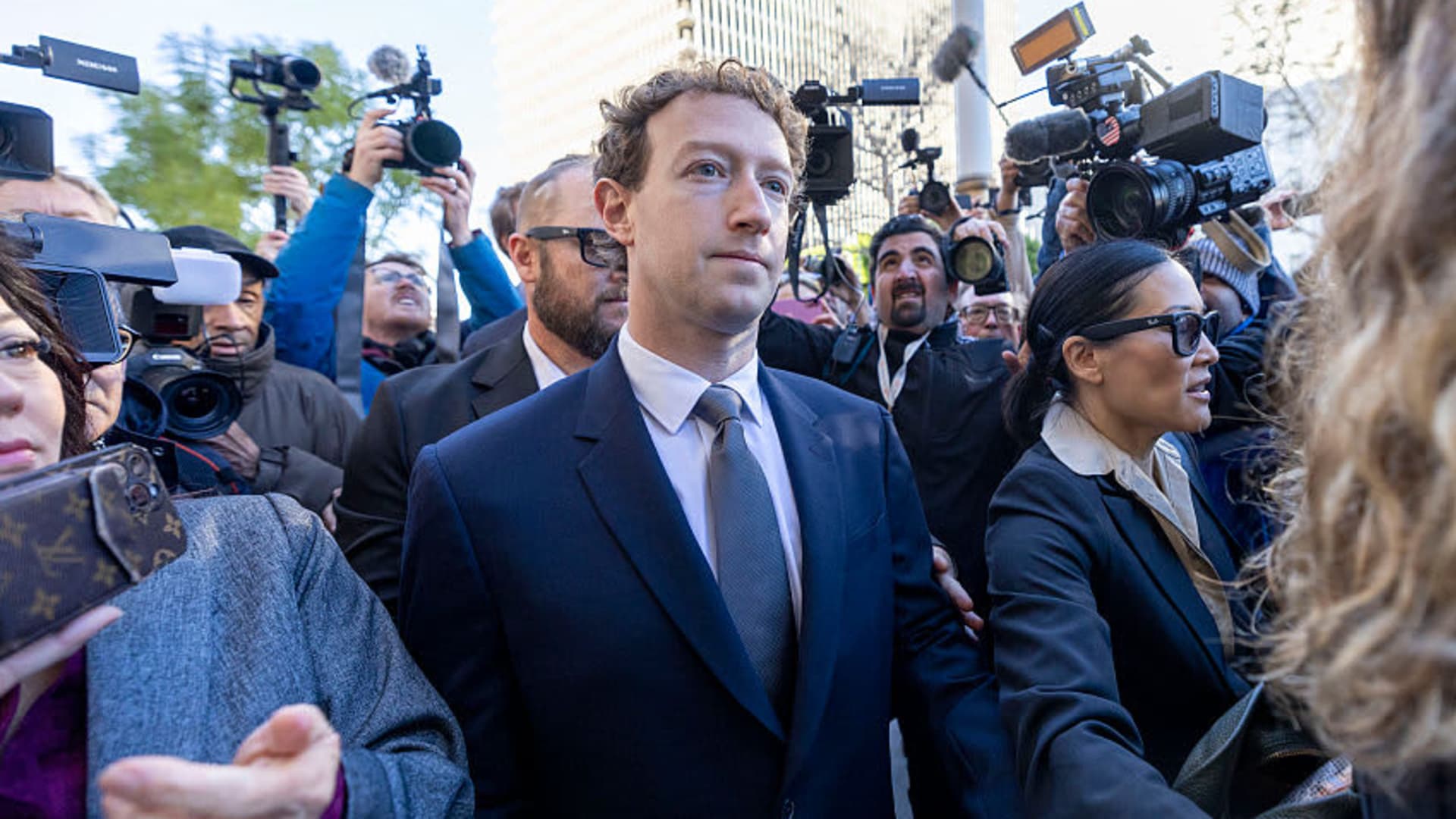

Meta CEO Mark Zuckerberg stated during a court appearance on Wednesday that he contacted Apple CEO Tim Cook to discuss the “wellbeing of adolescents and children.”
The remarks followed defense attorney Paul Schmidt highlighting an email correspondence between Zuckerberg and Cook from February 2018. “I believed there were possibilities that our company and Apple could pursue, and I wanted to discuss that with Tim,” Zuckerberg mentioned.
The email exchange served as part of a larger argument by the defense lawyer to demonstrate to the jury that Zuckerberg was more engaged regarding the safety of young Instagram users than what was initially presented in court by the opposing side, even going as far as to reach out to a business competitor.
“I am concerned about the wellbeing of the adolescents and children who utilize our services,” Zuckerberg expressed when discussing portions of the email.
Zuckerberg testified in a pivotal trial in Los Angeles Superior Court regarding social media and safety, which has been compared to the industry’s “Big Tobacco” moment.
The trial examined the purported harms of specific digital filters that promote cosmetic surgery, which Instagram head Adam Mosseri previously addressed earlier in the proceedings.
Zuckerberg noted that the company sought input from various stakeholders regarding beauty filters on Instagram, yet he did not name them. The plaintiff’s attorney probed Zuckerberg about communications revealing he lifted the ban due to it being perceived as “paternalistic.”
“That sounds like something I would express and something I believe,” Zuckerberg responded. “It seems a bit overbearing.”
Zuckerberg faced questioning about the decision to permit the feature despite guidance from specialists indicating that the beauty filters had adverse effects, especially on young girls.
He was specifically queried regarding a study from the University of Chicago in which 18 specialists stated that beauty filters as a feature cause harm to teenage girls.
Zuckerberg reiterated sentiments previously expressed by Mosseri in court that Meta ultimately opted to remove a temporary ban on cosmetic surgery digital filters without promoting them to additional users.
Defense lawyer Mark Lanier noted that Facebook’s vice president of product design and responsible innovation, Margaret Stewart, stated in an email that while she supported Zuckerberg’s final decision, she felt it was not the “right call considering the risks.” She mentioned in her correspondence a personal family situation that she recognized may have influenced her views but provided her “first-hand knowledge” of the alleged harms.
Zuckerberg mentioned that many Meta employees have differing opinions regarding the company’s choices, a practice the company encourages, and although he respected Stewart’s viewpoint, there was ultimately insufficient causal evidence to back the claims of harms from external experts.
When Lanier inquired if Zuckerberg possessed a college degree that would demonstrate expertise in causation, the Meta CEO replied, “I do not have a college degree in anything.”
“I acknowledge that I do not understand the legal concept of causation well, but I believe I have a decent grasp of how statistics function,” Zuckerberg declared.
The trial, which commenced in late January, centers around a young woman who claims she became addicted to social media and video streaming platforms such as Instagram and YouTube.
The Facebook founder resisted the implication that the social media firm prioritized increasing time spent on Instagram as a company objective.
Zuckerberg addressed a 2015 email conversation where he seemed to underscore enhancing engagement metrics as urgent for the company.
While the email thread may have featured the terms “company goals,” Zuckerberg asserted that those comments could have been aspirational and insisted that Meta does not have those objectives.
Later, lawyers referenced evidence from Mosseri, which included aspirations to boost daily user engagement time on the platform to 40 minutes by 2023 and 46 minutes by 2026.
Zuckerberg stated that the company employs milestones internally to compare with competitors and “achieve the outcomes we aim to see.” He maintained that the company is developing services to foster connections among people.
Attorneys also raised concerns regarding whether the company has sufficiently acted to eliminate underage users from its platform.
Zuckerberg testified that some users deceive about their age when registering for Instagram, which mandates that users must be 13 years or older. Lawyers also presented a document indicating that 4 million children under 13 utilized the platform in the U.S.
The Facebook founder asserted that the company removes all identified underage users and includes age-related terms during the sign-up process.
“You expect a 9-year-old to read every single detail,” a lawyer for the plaintiff challenged. “Is that your reasoning for swearing under oath that minors under 13 are prohibited?”
Instagram only began requiring birthdays at sign-up in late 2019. At various intervals, Zuckerberg mentioned his belief that age verification is better suited for companies such as Apple and Google, which operate mobile systems and app stores.
Zuckerberg later responded to inquiries regarding documents in which the company noted a higher retention rate on its platform for users who join as tweens. He asserted that lawyers were “misrepresenting” his statements and that Meta does not always launch products under development, such as an Instagram app for users below 13.
During Wednesday’s proceedings, Judge Carolyn B. Kuhl warned that anyone using AI smart glasses during Zuckerberg’s testimony would be held in contempt of court.
“If you have done so, you must erase that, or you will be held in contempt of court,” the judge stated. “This is extremely serious.”
Members of the team accompanying Zuckerberg into the building just prior to noon ET were seen wearing the Meta Ray-Ban AI glasses.
Recording is prohibited in the courtroom.
Lawyers also questioned whether Zuckerberg previously misled about the board’s inability to dismiss him.
“If the board wants to terminate me, I could choose a new board and reinstate myself,” he remarked, responding to comments he made on Joe Rogan’s podcast.
In his interview with the podcaster the previous year, Zuckerberg noted he was not concerned about losing his position due to his voting influence.
Zuckerberg informed the courtroom that he is “not good” at dealing with media.
Lawyers representing the plaintiff argue that Meta, YouTube, TikTok, and Snap deceived the public about the safety of their services and were aware that the design of their applications and specific features caused mental health issues in young users.
Snap and TikTok settled with the plaintiff involved in this case before the trial commenced.
Meta has denied the accusations, and a spokesperson informed CNBC in a statement that “the key question for the jury in Los Angeles is whether Instagram contributed significantly to the plaintiff’s mental health difficulties.”
Last week, Instagram’s Mosseri asserted that while he recognizes that social media can exhibit problematic usage, he does not consider that equates to clinical addiction.
“It’s a personal matter, but yes, I do think it is possible to use Instagram more than is beneficial,” Mosseri remarked. “Excess is relative; it’s subjective.”
The Los Angeles trial is among multiple significant court cases happening this year that experts have referred to as the social media sector’s “Big Tobacco” moment due to the claimed damage caused by their products and related corporate efforts to mislead the public.
Meta is also a participant in a significant trial in New Mexico, where the state’s attorney general, Raúl Torrez, claims that the social media giant failed to guarantee that children and young users are safeguarded from online predators.
“What we are fundamentally alleging is that Meta has created a hazardous product, one that facilitates not only the targeting of children but the exploitation of children in both virtual environments and the physical world,” Torrez expressed to CNBC’s “Squawk Box” last week during the opening statements for the case.
This summer, another social media trial is expected to commence in the Northern District of California. That trial also involves firms such as Meta and YouTube and allegations that their respective applications contain deficiencies that encourage detrimental mental health challenges in younger users.
CNBC’s Jennifer Elias contributed reporting.
WATCH: New Mexico AG Raul Torrez discusses his case against Meta