
This matters because it indicates these rocks were unlikely to have been altered in a hydrothermal setting, where boiling water was briefly released when ice melted due to volcanism or an impact.
Rather, they seem to have been changed under mild temperatures and sustained heavy rainfall. The researchers identified clear parallels between the chemical makeup of these clay pebbles and clays on Earth from eras when our planet’s climate was considerably warmer and wetter.
Credit:
NASA
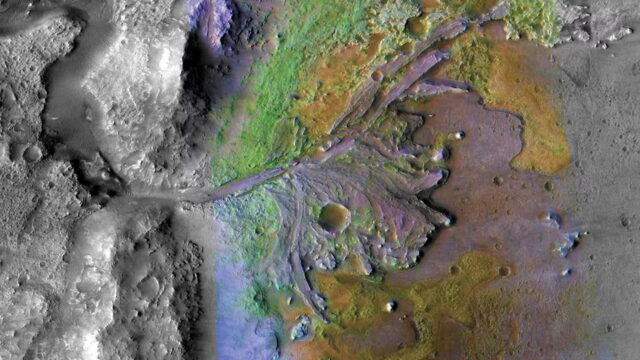
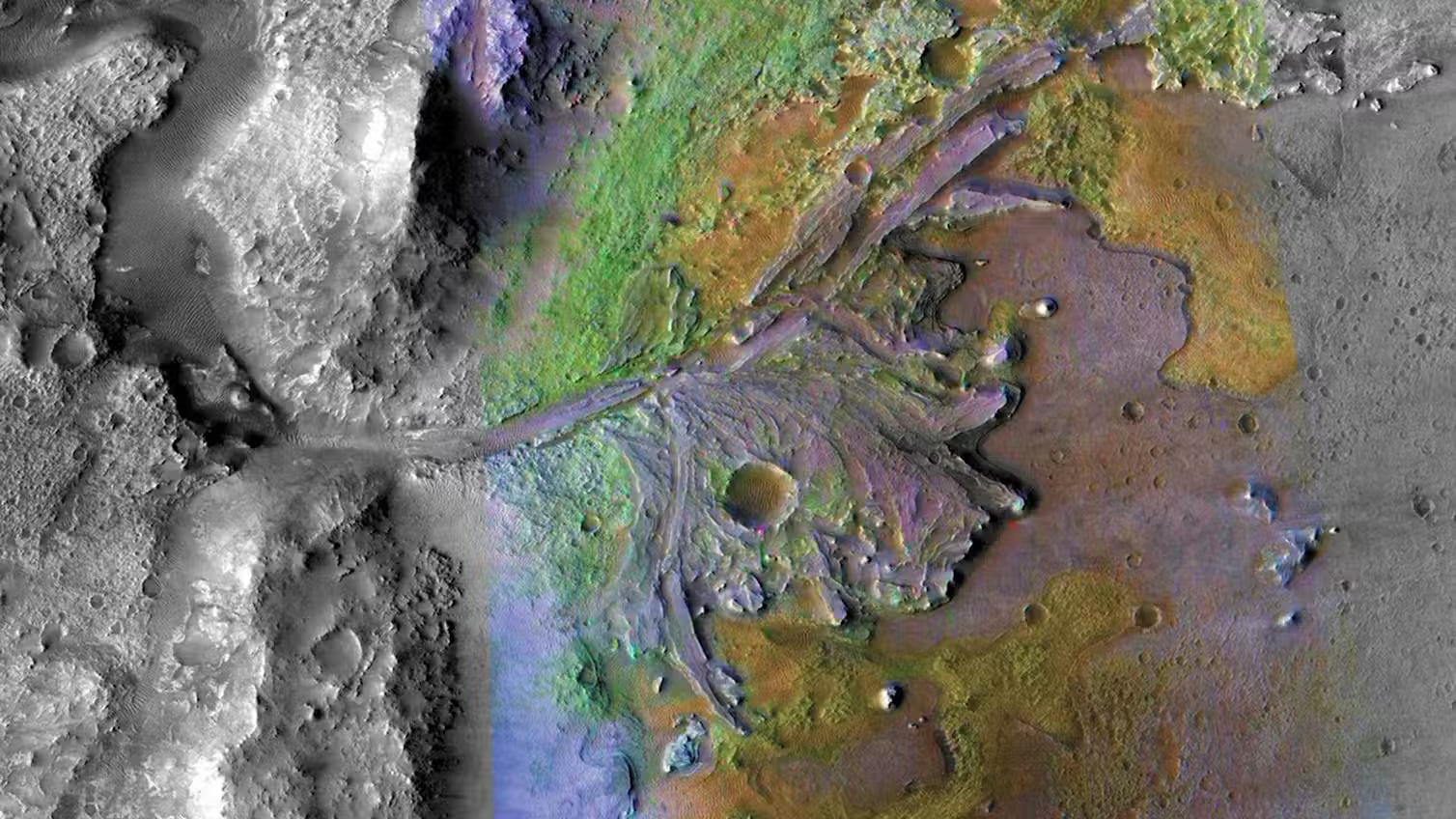
False-colour view of the dried river delta in Jezero crater that Perseverance is exploring now.
Credit:
NASA
The study concludes these kaolinite pebbles were modified under heavy-precipitation conditions comparable to “past greenhouse climates on Earth” and that they “likely represent some of the wettest intervals and possibly most habitable portions of Mars’ history”.
Moreover, the paper suggests these conditions could have persisted for spans ranging from thousands to millions of years. Perseverance also recently made headlines for finding possible biosignatures in samples it collected last year, likewise from within Jezero crater.
Those valuable samples are now stored in sealed containers on the rover awaiting recovery by a future Mars sample-return mission. Unfortunately, that mission was recently cancelled by Nasa, so any crucial evidence they may hold is unlikely to be examined in Earth laboratories for many years.
Central to any future analysis is the so-called “Knoll criterion” – an idea proposed by astrobiologist Andrew Knoll that argues evidence of life must not merely be consistent with biology; it must be impossible to explain without it. Whether these samples will ever satisfy the Knoll criterion will only be known if they can be returned to Earth.
In any case, it is striking to imagine a time on Mars, billions of years before humans walked the Earth, when a tropical climate — and possibly a living ecosystem — once existed in the now barren, wind-swept landscape of Jezero crater.
Gareth Dorrian is a postdoctoral research fellow in space science at the University of Birmingham
This article is republished from The Conversation under a Creative Commons license. Read the original article.
