
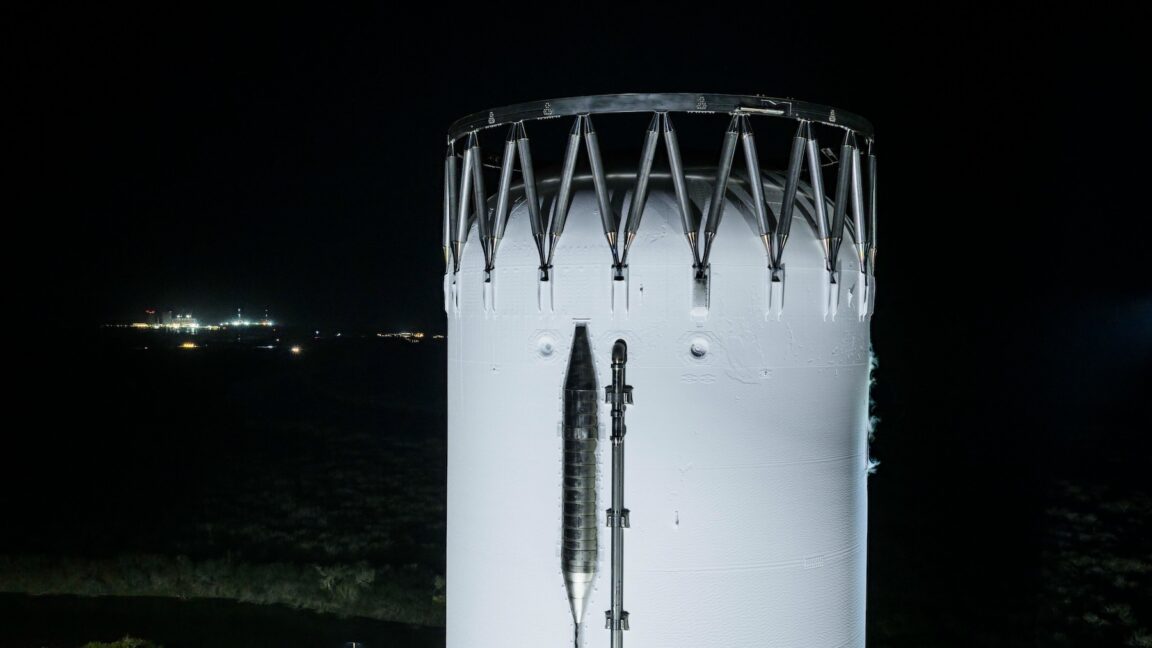
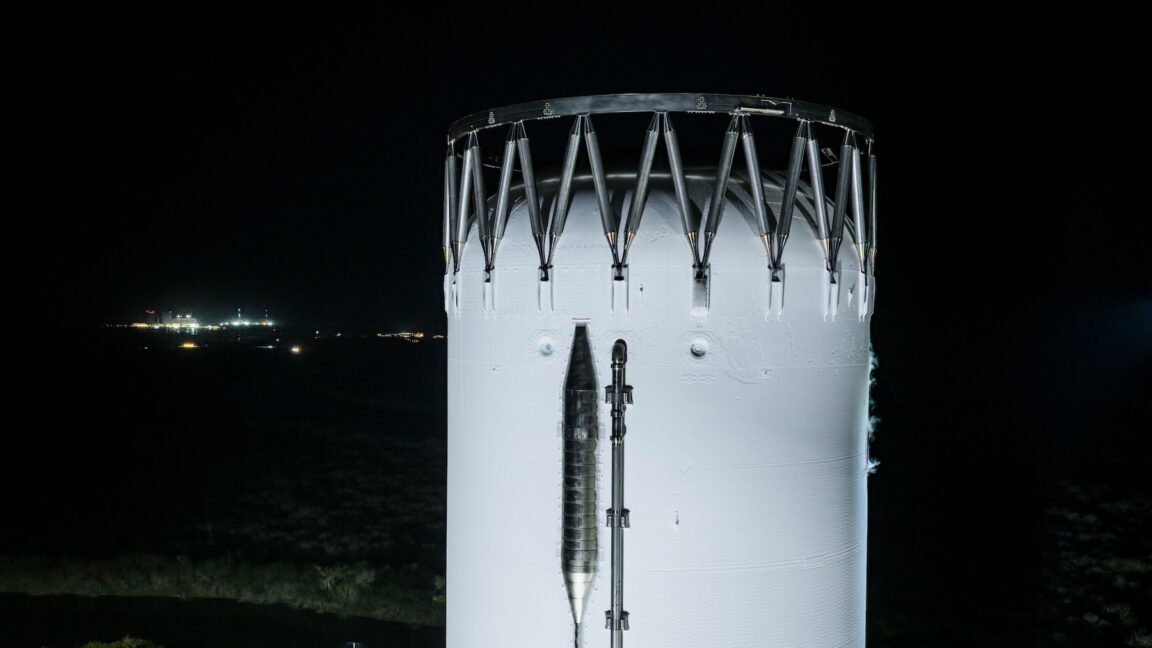
The improved Super Heavy booster intended to carry SpaceX’s next Starship mission has passed cryogenic proof testing, removing the obstacle that destroyed the company’s earlier booster.
SpaceX shared the achievement in a social post Tuesday: “Cryoproof operations finished for the first time on a Super Heavy V3 booster. This multi-day campaign evaluated the booster’s redesigned propellant systems and its structural integrity.”
At Starbase, Texas, crews moved the 237-foot-tall (72.3-meter) stainless-steel booster out of its factory and a short distance to Massey’s Test Site last week. Technicians first ran an ambient pressure check, then filled the rocket with super-cold liquid nitrogen on four occasions over six days, subjecting the booster to repeated thermal and pressurization cycles. The nitrogen stood in for the cryogenic methane and liquid oxygen that will occupy the propellant tanks at launch.
The proof test is significant because it advances engineers toward flying the first test of an upgraded iteration of SpaceX’s giant rocket, called Starship V3 or Block 3. SpaceX flew the prior Starship V2 version five times last year; the initial three tests failed, while the final two met the company’s objectives, paving the way to V3.
Improved outcome this time
The Super Heavy booster originally slated for the first Starship V3 test flight failed during a pressure test in November. The rocket’s liquid oxygen tank burst under pressure, prompting SpaceX to retire that booster and move on to the next one in line—Booster 19. That Super Heavy unit appears to have passed the stress testing, and SpaceX returned it to the factory early Monday. There, crews will install 33 Raptor engines on the rocket’s base and attach the booster’s grid fins.
These parts differ from the Starship V2 configuration. The Raptor engines introduced on Starship V3 deliver greater thrust and include modifications aimed at boosting reliability, according to SpaceX. The Raptor 3 engines are lighter, with plumbing and sensors integrated into the engine structure itself, removing the need for separate heat shields between engines at the rocket’s base.