Jaroslav Lukivand
Ana Faguy,on Capitol Hill in Washington DC
The United States has reported that it has taken possession of two tankers connected to oil exports from Venezuela in consecutive operations in the North Atlantic and Caribbean regions.
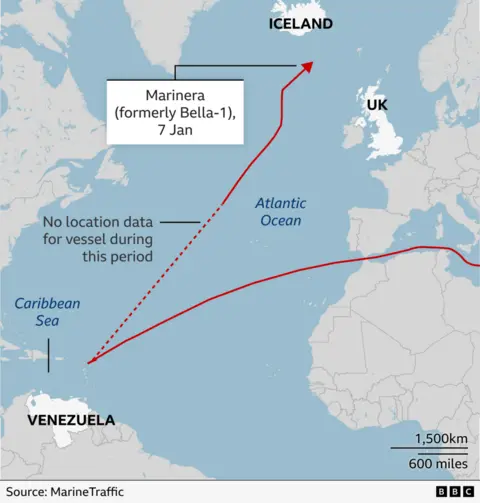
US forces intercepted the Russian-flagged Marinera after pursuing it for nearly two weeks while it traversed the seas between Iceland and Scotland. The Royal Navy of the UK provided logistical assistance by air and sea.
Additionally, the US accused a second tanker, the M/T Sophia, of engaging in “illicit activities” and boarded it in the Caribbean.
These actions coincide with the US’s efforts to restrict most Venezuelan crude oil exports and shortly follow the seizure of Venezuelan President Nicolás Maduro by special forces during a rapid operation at his residence in Caracas.
Defence Secretary Pete Hegseth stated on X: “The blockade of sanctioned and illegal Venezuelan oil remains in FULL FORCE – anywhere globally.”
Moscow has condemned the capture of the tanker under its flag, demanding the US to treat the Russians aboard appropriately and allow for their swift return to Russia.
The transport ministry declared it had granted the vessel “temporary authorization” to fly the Russian flag, asserting that no nation has the right to exert force against vessels duly registered under other countries’ jurisdictions.
Reports indicated that Russia sent a submarine to protect the vessel; however, it seems US forces boarded the tanker without encountering resistance.
The White House labeled the ship a “Venezuelan shadow fleet vessel considered stateless after displaying a false flag and had a judicial order” against it.
According to US Secretary of State Marco Rubio, Venezuela’s leadership is cooperating with the US regarding the second tanker seized in the Caribbean.
“They realize that the sole option to transport oil and generate income while avoiding economic collapse is to collaborate and partner with the United States,” he informed reporters.
Previously, US President Donald Trump noted that Venezuela – home to the largest proven oil reserves globally – “will be turning over” as much as 50 million barrels of oil valued at approximately $2.8 billion (£2.1 billion) to the US.
Rubio, who briefed US legislators on the ongoing operations in Venezuela on Wednesday, stated that the US would sell oil located in Venezuela “in the market at prevailing rates” and that the US would oversee how the profits are distributed “in a manner that benefits the Venezuelan populace”.
He indicated that the US has a well-conceived strategy for Venezuela’s future, asserting that the administration was “not just improvising”.
Rubio remarked that the Trump administration’s strategy in Venezuela involves stabilization, recovery, and eventual transition.
However, the discussions surrounding oil were only one aspect of the concerns US lawmakers possessed regarding the escalating crisis.
Senate Majority Leader Chuck Schumer emphasized the necessity for answers to lingering inquiries about the number of US troops that might be involved and the financial implications of US engagement in Venezuela.
Republicans generally appeared to support the administration’s actions in the area, although some expressed worries regarding the level of influence Congress holds.
The Senate is anticipated to vote next week on a bipartisan war powers resolution – an effort to restrict ongoing military operations in Venezuela. A war powers resolution – established following the Vietnam War – constrains a president’s authority to deploy US armed forces in hostilities without congressional consent.
“If we are going to pursue continued involvement in the forthcoming phase, I believe it must be subject to [war powers],” said North Carolina’s Thom Tillis.
Meanwhile, Missouri’s Josh Hawley remarked that if the administration’s actions amount to a law enforcement operation, then it does not necessitate congressional approval, but “if it’s a military campaign involving a foreign head of state, even one we do not officially recognize, that represents a significantly different scenario”.
China – the leading consumer of Venezuelan oil in recent times – has criticized the US actions, accusing it of endangering global energy security.
 US European Command
The US military announced the seizure of the two tankers in distinct social media posts on Wednesday.
The US European Command stated that the M/V Bella 1 – using the previous name of the Marinera – was boarded “for breaching US sanctions”.
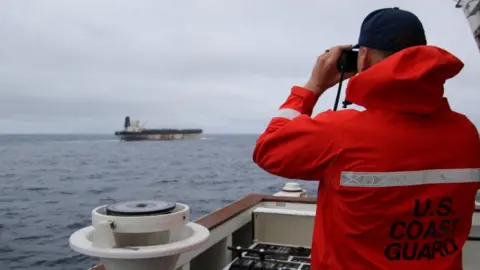
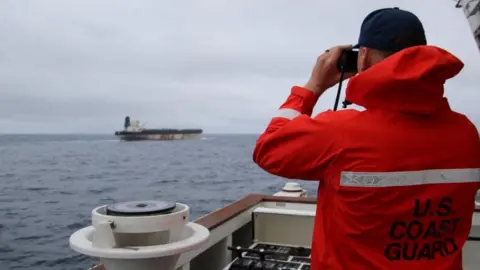
“The vessel was seized in the North Atlantic under a warrant issued by a US federal court following its tracking by USCGC Munro,” a cutter from the Coast Guard.
The Ministry of Defence of Britain noted that RAF surveillance aircraft and a naval support ship, the RFA Tideforce, were among the UK military assets involved in the operation at the request of the US for assistance.
Defence Secretary John Healey stated that the operation was “in complete adherence to international law” and “part of global initiatives to combat sanctions-violating activities”.
The vessel has been accused of violating US sanctions and transporting Iranian oil.
Images released by the Russian state media RT display a helicopter hovering near a ship identified as the M/V Bella 1.
The Russian Maritime Register of Shipping indicates that the tanker had renamed to Marinera and was sailing under the Russian flag with its home port designated as the southern Russian city of Sochi on the Black Sea.
The Russian transport ministry reported that US forces boarded the Marinera around 15:00 Moscow time (1200 GMT), after which communication with the vessel was lost.
US officials mentioned that the Marinera was fraudulently flying the Guyanese flag last month, rendering it stateless.
Experts informed BBC Verify that the US referred to the ship as Bella 1 since a vessel cannot alter its flag during a voyage unless there was an actual transfer of ownership or change of registry.
Additionally, experts indicated that under UN international maritime regulations, a stateless vessel may be boarded by authorities.
In a separate announcement, the US Southern Command declared on Wednesday that the defense and homeland security departments “captured a stateless, sanctioned dark fleet motor tanker without incident”.
“The confiscated vessel, M/T Sophia, was operating in international waters and engaging in illegal activities in the Caribbean Sea. The US Coast Guard is escorting M/T Sophia to the US for final processing.”
The US Southern Command also shared a video depicting a helicopter circling over a vessel.
Homeland Security Secretary Kristi Noem stated that “in two early morning operations today, the Coast Guard executed back-to-back, meticulously coordinated boarding of two ‘ghost fleet’ tanker vessels”.
She noted that both captured ships “were either most recently docked in Venezuela or heading towards it”.