
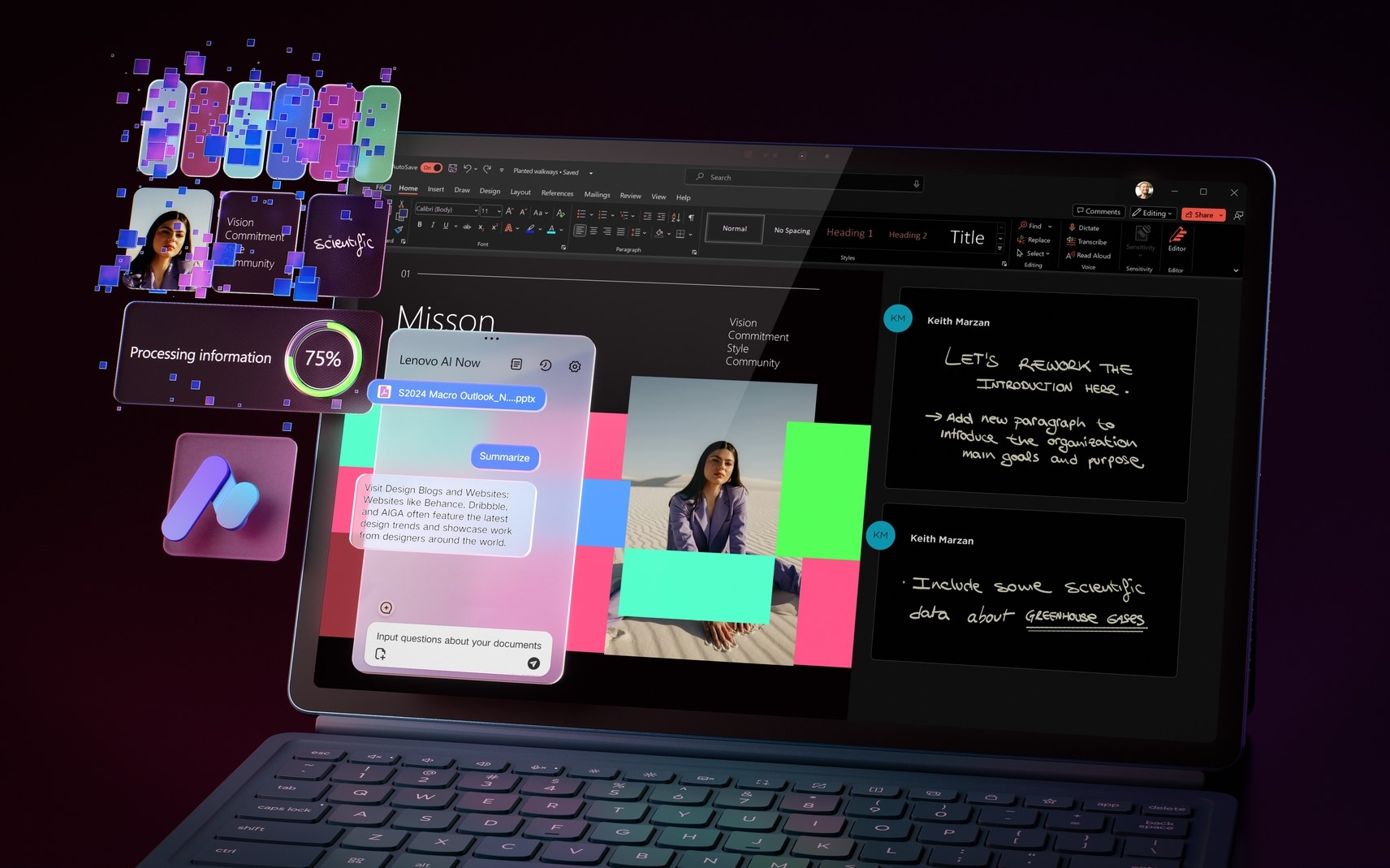

Qira, Lenovo’s most significant AI initiative to date, is designed to operate across Lenovo laptops and Motorola devices.
Qira, Lenovo’s most significant AI initiative to date, is designed to operate across Lenovo laptops and Motorola devices.


While much of the focus in the AI competition is on model creators and cloud services, Lenovo is closer to millions of consumers than many other firms. As the world’s leading PC manufacturer by volume, Lenovo sells tens of millions of units annually. What it decides to produce, package, and integrate can significantly influence how AI impacts everyday lives.
This made Lenovo’s announcement today at CES significant. At a vibrant event on Tuesday at The Sphere in Las Vegas, it unveiled Qira, a system-level, cross-device AI assistant intended to function across Lenovo laptops and Motorola smartphones. It represents Lenovo’s most daring AI initiative thus far and offers a rare glimpse into how a hardware leader with global presence is contemplating deeper AI integration.
Jeff Snow, Lenovo’s AI product leader, shared insights on how Qira was developed, the rationale behind the company’s choice to avoid a sole exclusive AI partnership, as well as lessons learned from past endeavors like Moto AI and Microsoft’s Recall issues.
According to Snow, Qira was born from a significant yet quiet internal restructuring less than a year ago. Lenovo consolidated AI teams from specific hardware divisions like PCs, tablets, and smartphones into a new software-centric group that collaborates across the entire organization.
For a firm historically focused on hardware models and supply chains, this transition represents a dedication to placing AI at the forefront. “We aimed for an integrated cross-device intelligence that assists you throughout your day, learns from your engagements, and can take action on your behalf,” Snow indicated. He noted using Qira’s on-device model during his flight to CES to refine how to present the news in discussions based on the notes and materials on his PC.
Qira is not centered around a single dominant AI model. Instead, it operates modularly. Internally, it combines local, on-device models with cloud-based counterparts, bolstered by Microsoft and OpenAI frameworks accessed via Azure. Stability AI’s diffusion model is also integrated, alongside collaborations with application-specific partners like Notion and Perplexity.
“We didn’t wish to bind ourselves to one model,” Snow remarked. “This industry is evolving too rapidly. Various tasks require different considerations regarding performance, quality, and expense.”
This perspective contrasts sharply with the pressures from prominent AI laboratories, many of which would gladly become the exclusive intelligence layer for a company with Lenovo’s scale. Lenovo believes that flexibility is essential, particularly because of its control over one of the largest consumer computing distribution networks worldwide.
Snow previously worked on Moto AI, Motorola’s assistant, which he noted had impressive initial engagement. Over half of Motorola’s user base tried it, but retention was poor. He mentioned that too much of the experience resembled prompt-driven chat functionalities that users could already access elsewhere.
“That steered us away from competing with chatbots,” Snow stated. “Qira focuses on capabilities that chatbots cannot provide, such as continuity, context, and taking direct actions on your device.”
Lenovo also took heed of the backlash concerning Microsoft’s Recall functionality. Snow remarked that Qira is designed from the ground up with opt-in memory, continual indicators, and transparent user controls. Context ingestion is optional, recording is noticeable, and nothing is collected without user consent.
Cost considerations are a major concern for this initiative. Memory costs are climbing as AI demand stretches supply chains, and analysts anticipate PC prices will follow suit. Snow stated that Qira does not increase the baseline system requirements for PCs; however, its performance is optimized for higher-end machines with greater RAM. Lenovo is aiming to scale down local models to operate on smaller memory infrastructures, like 16 gigabytes of RAM, without compromising the user experience.
From a strategic standpoint, Lenovo views Qira as both a means of customer retention and a safeguard against hardware commoditization. In the near term, it hopes that enhanced integration between laptops and phones will prompt customers to remain within the Lenovo ecosystem. Over the long haul, Snow characterized Qira as a method to set Lenovo devices apart when specifications alone become insufficient.
