Grace Eliza Goodwin
 Reuters
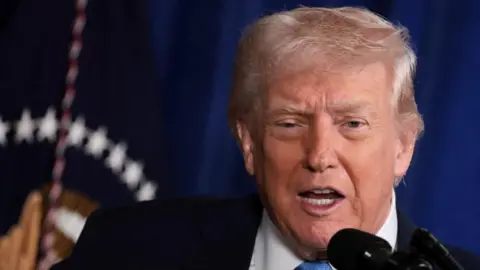
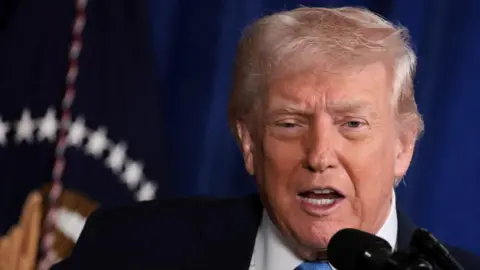
Donald Trump has cautioned Venezuela’s new president Delcy Rodríguez that she could “face significant consequences, likely more severe than Maduro” if she “fails to act appropriately”.
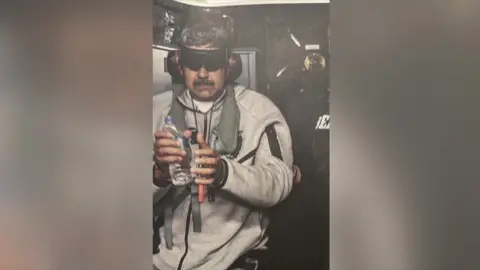
His remarks to US publication The Atlantic arose as the ousted president Nicolás Maduro was to make an appearance in a New York court on Monday.
The US charges Maduro, who faces accusations of drug trafficking and arms violations, with operating a “narco-terrorist” state, a claim he refutes.
Rodríguez – who was Maduro’s vice president – took a gentler tone during her inaugural cabinet meeting on Sunday, extending an offer of collaboration with the US.
“We welcome the US government to work together with us on a collaborative agenda aiming for mutual development within the scope of international law,” she stated.
Supported by Venezuela’s Supreme Court and the military, she will be inaugurated as president on Monday in Caracas, at 08:00 local time (12:00 GMT).
US Secretary of State Marco Rubio has stressed that the US is not waging war against Venezuela, following air strikes in Caracas on Saturday that resulted in the capture of Maduro and his wife, who were then relocated to the US.
Some Democratic legislators described the operation as an “act of war”.
In an interview with The Atlantic on Sunday, Trump remarked on Rodríguez: “If she fails to act correctly, she will face significant consequences, possibly even worse than Maduro.”
He added that for Venezuela, “Regime change, or however you want to label it, is preferable to what currently exists. It can’t get worse.”
 Donald Trump
On Saturday, Trump had committed that the US would “manage” the nation until “a secure, proper, and thoughtful transition” could be achieved.
Trump also asserted that US oil firms would enter the country to repair infrastructure “and initiate generating revenue for the nation”.
Despite the assertions made by the US president, Maduro’s supporters remain in control.
The Cuban government reported that 32 “valiant Cuban soldiers” lost their lives during the US forces’ raid that led to the apprehension of Maduro and his spouse. Cuba – a longstanding socialist ally of Maduro – declared two days of national mourning.
In multiple television interviews on Sunday morning, Rubio reiterated support for the US’s military engagement in Venezuela, emphasizing it does not signify that the US is at war with the South American nation.
“We are in conflict with drug trafficking syndicates. That does not equate to a war against Venezuela,” Rubio informed NBC’s Meet the Press on Sunday morning.
The Secretary of State also conveyed to CBS that if Venezuela does not “make the right choices”, the US “will maintain various forms of influence to ensure that our interests are safeguarded”.
This includes the “quarantine” imposed by the US on Venezuelan oil, he stated.
“We’re going to assess everything based on their actions, and we will observe what they do,” he added.
Trump also issued threats towards Colombia, speaking to journalists aboard Air Force One.
He did not dismiss the possibility of military measures against Colombia, expressing that “it sounds appealing to me”, and labeled Colombian President Gustavo Petro as “a disturbed individual”.
“Colombia is extremely unwell, too, governed by a deranged individual who enjoys producing cocaine and selling it in the United States, and he won’t be able to do it for long,” Trump stated.
 AFP via Getty Images
Maduro, who heads the United Socialist Party of Venezuela and has held power since 2013, has been accused multiple times of suppressing opposition factions and silencing dissent in Venezuela, occasionally through violent means.
He is broadly viewed by adversaries both domestically and internationally as having illegitimately secured victory in Venezuela’s 2024 elections.
Venezuela’s leftist leader and his spouse, Cilia Flores, were apprehended at their residence and flown to the US, as part of a dramatic special forces operation in the early hours of Saturday that involved strikes on military installations.
The couple has since been charged with arms and drug-related offences and are due to appear in a New York court on Monday.
Maduro has denied being involved with drug cartels and has accused the US of utilizing its “war on drugs” as a pretext to attempt to overthrow him and acquire Venezuela’s oil resources.
While US officials have stated that no American soldiers were harmed during the operations, Venezuela’s Defence Minister Vladimir Padrino claimed that a “significant portion” of Maduro’s security force, along with “soldiers and innocent civilians” were killed in the US mission.
When queried why congressional approval was not sought prior to the US operation in Venezuela, Rubio explained to ABC that it “wasn’t necessary as this wasn’t an invasion”.
He classified it as a “law enforcement operation” and stated that Maduro was taken into custody on-site by FBI agents.
You cannot inform Congress of an operation of this nature because “it will leak”, he added.
In conversations with US media, Rubio was asked if the US acknowledges Rodríguez as the rightful president of Venezuela.
He replied that “this isn’t about the legitimate president” since the US does not perceive the regime as legitimate.
 AFP via Getty Images
Numerous Democratic legislators have criticized the administration’s actions.
House Minority Leader Hakeem Jeffries remarked that the covert military operation, which took place without congressional authorization, “was not merely a narcotics operation”.
“It was an act of war,” Jeffries stated during NBC’s Meet the Press.
“This was a military endeavor involving Delta Force, the army, clearly involving thousands of personnel, utilizing at least 150 military aircraft, possibly involving numerous ships off the shores of Venezuela and South America.”
Jim Himes, the highest-ranking Democrat on the House intelligence committee, informed CBS Face the Nation that he had received “no outreach” from the Trump administration, adding “no Democrat that I’m aware of has had any outreach”.
In an interview with ABC This Week, Senate Minority Leader Chuck Schumer questioned the legality of the US operation.
Schumer indicated that while he considers Maduro to be a terrible figure, “You don’t address lawlessness with further lawlessness”.
“We’ve learned over the years that when America attempts regime change and nation building in this manner, the American people bear the consequences in terms of both blood and dollars,” Schumer commented.
Both Schumer and Jeffries pledged to support a resolution which, if passed by both legislative chambers, would prevent Trump from taking any further action in Venezuela without Congressional consent.
In a joint statement, the governments of Brazil, Chile, Colombia, Mexico, Uruguay, and Spain asserted that the military interventions by the US “constitute an exceedingly perilous precedent for peace and regional stability and jeopardize the civilian population”.
Further reporting by Laurence Peter