
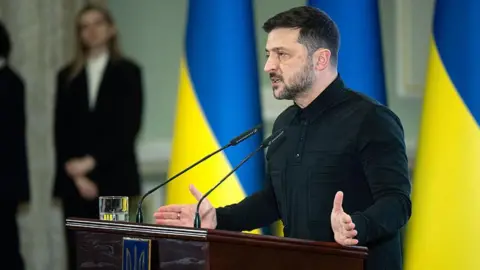

Volodymyr Zelensky of Ukraine has outlined an updated peace proposal that includes the possibility of withdrawing Ukrainian forces from the eastern region and establishing a demilitarized zone in their stead.
While detailing the 20-point plan that US and Ukrainian representatives settled on in Florida over the weekend, Zelensky stated that Russia would provide a response on Wednesday following discussions with the Americans.
He characterized the plan as “the primary framework for concluding the conflict,” indicating it suggests security assurances from the US, NATO, and European nations for a coordinated military response should Russia re-invade Ukraine.
When addressing the significant issue of Ukraine’s eastern Donbas region, Zelensky pointed to a “free economic zone” as a feasible alternative.
He informed reporters that given Ukraine’s opposition to withdrawal, US negotiators aimed to create a demilitarized zone or a free economic zone. Any region vacated by Ukrainian forces would need to be monitored by Ukraine, he emphasized.
“There are two alternatives,” Zelensky remarked, “either the conflict continues, or we must reach a conclusion regarding all potential economic zones.”
The 20-point plan is perceived as a revised version of the original 28-point document earlier reached by US envoy Steve Witkoff and the Russians weeks ago, which was viewed as heavily aiming to meet the Kremlin’s demands.
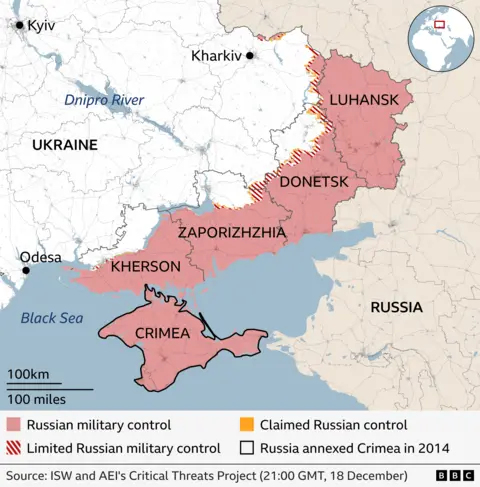
The Russians have maintained that Ukraine must retreat from nearly a quarter of its territory in the eastern Donetsk region in exchange for a peace agreement. The remainder is already under Russian control.
Sensitive matters, including territorial disputes, would need to be handled “at the leadership level,” though the updated draft would offer Ukraine strong security guarantees along with a military capacity of 800,000, Zelensky clarified.
A considerable portion of the revamped plan reflects the outcomes of recent discussions in Berlin involving US negotiators Witkoff and Jared Kushner alongside Ukrainian and European leaders. The dialogue shifted to Miami last weekend, where President Donald Trump’s team engaged separately with Russian envoy Kirill Dmitriev and then with Ukrainian and European representatives.
There seems to be enhanced elaboration on the territorial concerns, though it is evident that the Ukrainian side struggled to achieve consensus with the Americans.
Zelensky clarified that if Ukraine was willing to withdraw its heavy forces between five, ten, or forty kilometers in the 25% of Donetsk it controls to establish an economic zone, effectively demilitarizing it, then Russia would be obliged to do likewise “in accordance with the same distances.”
Currently, Russian troops are positioned about 40km (25 miles) east of Ukraine’s “fortress belt” cities of Sloviansk and Kramatorsk, having seized the town of Siversk.
Russian President Vladimir Putin is not expected to be favorably inclined toward the compromises proposed for Donetsk. Earlier this month, he stated that Russia would acquire control over the entire eastern region of Ukraine by force if Ukrainian forces did not withdraw.
However, Trump is advocating for a resolution to terminate nearly four years of extensive conflict, and the Ukrainian president believes Russia cannot afford to turn down the US proposal.
“They cannot inform President Trump that they are opposed to a peaceful resolution,” Zelensky stated to the press. “If they attempt to obstruct everything, then President Trump must heavily arm us while imposing all conceivable sanctions against them.”
Zelensky insisted that if a free economic zone were established in Donetsk, it must operate under Ukrainian management and law enforcement – “definitely not under the so-called Russian policing.” The present front line would then delineate the boundary of the economic zone, with international forces present along the contact line to prevent any Russian infiltration.
Russia has thus far dismissed a European proposal to oversee any peace agreement through a Coalition of the Willing as a “shameless threat.”
A referendum would be necessary to decide on the overall peace plan, Zelensky mentioned, and only such a referendum could determine the possibility of a free economic zone in Donbas.
He stressed that an economic zone should also be established around the Zaporizhzhia nuclear power plant currently held by Russian forces, and that they must withdraw from four additional Ukrainian regions – Dnipropetrovsk, Mykolaiv, Sumy, and Kharkiv.
The existing US proposal for the nuclear facility suggests a joint operation between Ukraine, the US, and Russia, but Kyiv objects to that, according to Zelensky.
The core aspects of the plan reaffirm Ukraine’s sovereignty and recommend a non-aggression agreement between Russia and its neighbor, along with a monitoring framework.
In addition to robust security guarantees akin to NATO’s Article Five, which mandates member countries to assist an ally under attack, Ukraine is to be permitted a maximum military capacity of 800,000 during peacetime.
Negotiations are ongoing regarding a US arrangement to receive compensation in exchange for security assurances, so Zelensky indicated that this is not yet a part of the document.
There is no clause preventing Ukraine from joining NATO, which was included in the original 28-point plan and which Russia has consistently requested.
Moreover, the latest proposal indicates that Ukraine will join the European Union with a specified accession date. Currently, it is a candidate, but several other candidate nations are perceived as being ahead in line, such as Albania.
Plans for establishing a Ukraine investment fund of approximately $200 billion (£150 billion) involving both the US and Europe are also in place.
Among additional points is a stipulation for Ukraine to conduct elections as soon as possible after the agreement is signed. Both Russia and the US have advocated for a vote, despite Ukraine being under martial law due to the full-scale invasion.
